

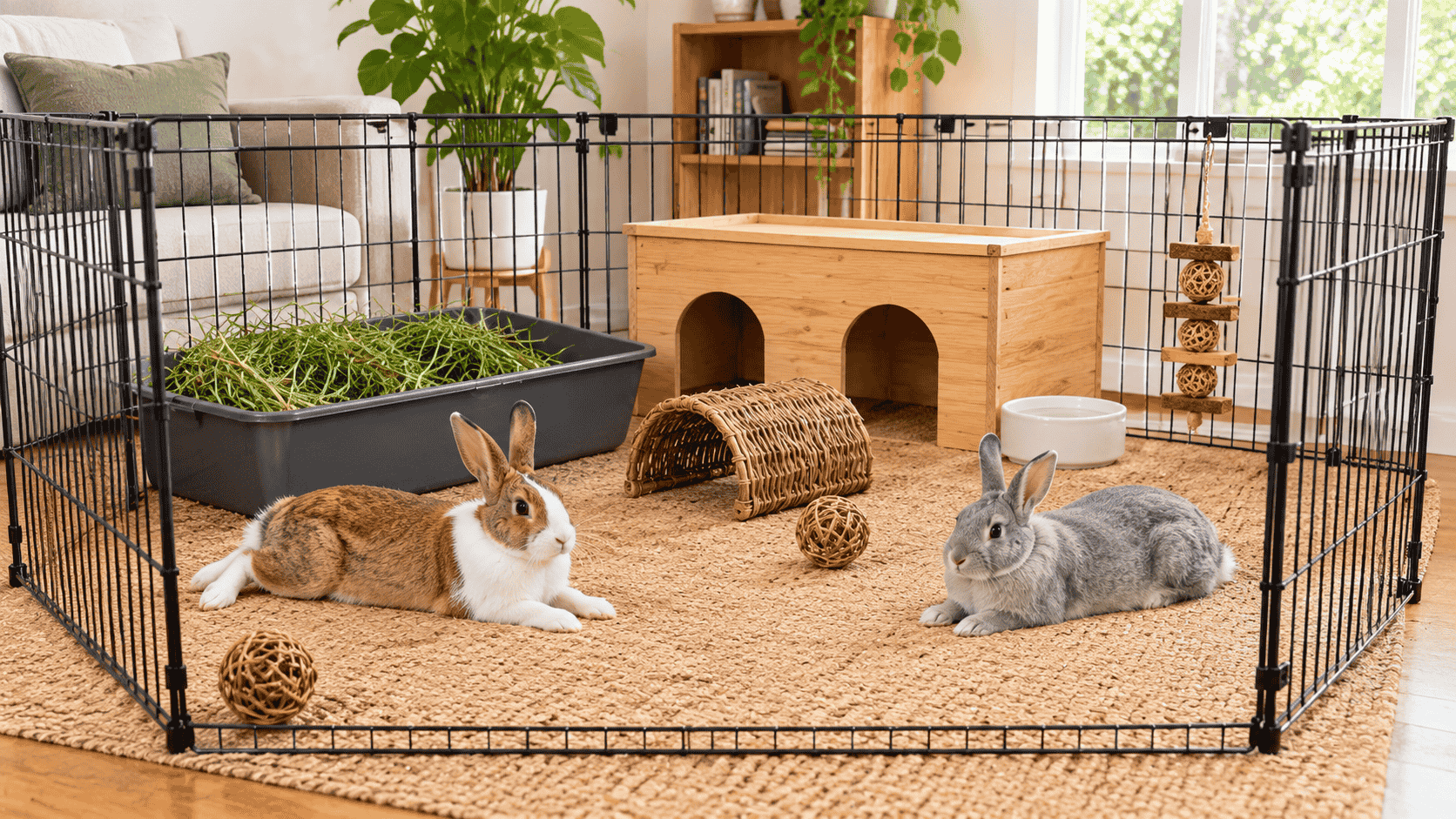
Choosing the best rabbit cage size is one of the most important decisions you will make for your rabbit’s physical and mental health. Most standard cages sold in pet shops are far too small for an adult rabbit. Confining an energetic, ground-dwelling animal to a tiny box restricts natural hopping, weakens bones and muscles, triggers obesity and sore hocks, and fuels territorial biting and bar-chewing.
The honest answer to how much space a rabbit needs depends on whether you are housing indoor or outdoor pet rabbits or managing commercial breeding stock, though welfare principles apply everywhere: bigger is always better. For pet rabbits, leading welfare organisations such as the RSPCA and the Rabbit Welfare Association & Fund recommend a minimum permanent living area of 3 metres by 2 metres by 1 metre high (6 square metres) on a single level, rather than relying on a standalone hutch or small wire cage. Whether you keep house rabbits in an Accra apartment, build backyard hutches in Kumasi or Tamale, or design an outdoor setup in the UK, this guide gives you exact space charts by breed size, compares indoor pens, hutches, and farm cages, explains how to measure whether your current enclosure is large enough, and shows you affordable ways to expand your rabbit’s living area.
Why Most Store-Bought Rabbit Cages Are Too Small
Walk into almost any pet shop or browse online marketplaces, and you will see plastic-bottom “starter rabbit cages” measuring roughly 90 cm by 45 cm (3 ft by 1.5 ft). Once you place a medium litter box, a ceramic water bowl, a hay rack, and a small hideout inside a 90 cm cage, almost zero open floor space remains. Your rabbit can barely turn around, let alone take a single hop.
Wild rabbits roam over large territories every dawn and dusk, sprinting, leaping, foraging, and digging to stay fit. Domestic rabbits share the exact same skeleton, muscle structure, and nervous system. Keeping a 3 kg adult rabbit locked inside a 90 cm cage for 20 hours a day is roughly equivalent to keeping a medium-sized dog permanently inside a bathroom cubicle. Even if you open the door for one hour in the evening, rabbits are crepuscular animals most active at dawn, dusk, and overnight, so they need generous, secure space available 24 hours a day.
Minimum Rabbit Space Requirements: Pet Welfare vs. Farm Housing
Space recommendations vary depending on whether rabbits are kept as long-term companion pets or managed in commercial agricultural systems. Being clear about both standards helps you make informed, humane choices for your specific setup.
Companion Pet Rabbit Standards (Indoor and Outdoor)
Based on animal-welfare research by the RSPCA and the University of Bristol, the Rabbit Welfare Association & Fund (RWAF) minimum space recommendations advise a permanent, single-level enclosed area of at least 3 m long by 2 m wide by 1 m high (approximately 10 ft x 6.5 ft x 3.3 ft, or 6 square metres / 64 square feet) for a single rabbit or a bonded pair of average-sized rabbits. Inside that setup, any sleeping shelter or hutch should measure at least 1.8 m x 0.6 m x 0.6 m high (6 ft x 2 ft x 2 ft) and remain permanently connected to the full exercise run at all times.
Notice an important detail in that guideline: even a single pet rabbit needs the same 3 m x 2 m footprint as a pair, because one rabbit still requires full length to sprint, hop three to four times in a row, and binky freely.
Backyard and Commercial Rabbitry Standards (Ghana and International)
In agricultural production across Ghana and West Africa, rabbits are typically housed individually in raised wooden or galvanised welded-wire compartments for breeding control, hygiene, and biosecurity. Even in a farm rabbitry, cramped cages lower fertility, increase kindling stress, trigger sore hocks, and cause young weaned kits to grow poorly. Agricultural husbandry guidelines recommend at least 0.54 to 0.72 square metres per adult medium-breed doe (such as a 90 cm x 60 cm or 90 cm x 80 cm compartment) so a kindling nest box fits cleanly without cramping the mother, with a minimum ceiling height of 50 cm to 60 cm so adult rabbits can sit upright comfortably.
| Housing Type | Minimum Recommended Dimensions (L x W x H) | Floor Area | Key Welfare Note |
|---|---|---|---|
| Pet rabbit full living space (indoor or outdoor, 1 to 2 rabbits) | 300 cm x 200 cm x 100 cm high (10 ft x 6.5 ft x 3.3 ft) | 6.0 sq m (64 sq ft) | Continuous 24/7 access; hutch or crate serves only as a shelter inside or attached to this run |
| Pet rabbit minimum shelter / hutch (must connect to a run) | 180 cm x 60 cm x 60 cm high (6 ft x 2 ft x 2 ft) | 1.08 sq m (12 sq ft) | Never suitable as a standalone permanent home without an attached exercise pen or run |
| Indoor exercise pen (X-pen) starter minimum for 1 medium pet | 180 cm x 120 cm x 90 cm high (plus daily supervised room roaming) | 2.16 sq m (24 sq ft) | Practical minimum base for small apartments when paired with several hours of daily free-roam exercise |
| Commercial breeding doe hutch (medium breed, 3.5 to 5 kg) | 90 cm x 60 cm to 75 cm x 50 cm to 55 cm high | 0.54 to 0.68 sq m | Must comfortably hold a 45 cm x 28 cm kindling nest box plus feeder, drinker, and solid resting mat |
| Commercial buck hutch (medium breed) | 80 cm x 60 cm x 50 cm high | 0.48 sq m | Requires solid resting tile/mat on wire floors and strong cross-ventilation |
| Weaned grower cage (4 to 6 kits, 6 to 12 weeks) | 120 cm x 75 cm x 50 cm high | 0.90 sq m | Provide at least 0.15 to 0.20 sq m per growing kit to prevent crowding and coccidiosis |
Best Rabbit Cage and Enclosure Size by Breed Weight
A 1.1 kg Netherland Dwarf and a 7 kg Flemish Giant do not fit comfortably in the same shelter. Breed weight directly determines how much door clearance, sleeping width, and ceiling height your rabbit needs.
| Breed Category & Adult Weight | Example Breeds | Minimum Shelter / Base Cage (L x W x H) | Recommended Total Living Area (Pet) |
|---|---|---|---|
| Dwarf / Small Breeds (1.0 kg to 2.0 kg) | Netherland Dwarf, Holland Lop, Polish, Mini Rex | 120 cm x 60 cm x 60 cm (4 ft x 2 ft x 2 ft) | At least 240 cm x 150 cm to 300 cm x 200 cm (high energy despite small size) |
| Medium Breeds (2.0 kg to 4.5 kg) | Dutch, Mini Lop, English Spot, Californian, New Zealand White, Ghanaian local crosses | 150 cm to 180 cm x 60 cm to 75 cm x 60 cm (5 to 6 ft x 2 to 2.5 ft x 2 ft) | 300 cm x 200 cm x 100 cm high (6 sq m minimum) |
| Large & Giant Breeds (4.5 kg to 8.0+ kg) | Flemish Giant, Continental Giant, French Lop, Checkered Giant | 180 cm to 210 cm x 90 cm x 75 cm to 90 cm (6 to 7 ft x 3 ft x 2.5 to 3 ft) | 350 cm x 250 cm+ (or full rabbit-proofed room / large garden shed + run) |
Do not assume small dwarf breeds need tiny cages. Dwarf rabbits are often more active and energetic than calm giant breeds, covering long distances in bursts of zoomies and binkies. Giant breeds like Flemish Giants stretch nearly 90 cm long when lying flat, so standard 60 cm-deep hutches leave them unable to lie sideways comfortably.
The 3-Movement Test: Checking If Your Cage Is Big Enough
If you already own a rabbit cage or hutch and want to know right now whether it meets basic physical needs, watch your rabbit inside it and run these three simple checks:
- The 3-Hop Length Test: Watch your rabbit hop in a straight line across the full length of the enclosure. Your rabbit should be able to take at least three full consecutive hops without bumping its nose into the opposite wall. Because an average medium rabbit covers roughly 45 cm to 50 cm per hop, even a basic shelter needs at least 150 cm to 180 cm in length.
- The Full-Stretch Width Test: Watch your rabbit lie down completely outstretched with its hind legs kicked straight out behind it (the “sploot” or side flop). The enclosure width must be wider than your rabbit’s full stretched-out body length, with extra room left over so it does not press against a litter box or water bowl.
- The Periscope Height Test: When a rabbit sits upright on its hind legs to scan its surroundings (“periscoping”), its ears must never brush, fold, or bend against the ceiling wire or roof panels. For medium breeds, this requires at least 60 cm to 75 cm of clear height in the shelter and 90 cm to 100 cm in the main exercise area so it can jump and binky safely.
If your current cage fails any one of those three tests, plan an upgrade as soon as possible.
Best Indoor Rabbit Housing Options Compared (Pens, Crates, Free-Roam)
For indoor house rabbits, skipping small pet-shop cages altogether saves money and gives your rabbit three to five times more floor space. Compare the four most practical indoor setups below:
| Indoor Setup | Typical Space Provided | Pros | Things to Watch Out For |
|---|---|---|---|
| Metal Dog Exercise Pen (X-Pen) | 2.0 sq m to 4.0+ sq m (easily doubled by linking two pens) | Affordable, foldable, flexible shape, tall walls (90 cm to 105 cm stops jumping), excellent airflow | Protect floors underneath with washable non-slip rugs or woven mats; ensure bar spacing is under 3.8 cm for small breeds |
| Modular C&C Wire Grid Pen | Customisable (build 2 m x 1.5 m or larger) | Fits awkward apartment corners; easy to add doors, hay stations, and clean surfaces | Use heavy cable ties to reinforce plastic connectors; build at least 2 grids high (70 cm to 90 cm) for jumpers |
| Large XL Dog Crate + Attached Pen | Crate (120 cm x 75 cm) + open X-pen attached | Crate acts as a cosy den and litter base while the attached pen provides 24/7 running room | Never lock the rabbit inside the dog crate alone all day; keep the crate door permanently clipped open into the pen |
| Rabbit-Proofed Spare Room or Free-Roam | 8 sq m to 20+ sq m | Best possible welfare, strong muscle tone, happiest behaviour, easiest social bonding | Requires thorough rabbit-proofing: cover all electrical cords with plastic tubing, block narrow gaps behind fridges, and remove toxic houseplants |
When setting up an indoor pen, place a roomy rectangular litter box filled with safe absorbent litter and fresh hay in one corner so your rabbit keeps the entire floor clean. Follow our step-by-step setup in how to litter train a rabbit cleanly indoors to make indoor pen maintenance effortless.
Outdoor Rabbit Hutch and Attached Run Dimensions
Outdoor rabbits need two connected zones: a dry, shaded, weatherproof sleeping shelter and a large predator-proof exercise run. A traditional wooden hutch sitting alone on a lawn does not provide enough exercise room for pet rabbits.
Smart Outdoor Layouts
- Large hutch + permanent attached run: Build or buy a raised 180 cm x 60 cm x 60 cm hutch connected via a wide, non-slip ramp or sturdy tunnel to a secure 300 cm x 200 cm x 100 cm welded-wire run. Cover the top of the run with welded wire mesh to stop hawks, stray cats, and dogs from jumping in, and lay buried wire mesh or paving slabs around the perimeter so rabbits cannot dig out.
- Converted garden shed + attached run: A shaded, well-ventilated wooden or block garden shed (2 m x 1.8 m) fitted with insulated roofing, welded-wire window screens, and a low cat-flap opening into a covered run gives pet rabbits superb protection from heavy tropical rain and predators while letting you stand upright comfortably during cleaning.
- Custom low-cost raised hutch (backyard or farm): If you are building your own timber-and-wire housing from scratch, follow our detailed blueprints, wire-gauge charts, and ventilation rules in how to build a low-cost rabbit hutch with proper materials and airflow.
Do Two-Storey Hutches and Multi-Level Cages Count as Double Space?
Many pet stores advertise two-storey hutches measuring 120 cm x 60 cm on two stacked levels as “large luxury cages”. Unfortunately, stacked upper levels do not replace single-level floor space.
Here is why: rabbits are horizontal runners, not tree-climbing squirrels. A 120 cm hutch with an upstairs bedroom still gives your rabbit only 120 cm of straight running length, and once you cut a ramp hole out of the upper floor, usable space shrinks even further. Steep wooden ramps also become slippery and painful for older arthritic rabbits or young kits. Upper shelves and low sturdy wooden platforms (around 25 cm to 30 cm high) are wonderful enrichment extras for jumping and lookouts, yet your rabbit’s core minimum footprint must always sit on one continuous flat level.
How Much Space Do Two or More Rabbits Need?
Rabbits are social animals that thrive in neutered, bonded pairs, provided they have enough territory to rest together or move apart peacefully when they want quiet time.
- Bonded pair (2 medium rabbits): Keep the full 3 m x 2 m x 1 m high (6 sq m) single-level minimum for pet rabbits, and provide two separate hideout boxes (each with two exits), two water bowls, and an extra-large litter box (at least 60 cm x 40 cm) or two medium trays so neither rabbit guards resources.
- Trios or groups (3 to 4 bonded pet rabbits): Add at least 1.0 to 1.5 square metres of extra floor space per additional rabbit, plus extra litter stations and feeding bowls spaced apart so quieter rabbits always eat without bullying.
- Unbonded or intact adult rabbits: Never house two unneutered adult bucks together, and never crowd unbonded adult does into a small shared cage. Fighting over limited space causes deep, severe bite wounds within minutes. House unbonded breeding stock in separate individual compartments separated by solid wooden dividers or double wire so noses cannot touch.
Rabbit Cage Sizing in Ghana: Indoor Homes and Backyard Farms
Housing rabbits in Accra, Tema, Kumasi, Takoradi, Cape Coast, Sunyani, or Tamale brings distinct practical considerations around home layouts, dry-season heat, and local breeds:
- Space directly improves cooling in hot Ghanaian weather: Tightly packed cages trap body heat and stagnant air. Between November and April, when afternoon temperatures reach 33°C to 38°C, a spacious, open-wire enclosure lets rabbits stretch out fully on cool ceramic tiles and lets cross-breezes sweep heat away cleanly. Pair generous cage spacing with our practical dry-season strategies in how to keep rabbits cool in hot weather.
- Apartment setups in Accra and Kumasi: If you keep a pet rabbit in a tiled apartment or on a shaded, enclosed veranda, a 180 cm x 120 cm (or larger) folding metal dog exercise pen placed over a woven straw mat or washable cotton rug gives far more room than any imported plastic cage, often at half the price. Keep the pen out of direct afternoon sun and cover slippery ceramic tiles so your rabbit does not splay its legs.
- Sizing for popular Ghanaian farm breeds (New Zealand Whites and Californians): Most commercial rabbits raised in Ghana are New Zealand Whites, Californians, Chinchillas, or heavy crossbreeds weighing 3.5 kg to 5.0 kg as adults. Avoid building narrow 60 cm x 45 cm compartments that squeeze large breeding does. Standardise doe compartments at 90 cm x 60 cm to 75 cm x 50 cm high (with a solid ceramic tile or plastic resting mat over the wire floor) so a 45 cm x 28 cm kindling nest box fits easily with plenty of room left for the doe to stretch out and nurse safely.
- Spacing multi-cage farm sheds: In commercial rabbitries, leave at least 100 cm to 120 cm walkways between rows of hutches and keep cage roofs at least 2.5 metres below the main shed roof so hot air rises well above rabbit level.
How to Upgrade a Small Rabbit Cage on a Tight Budget
If you already bought a standard 90 cm or 120 cm cage before learning how much room rabbits need, you do not have to throw it away. Turn it into a comfortable base inside a much larger budget setup:
- Attach a folding metal exercise pen directly to the cage door: Unclip or prop the front cage door permanently open (draping a folded cotton towel over the wire door ramp so toes never catch in the bars) and clip an 8-panel 90 cm-tall metal puppy pen onto both sides of the cage. Instantly, your rabbit’s cage becomes its cosy bedroom and litter station inside a 2.5 to 3.5 square metre play area.
- Use affordable DIY wooden framing and welded wire mesh: Build a simple open-topped or mesh-topped floor run using untreated 5 cm x 5 cm local timber battens and 16-gauge welded wire mesh for a fraction of the cost of retail hutches.
- Dedicate a rabbit-proofed hallway or shaded veranda: Block off doorways with sturdy 90 cm-high wooden or wire frames, tuck electrical cables inside rigid plastic conduit pipes, lay down affordable woven mats for traction, and give your rabbit free-roam hours morning and evening.
- Add floor-friendly bedding and resting zones: Whichever layout you build, line sleeping areas with soft, dry, dust-free materials suited to your climate. Compare safe, budget-friendly choices in our guide on the best rabbit bedding materials for safety and comfort.
Health and Behaviour Problems Caused by Cramped Cages
Undersized housing is not just an ethical concern; veterinary studies show that cramped cages directly trigger expensive physical and behavioural problems:
- Spinal deformities and weak bones (osteoporosis): Rabbits unable to hop, sprint, and stretch develop weak bone density and brittle spines, making fractures far more likely during routine handling.
- Obesity and fatty liver risk: Lack of movement paired with normal feeding leads quickly to heavy fat pads around the heart, liver, and rump. Overweight rabbits cannot reach their bottoms to eat caecotrophs, triggering messy fur and fatal flystrike.
- Sore hocks (ulcerative pododermatitis): Sitting motionless in one damp spot or on bare wire mesh wears away the protective heel fur, leaving painful bleeding foot ulcers.
- Territorial cage aggression and biting: Rabbits trapped inside tiny enclosures guard every centimetre fiercely, lunging, grunting, and biting any hand that enters to refill bowls. Upgrading to a roomy pen often calms defensive behaviour within weeks; read more in our guide on why rabbits bite and how space fixes territorial aggression.
- Destructive boredom habits: Bar-chewing (which can fracture front incisor teeth), frantic digging at plastic trays, fur-plucking, and constant thumping are classic signs of chronic confinement stress.
6 Common Rabbit Cage Sizing Mistakes to Avoid
Steer clear of these six frequent errors when buying or building a rabbit enclosure:
- Buying a cage for your baby rabbit’s current size: An 8-week-old kit weighing 600 g will grow into a 3.5 kg to 4.5 kg adult within four to five months. Always buy or build for your rabbit’s full adult weight on day one.
- Forgetting to subtract space taken up by furniture: A large litter box, water bowl, hideout house, and hay feeder easily occupy 35% to 40% of a small cage’s floor area. Measure the remaining open hopping space, not just the empty outer walls.
- Using short 60 cm playpens for athletic breeds: Healthy medium rabbits can easily clear a 60 cm barrier from a standing start. Choose exercise pens at least 90 cm (36 inches) tall, or secure a lightweight sheet or wire mesh lid across the top if you own a skilled jumper.
- Counting square metres without checking straight running length: A narrow 60 cm corridor or a cramped multi-tier tower may add up on paper yet still prevent three straight hops in a row. Prioritise wide, open, single-level floor runs.
- Assuming “my rabbit sleeps all afternoon, so it does not need space”: Rabbits naturally nap during midday hours and become bursting with energy at 5:30 AM and 8:00 PM when owners are asleep or busy. They need exercise room available during their own natural active hours.
- Overcrowding weaned grower pens on farms: Packing ten 8-week-old kits into a single 90 cm cage spikes humidity, fouls feeders with droppings, triggers rapid coccidiosis outbreaks, and causes ear-biting fights. Split growing litters into smaller groups by 8 to 10 weeks and separate bucks from does by 10 to 12 weeks.
Frequently Asked Questions About Rabbit Cage Size
1. What is the minimum cage size for one pet rabbit?
Leading veterinary and welfare bodies (including the RSPCA and RWAF) recommend a minimum permanent single-level living space of 3 m x 2 m x 1 m high (6 square metres) for one or two pet rabbits, with a sheltered hutch or sleeping area of at least 1.8 m x 0.6 m x 0.6 m high permanently attached to the exercise space. If you use an indoor exercise pen in a small apartment, aim for at least 1.8 m x 1.2 m (2.16 sq m) as a base paired with several hours of daily supervised room roaming.
2. Is a 120 cm (4-foot) rabbit cage big enough for one rabbit?
A 120 cm x 60 cm cage is too small to serve as a permanent full-time home for any adult rabbit, because once you add a litter tray, water bowl, and hideout, the rabbit cannot take three full hops. However, a 120 cm cage works well as an open-door bedroom and toilet base when permanently attached to a large metal exercise pen.
3. How big should a commercial breeding rabbit cage be in Ghana?
For medium-to-large breeds commonly farmed in Ghana (such as New Zealand Whites and Californians weighing 3.5 kg to 5 kg), build individual breeding doe compartments at least 90 cm long x 60 cm to 75 cm deep x 50 cm high so a 45 cm x 28 cm kindling nest box fits cleanly alongside feeders and a solid ceramic resting tile. Individual buck cages should measure at least 80 cm x 60 cm x 50 cm high.
4. How tall does a rabbit exercise pen need to be so my rabbit cannot jump out?
Most healthy adult rabbits can clear a 60 cm barrier effortlessly. Choose an exercise pen at least 90 cm (36 inches) tall for medium and large breeds, or 105 cm (42 inches) for athletic young rabbits. Keep cardboard hideout boxes positioned toward the middle of the pen rather than right against the fence so your rabbit cannot use the roof as a launchpad.
5. Can a rabbit live in a dog crate instead of a rabbit cage?
Yes. An extra-large folding wire dog crate (120 cm x 75 cm) makes a far better, cheaper, and easier-to-clean indoor shelter base than most pet-shop rabbit cages, provided you keep the door permanently open into an attached exercise pen or rabbit-proofed room. Check that the bar spacing is narrow enough (under 3.8 cm) so tiny dwarf breeds cannot push their heads through.
6. How much space do two bonded rabbits need?
Two bonded average-sized pet rabbits require the same minimum 3 m x 2 m x 1 m high (6 square metres) permanent single-level space, equipped with two separate hideout boxes, a large litter box (or two trays), and enough room to stretch out apart whenever they want quiet rest. Giant bonded pairs need at least 3.5 m x 2.5 m or a full rabbit-proofed room.
7. Can rabbits live free-roam indoors without a cage at all?
Yes. Many indoor house rabbits live completely cage-free inside a fully rabbit-proofed bedroom or living room, using a large open litter tray, hay station, water bowl, and cardboard hideouts as their home base. Thorough rabbit-proofing (covering all electrical cords, blocking tight gaps, and removing toxic plants) is essential before allowing unsupervised roaming.
8. How can I tell if my rabbit’s cage is making it stressed or bored?
Classic signs of an undersized enclosure include chewing obsessively on wire bars, rattling the door, digging frantically at bare plastic corners, thumping frequently, lunging or biting hands entering the cage, sitting hunched and lethargic all day, or developing obesity and red sore patches on the hind feet.
Giving Your Rabbit Room to Move and Thrive
Finding the best rabbit cage size starts with shifting how you view rabbit housing: a cage or hutch is only a bedroom and safe shelter, never a complete world on its own. Whether you connect an affordable metal exercise pen to a starter cage indoors, build a shaded 180 cm hutch linked to a secure garden run, or size your Ghanaian breeding compartments generously at 90 cm by 75 cm with cool ceramic resting tiles, extra floor space pays immediate dividends.
Run the 3-movement test on your setup today: check that your rabbit can take three full hops, stretch out completely flat, and stand upright without its ears touching the roof. Giving your rabbit room to run, binky, and explore builds stronger bones, healthier digestion, calmer behaviour, and a noticeably happier life.
