

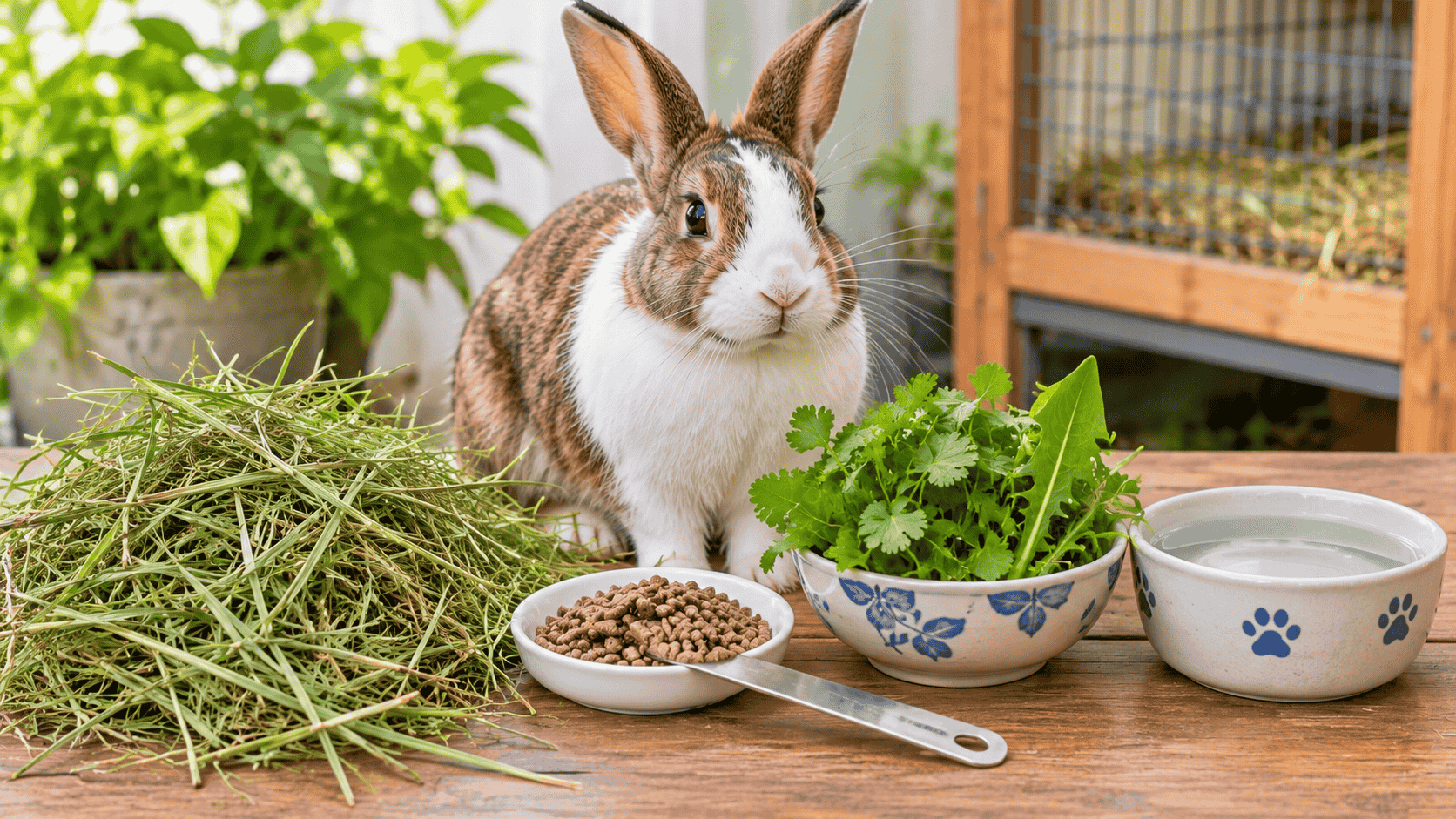
Knowing how much should you feed a rabbit daily prevents two of the most expensive and avoidable health problems in rabbit keeping: chronic obesity in pet rabbits and stunted growth or wasting in breeding herds. Rabbits are continuous grazers whose feeding quantities change dramatically as they move through early kit growth, adulthood, pregnancy, lactation, and senior life.
Many beginners either fill a pellet bowl to the brim every morning (causing obesity, soft unformed caecotrophs, and painful dental spurs) or underfeed nursing mothers and fast-growing meat fryers (causing weak litters and slow 12-week market weights). Whether you care for a 2 kg indoor Dutch rabbit in Accra or London, or manage 4.5 kg New Zealand White and Californian breeding does in Kumasi, Sunyani, or Tamale, this guide gives you exact daily feeding quantities by age, body weight, and life stage, complete with practical tablespoon and gram charts, hydration volumes, Ghanaian forage-and-pellet rations, body condition checks, and common portion mistakes to avoid.
The Daily Rabbit Diet Ratio: Hay, Pellets, Greens, and Treats
Before measuring individual grams or tablespoons, understand how the four parts of a rabbit’s daily diet fit together. A rabbit’s digestive tract requires constant indigestible long-stem fibre to keep gut contractions steady and wear down continuously growing teeth. Concentrated pellets supply balanced vitamins, trace minerals, and protein, yet pellets never replace hay or fibrous grasses.
| Food Group | Adult Pet Rabbit (Daily Share) | Commercial Breeding / Growing Rabbit (Daily Share) | Core Purpose |
|---|---|---|---|
| Clean Dry Grass Hay / Shade-Wilted Fibrous Grass | 75% to 80% (unlimited 24/7) | 50% to 60% (unlimited 24/7) | Keeps gut moving continuously, prevents GI stasis, and grinds down molar teeth |
| Safe Leafy Greens & Wilted Local Browse | 10% to 15% | 10% to 15% | Provides hydration, natural vitamins, antioxidants, and dietary variety |
| Plain High-Fibre Rabbit Pellets | 5% to 10% (strictly measured) | 30% to 40% (supports rapid growth and milk production) | Supplies concentrated protein, essential amino acids, and balanced minerals |
| Healthy Treats (Fruit / Root Veg) | Under 5% (occasional only) | 0% to 2% (skip for kits under 12 weeks) | Bonding rewards only; excess sugar disrupts caecal bacteria |
| Fresh Clean Drinking Water | Unlimited 24/7 | Unlimited 24/7 | Essential for digesting dry fibre and regulating body temperature |
A helpful visual benchmark for adult pet rabbits is the body-size hay rule: every day, your rabbit should eat a pile of clean grass hay at least equal to the size of its own body. If your rabbit leaves hay untouched while waiting impatiently for pellets, you are almost certainly serving too many pellets.
Daily Rabbit Feeding Quantities by Age (Birth to Senior)
A rabbit’s calorie, protein, and calcium requirements shift sharply across its lifespan. Growing kits need high energy and extra calcium to build bone and muscle, while resting adult pets need lean, high-fibre maintenance rations to avoid obesity and bladder sludge. Use the age-by-age chart below to match daily portions accurately.
| Rabbit Age & Stage | Hay / Roughage Quantity | Daily Pellet Quantity | Leafy Greens & Treats |
|---|---|---|---|
| Birth to 3 Weeks (Newborn Kits) | Mother’s milk only (kits begin sniffing and nibbling nest hay around day 14 to 21) | None directly (kits nibble mother’s pellets by week 3) | None |
| 3 to 7 Weeks (Pre-Weaning Kits) | Unlimited soft grass hay and/or alfalfa hay | Free access to mother’s plain high-fibre pellets | None (avoid watery fresh greens to prevent weaning diarrhoea) |
| 8 to 12 Weeks (Newly Weaned Youngsters) | Unlimited dry grass hay (mix with small amount of alfalfa hay for growth) | Free-choice plain grower pellets (approx. 50 g to 110 g per kit depending on breed) | Avoid watery fruits and rich greens until 12 weeks; introduce dry safe herbs slowly after 12 weeks |
| 3 to 6 Months (Juveniles / Growers) | Unlimited grass hay (gradually phase out alfalfa hay by 6 months for pets) | Pet breeds: 1/4 to 1/2 cup (35 g to 70 g) daily; Commercial fryers: free-choice (100 g to 140 g daily) | Introduce 1 new safe leafy green every 3 to 5 days, building up to 1 cup per 2 kg body weight |
| 7 Months to 5 Years (Healthy Adults) | Unlimited Timothy, orchard, or clean local grass hay (body-sized pile daily) | Pet adults: 25 g per kg of ideal body weight (approx. 1.5 to 2 tablespoons per kg); Resting farm adults: 90 g to 130 g daily | 1 packed cup (50 g to 80 g) mixed safe greens per 1 kg to 2 kg body weight; fruit under 1 teaspoon twice weekly |
| Over 5 to 6 Years (Senior Rabbits) | Unlimited soft, fragrant grass hay (check back molars if hay intake drops) | 25 g per kg if weight is steady; increase gradually to 30 g to 35 g per kg under veterinary advice if senior loses weight | 1 to 2 cups safe hydrating leafy greens daily; avoid high-calcium greens if bladder sludge occurs |
If you are raising a young litter through the fragile birth-to-8-week window, follow our full week-by-week feeding and weaning guidance in how to care for baby rabbits safely during their first 8 weeks.
Exact Daily Pellet Portions by Body Weight (Pet vs. Farm Rabbits)
Because rabbit breeds span 1 kg Netherland Dwarfs up to 7 kg Flemish Giants, measuring pellets by ideal adult body weight is far more accurate than guessing by eye. Always use a simple kitchen scale (in grams) or a dedicated measuring tablespoon rather than pouring straight out of a sack.
Standard measuring reference: One level tablespoon of standard extruded rabbit pellets weighs approximately 10 g to 12 g, and one standard 250 ml measuring cup holds roughly 130 g to 150 g of pellets (weigh your own brand once to be exact).
| Adult Ideal Body Weight | Example Breeds | Pet Adult Daily Pellets (Maintenance) | Commercial Farm Adult Daily Pellets (Resting) | Farm Breeding / Lactating Doe Daily Pellets |
|---|---|---|---|---|
| 1.0 kg to 1.5 kg | Netherland Dwarf, Polish | 25 g to 35 g (2 to 3 level tbsp) | Not typically farmed | Not typically farmed |
| 2.0 kg to 2.5 kg | Dutch, Mini Rex, Mini Lop | 50 g to 60 g (4 to 5 level tbsp) | 60 g to 80 g | 150 g to 220 g (free-choice during peak nursing) |
| 3.0 kg to 3.5 kg | Harlequin, Standard Chinchilla, local crosses | 75 g to 85 g (approx. 1/2 cup) | 85 g to 105 g | 220 g to 320 g (free-choice during peak nursing) |
| 4.0 kg to 4.5 kg | Californian, medium New Zealand White | 90 g to 110 g (approx. 2/3 cup) | 100 g to 125 g | 300 g to 420 g (free-choice during peak nursing) |
| 5.0 kg to 6.0+ kg | Large New Zealand White, Flemish Giant | 120 g to 150 g (approx. 3/4 to 1 cup) | 125 g to 150 g | 350 g to 480+ g (free-choice during peak nursing) |
Always calculate pellet rations using your rabbit’s ideal healthy weight, not its current weight if it is already overweight. For example, if a Dutch rabbit should weigh 2.2 kg but currently weighs 2.8 kg, base its daily pellet ration on 2.2 kg (roughly 50 g per day) while keeping grass hay unlimited so it slims down gradually without risking fatty liver disease.
How Much Hay or Grass Should a Rabbit Eat Every Day?
There is no upper limit on clean grass hay for a healthy rabbit. Hay should be available 24 hours a day, 7 days a week, topped up fresh every morning and evening. Rabbits are selective grazers that pick out the sweetest leafy blades first and leave coarse, dusty stalks behind. Refreshing the hay rack twice a day (even if a small amount of old stalk remains) keeps your rabbit eating steadily.
Practical Daily Roughage Benchmarks
- Dry grass hay (Timothy, orchard, meadow, or sun-cured local guinea grass): Expect an adult 2 kg to 3 kg pet rabbit to eat roughly 80 g to 150 g of dry hay daily (a loose mound equal to its own body size), while a 4.5 kg New Zealand White eats 150 g to 250 g of dry hay if fed minimal pellets.
- Fresh shade-wilted tropical grass (Ghanaian forage systems): Because fresh wilted grass still holds roughly 60% to 70% moisture compared to 12% moisture in dry hay, rabbits must eat a much larger physical volume to get the same dry fibre. Offer a generous 300 g to 500 g of clean shade-wilted grass and safe browse daily per adult 4 kg farm rabbit alongside dry hay or measured pellets.
To make sure you are offering the safest, highest-fibre grasses and avoiding poisonous roadside weeds, review our botanical directory on the best grasses and leaves for rabbits and unsafe plants.
How Much Leafy Greens, Herbs, and Fruit Treats Are Safe Daily?
Fresh leafy greens and herbs add hydration, vitamin A, vitamin C, and natural foraging enjoyment, yet overdoing watery greens or sugary root vegetables quickly upsets gut flora.
Daily Leafy Green Portions
- Standard rule for healthy adult rabbits (over 6 months): Serve roughly 1 packed cup (50 g to 80 g) of mixed washed leafy greens per 1 kg to 2 kg of body weight per day. For a 2 kg Dutch rabbit, that equals 1 to 1.5 cups daily; for a 4.5 kg New Zealand White, that equals 2 to 3 cups daily.
- Aim for variety (3 different greens daily): Rotate safe staples such as coriander, parsley, romaine lettuce, dandelion greens, carrot tops, sweet potato vines, and Tridax procumbens. Keep high-calcium or gas-forming greens (such as moringa, kale, spinach, and cabbage) to no more than 15% to 20% of the leafy portion so you avoid bladder sludge or intestinal gas.
Strict Limits on Fruit and Sugary Vegetables
Carrots, apples, bananas, pawpaw, mango, and watermelon are treats, never daily staple vegetables. High natural sugar feeds harmful bacteria in the caecum.
- Maximum safe limit for healthy adult rabbits: No more than 1 level teaspoon (roughly 5 g to 10 g) per 1 kg of body weight, given only 1 to 2 times per week. For a 2 kg rabbit, that is a single 1 cm slice of carrot or one fingernail-sized piece of ripe pawpaw or banana twice a week.
- Skip sweet treats completely for kits under 12 weeks old, overweight rabbits, or any rabbit with a history of soft uneaten caecotrophs.
Feeding Quantities for Pregnant and Nursing Mother Rabbits
A breeding doe’s nutritional needs triple between mating and peak lactation. Underfeeding a nursing mother causes rapid muscle wasting, weak milk supply, and high kit losses, while overfeeding her during early pregnancy causes excess internal fat and difficult kindling.
| Reproductive Stage | Daily Pellet Ration (4.5 kg Doe) | Roughage & Protein Browse | Daily Water Need |
|---|---|---|---|
| Early Pregnancy (Days 1 to 14) | Normal maintenance ration: 110 g to 130 g daily (do not overfeed early) | Unlimited clean dry grass hay / wilted grass | 300 ml to 450 ml |
| Late Pregnancy (Days 15 to 28) | Gradually increase to 150 g to 180 g daily as foetuses grow rapidly | Unlimited dry hay + moderate wilted protein leaves (sweet potato vines, moringa) | 400 ml to 600 ml |
| Kindling Window (Days 29 to 31) | Appetite naturally dips for 12 to 24 hours right before birth; keep 150 g available plus fragrant hay | Unlimited dry hay and fresh water right beside the nest box | 500 ml to 700 ml |
| Peak Lactation (Weeks 1 to 4 Nursing 7 to 10 Kits) | Free-choice (ad libitum): 300 g to 450+ g daily by week 3 (and more once kits start nibbling) | Unlimited hay + generous wilted protein-rich leaves refreshed twice daily | 600 ml to 1,200 ml (check bowls morning and evening) |
| Weaning Dry-Off (Week 6 to 8) | Drop pellets sharply back to 80 g to 100 g for 3 to 4 days right after removing kits so milk dries off safely without mastitis, then resume 110 g to 130 g | Unlimited dry grass hay only during dry-off days | 300 ml to 450 ml |
That brief weaning dry-off reduction is an essential farm management step: cutting a doe’s pellets temporarily for 3 days while offering unlimited dry grass hay and clean water signals her body to slow milk production cleanly, preventing painful engorged mammary glands and bacterial mastitis.
How Much Water Does a Rabbit Drink Daily?
Water is the single most critical nutrient in your rabbit’s diet. A healthy rabbit drinks roughly 50 ml to 150 ml of water per kilogram of body weight every 24 hours, meaning an average 2.5 kg pet rabbit drinks 150 ml to 350 ml daily, while a 4.5 kg commercial rabbit in warm weather drinks 300 ml to 600 ml daily, and a lactating doe can drink over 1 full litre.
- Water intake rises when rabbits eat mostly dry hay and dry pellets, during hot dry-season afternoons above 28°C, and during lactation.
- Water intake dips slightly when rabbits eat large portions of washed leafy greens or shade-wilted fresh grass, though clean drinking water must still remain available 24/7.
- Use heavy ceramic bowls or clean earthenware crocks: Veterinary studies confirm rabbits drink noticeably more water from wide open bowls than from small metal ball-bearing bottles, which directly boosts hay intake and prevents urinary sludge.
For additional veterinary-reviewed standards on daily rabbit nutrition, fibre needs, and healthy portion control, you can consult the PDSA veterinary advice on rabbit diet and daily feeding.
Practical Daily Feeding Portions for Rabbits in Ghana
Across Ghana (including indoor pet homes in Accra and Tema and commercial breeding sheds in Kumasi, Takoradi, Cape Coast, Sunyani, and Tamale), most rabbit keepers combine shade-wilted local forages with commercial rabbit pellets or a balanced local wheat-bran mix to keep feed costs sustainable. Below is a practical, field-tested daily portion template for a standard 4.0 to 4.5 kg New Zealand White or Californian rabbit in Ghana:
| Rabbit Class (4.0 to 4.5 kg Breed) | Morning Meal (6:00 AM to 7:00 AM) | Evening Meal (5:30 PM to 6:30 PM) | All-Day Access |
|---|---|---|---|
| Resting Adult Buck or Doe | 50 g to 60 g plain rabbit pellets + 150 g shade-wilted guinea grass / Tridax | 50 g to 60 g plain rabbit pellets + 200 g shade-wilted grass / sweet potato vines | Dry cured grass hay + 500 ml cool clean water |
| Nursing Doe (With 8 Kits, Week 3) | 150 g to 200 g pellets + 250 g wilted sweet potato vines / guinea grass / moderate moringa | 200 g to 250 g pellets + 300 g wilted grass & safe leaves | Unlimited dry hay + 1,000 ml+ cool clean water (refill midday) |
| Growing Fryer (10 Weeks Old, ~2.0 kg) | 50 g to 60 g grower pellets + 100 g dry grass hay or well-wilted grass | 60 g to 70 g grower pellets + 150 g wilted grass / sweet potato vines | Unlimited dry hay + 250 ml to 300 ml clean water |
Notice two key Ghanaian adjustments in the schedule above: serving the slightly larger forage portion in the cooler evening (5:30 PM to 6:30 PM) matches rabbits’ natural dusk-and-nighttime grazing peak when tropical heat subsides, and keeping clean dry hay available overnight prevents hungry rabbits from chewing wooden hutches. Explore safe local grasses, moringa limits, and toxic Ghanaian foods in our guide on what rabbits eat in Ghana and safe local foods, and lock in consistent meal timings with our morning and evening rabbit feeding schedule guide.
How to Tell If You Are Overfeeding or Underfeeding Your Rabbit
Charts provide an excellent starting point, yet individual rabbits vary in metabolism and activity. Check three simple physical signs every week to fine-tune your exact daily portions:
Signs You Are Overfeeding Pellets or Rich Foods
- Uneaten soft caecotrophs smeared on the floor or tail fur: The earliest, clearest clue that daily pellets, starch, or sugary treats are too high.
- Ignoring hay while waiting for the pellet scoop: Rabbits full of dense pellets stop chewing roughage, raising their risk of molar spurs and GI stasis.
- Body Condition Score 4/5 or 5/5: You must press firmly through thick fat pads to feel the ribs and spine, or your rabbit develops heavy rump fat and struggles to groom its bottom cleanly.
Signs You Are Underfeeding (Or Missing Nutrients)
- Body Condition Score 2/5 or 1/5: The backbone feels like a sharp bony ridge and hip bones jut out prominently beneath the fur.
- Losing 5% to 10% of body weight on monthly scale checks: Weigh your rabbit monthly in a tared basket on a digital scale. If your rabbit loses weight despite eating normal portions, do not just dump extra pellets into the bowl; check for dental spurs, parasites, or internal disease using our guide on why rabbits lose weight and when to seek veterinary care.
- Slow kit growth or restless empty-bowl chewing: Growing 12-week fryers weighing under 1.8 kg or nursing does looking gaunt along the spine signal an energy or protein shortfall.
How to Adjust Daily Feeding Quantities Safely (Step by Step)
Never make abrupt overnight jumps or sudden cuts to a rabbit’s diet. Rapid changes shock caecal bacteria and can trigger fatal GI stasis or fatty liver disease (hepatic lipidosis) in overweight rabbits.
- Weigh your rabbit and record its current daily pellet intake in grams for 3 days so you know your true baseline.
- For an overweight pet rabbit needing weight loss: Keep clean grass hay 100% unlimited and eliminate all sugary fruit treats immediately. Reduce daily pellets slowly by just 10% to 15% per week until you reach the target maintenance dose (25 g per kg of ideal body weight), aiming for safe, gradual weight loss of 1% to 2% of body weight per week while increasing daily exercise space.
- For a thin or newly pregnant doe needing more calories: Increase plain high-fibre pellets gradually by 10 g to 15 g every 2 to 3 days alongside unlimited hay and wilted protein-rich leaves, checking faecal pellets every morning to confirm droppings stay firm and round.
- When introducing any new leafy green or local forage: Start with a single small leaf or pinch for 2 days, double it on days 3 to 4, and reach full portion size by day 6 to 7 only if droppings stay normal.
7 Common Daily Portion Mistakes Rabbit Owners Make
Avoiding these seven frequent feeding errors prevents obesity, digestive emergencies, and wasted feed money:
- Free-feeding pellets to adult pet rabbits: Keeping a large bowl constantly overflowing with pellets is the #1 cause of rabbit obesity, sore hocks, uneaten caecotrophs, and dental disease. Measure adult pet pellets strictly once or twice daily.
- Serving tiny “handfuls” of hay instead of unlimited piles: A single small pinch of hay disappears in 20 minutes, leaving your rabbit’s gut without long fibre for the rest of the day. Always keep hay racks visibly full.
- Using a big scoop without ever weighing what it holds: A standard plastic kitchen cup or margarine tub can easily hold 180 g to 250 g of pellets, which is triple what a 2.5 kg pet rabbit should eat in a whole day. Weigh your scoop once on a kitchen scale and mark the exact gram line with a permanent marker.
- Feeding adult maintenance rations to a nursing mother: Restricting pellets for a lactating doe raising 8 kits starves the mother and causes stunted, weak kits. Nursing mothers need free-choice pellets and abundant water.
- Feeding huge bowls of carrots or fruit as “healthy vegetables”: Carrots and sweet fruits are high-sugar treats, not daily leafy greens.
- Feeding two bonded rabbits from one tiny bowl: A dominant rabbit often eats 80% of the pellets while its quieter partner slowly loses weight. Serve measured pellets in two separate ceramic dishes spaced apart, or scatter pellets across a clean mat so both eat evenly.
- Forgetting to cut back pellets when a doe’s kits are weaned: Continuing to feed 400 g of pellets per day after weaning quickly causes painful mammary engorgement (mastitis) and rapid obesity.
Frequently Asked Questions About Daily Rabbit Feeding Quantities
1. How many tablespoons of pellets should I feed my rabbit a day?
For a healthy adult pet rabbit, feed roughly 1.5 to 2 level tablespoons (about 25 g) of plain high-fibre pellets per kilogram of ideal body weight per day. That works out to roughly 4 to 5 tablespoons (50 g to 60 g) daily for a 2.2 kg Dutch or Mini Lop, and 8 to 9 tablespoons (90 g to 110 g) daily for a 4.5 kg New Zealand White, always paired with unlimited grass hay.
2. How much hay should a rabbit eat every day?
Every rabbit should have unlimited clean dry grass hay 24 hours a day. As a visual guide, your rabbit should eat a loose pile of hay at least equal to the size of its own body every day (roughly 80 g to 150 g of dry hay for a small-to-medium pet rabbit, or 300 g to 500 g of shade-wilted fresh grass in Ghanaian forage systems).
3. How many times a day should you feed a rabbit?
Feed measured pellets and fresh leafy greens (or shade-wilted local forage) twice a day, once in the early morning (around 6:00 AM to 7:00 AM) and once in the evening (around 5:30 PM to 6:30 PM), splitting the daily pellet allowance evenly between both meals while keeping dry grass hay and fresh water available 24/7.
4. Should baby rabbits have unlimited pellets?
Yes. Growing rabbits between weaning (6 to 8 weeks) and roughly 5 to 6 months of age have very high energy and protein demands and can receive unlimited plain, high-fibre grower pellets alongside unlimited dry grass hay and clean water. Around 6 to 7 months (once adult frame growth slows), gradually transition pet rabbits down to measured adult maintenance portions.
5. How much food does a pregnant or nursing rabbit need daily?
Keep a pregnant doe on her normal maintenance pellet ration (110 g to 130 g for a 4.5 kg doe) during the first 14 days, increase gradually to 150 g to 180 g during days 15 to 28, and offer unlimited free-choice pellets (300 g to 450+ g daily) alongside unlimited dry hay, wilted greens, and up to 1.2 litres of clean water daily throughout peak nursing (weeks 1 to 4 after birth).
6. How can I tell if I am feeding my rabbit too much?
The clearest signs of overfeeding are frequent soft, smelly uneaten caecotrophs stuck to the fur or cage floor, leaving hay untouched while begging for pellets, and thick fat pads covering the ribs and spine (Body Condition Score 4/5 or 5/5).
7. How much leafy greens should I give my rabbit each day?
For healthy adult rabbits over 6 months old, offer roughly 1 packed cup (50 g to 80 g) of mixed washed safe leafy greens per 1 kg to 2 kg of body weight daily. Introduce greens slowly one plant at a time starting after 12 weeks of age, and limit sugary treats like carrots and fruit to under 1 teaspoon per kg once or twice a week.
8. How much water should a rabbit drink every day?
A healthy rabbit drinks approximately 50 ml to 150 ml of water per kilogram of body weight daily (roughly 200 ml to 500 ml for most adults, rising past 1 litre daily for nursing mothers or rabbits in hot weather above 30°C). Always provide clean, cool water in a heavy ceramic bowl or working drinker 24 hours a day.
Keeping Daily Portions Simple, Measured, and Consistent
Answering how much you should feed a rabbit daily becomes effortless once you replace guesswork with a marked scoop and a weekly body-condition check. Give every rabbit unlimited clean dry grass hay or properly wilted fibrous grasses 24 hours a day, measure plain high-fibre pellets accurately by ideal body weight and life stage (unlimited for growing kits and nursing mothers, strictly measured at 25 g per kg for resting adult pets), serve 1 to 2 cups of varied safe leafy greens, and keep sugary fruits rare.
Pair measured morning and evening meals with constant clean cool water in heavy ceramic bowls, weigh your rabbits monthly on a digital scale, and adjust portions slowly over 7 days whenever their life stage changes. Balanced daily portions keep teeth trim, digestion running smoothly, litters vigorous, and feed costs firmly under control.
