

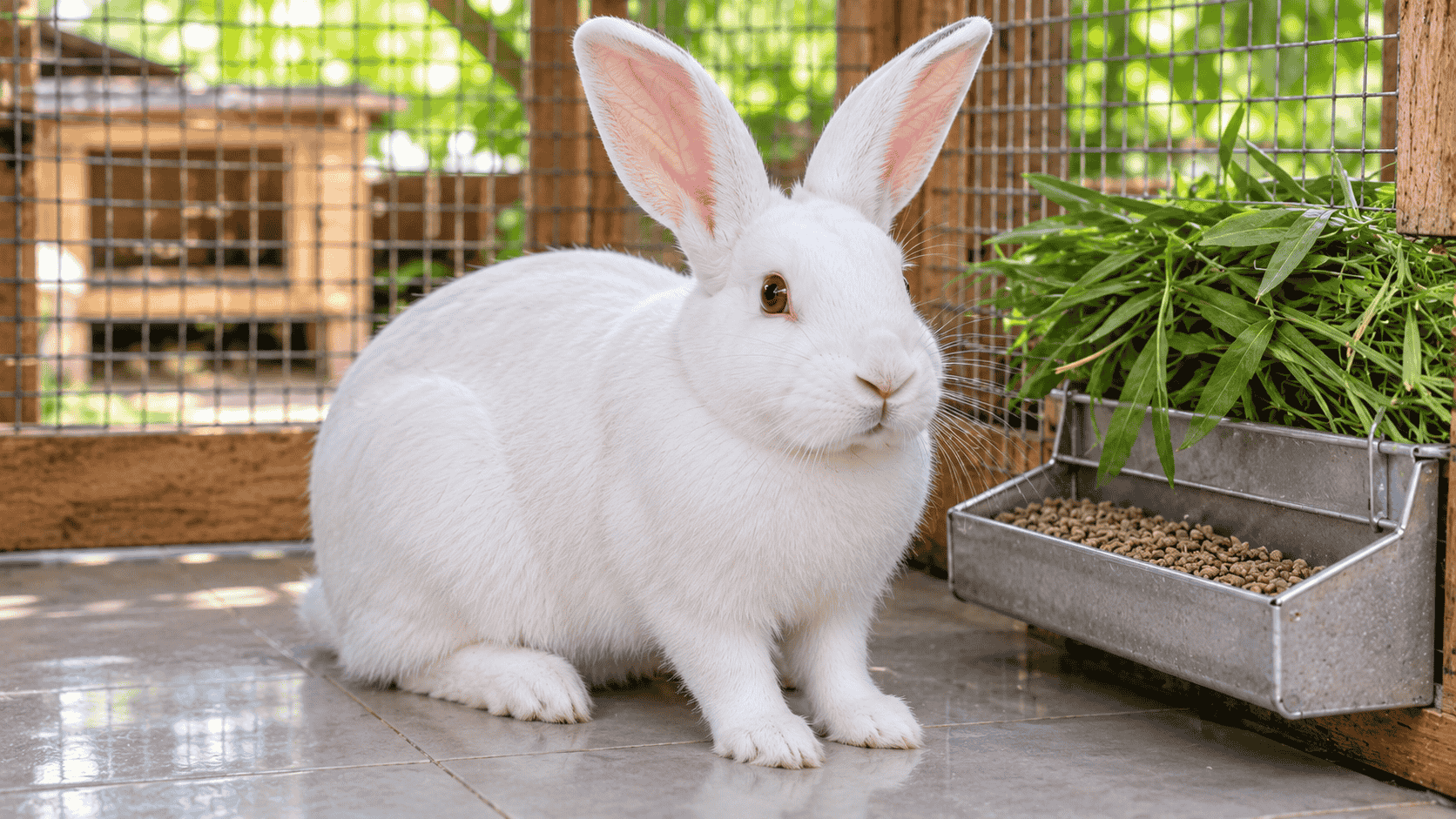
New Zealand White rabbits are the backbone of modern commercial rabbit farming worldwide and remain the single most popular meat and breeding breed across Ghana. Recognised immediately by their pure snow-white coat, ruby-pink eyes, broad muscular shoulders, and sturdy upright ears, adult New Zealand Whites reach 4.0 kg to 5.5 kg with a calm, steady temperament that suits both beginners and experienced farmers.
Although the breed was developed in the early twentieth century in the United States for efficient meat and pelt production, its docile personality also makes it a surprisingly gentle companion rabbit when given enough indoor or shaded outdoor space. Whether you are starting a backyard rabbitry in Accra, Kumasi, Sunyani, or Tamale, expanding a commercial breeding herd, or keeping a calm New Zealand White as a house pet in the UK, this guide covers the breed’s physical characteristics, exact housing and flooring standards, daily feeding and growth targets, breeding and kindling management, Ghanaian climate adaptations, common health risks, and mistakes to avoid.
Origin and Overview of the New Zealand White Rabbit
Despite its name, the New Zealand White rabbit did not originate in New Zealand. Breeders in California developed the breed in the 1910s, refining earlier New Zealand Red lines and crossing them with Angora and Flemish Giant stock to create a medium-large, fast-growing, white-furred meat rabbit. By 1920, the New Zealand White was officially recognised by the American Rabbit Breeders Association (ARBA) and rapidly spread across Europe, Asia, and Africa as the global standard for commercial rabbit production.
Why do farmers keep coming back to this single breed a century later? Four measurable advantages explain its dominance:
- High meat-to-bone ratio: New Zealand Whites pack thick, meaty loins and wide hindquarters onto relatively fine bones, giving dressed carcass yields of roughly 52% to 58% of live weight under good nutrition.
- Large, uniform litters and dependable mothering: Healthy mature does regularly kindle 7 to 10 kits per litter, pull generous fur for their nests, and produce rich milk consistently.
- Rapid feed conversion: Young fryers convert balanced high-fibre pellets and clean wilted grasses efficiently, reaching a 2.0 kg to 2.5 kg market weight in 10 to 12 weeks on quality diets.
- Calm handling temperament: Unlike skittish dwarf breeds, New Zealand Whites stay steady during routine weighing, breeding transfers, and weekly health checks, which reduces handling stress and spinal injury risk.
New Zealand White Rabbit Breed Profile at a Glance
Use this summary table to check standard breed traits, production benchmarks, and care requirements before buying starter stock.
| Breed Trait | Standard Specification | Practical Management Note |
|---|---|---|
| Adult Buck Weight | 4.0 kg to 5.0 kg (9 to 11 lb) | Keep breeding bucks lean and active (Body Condition Score 3/5) for strong fertility |
| Adult Doe Weight | 4.5 kg to 5.5 kg (10 to 12 lb) | Does naturally grow slightly heavier than bucks and often develop a neat chin dewlap |
| Coat & Colour | Pure white, dense flyback fur; ruby-pink (albino) eyes | Low-maintenance short coat; brush once weekly and more often during moults |
| Body Type | Commercial (medium length, deep rounded hindquarters, broad shoulders) | Heavy body weight requires solid resting mats on wire floors to prevent sore hocks |
| Average Litter Size | 7 to 10 kits (sometimes up to 12) | Provide a 45 cm x 28 cm nest box on day 27 of pregnancy |
| Breeding Maturity | Does: 5 to 6 months (at least 3.6 kg); Bucks: 6 to 7 months | Do not mate underweight young does early, as early breeding stunts adult growth |
| Average Lifespan | 5 to 8 years (pet care); 2 to 3 years productive breeding life on farms | Spaying pet females by 6 to 12 months prevents uterine cancer and extends lifespan |
| Primary Uses | Commercial meat farming, breeding stock, backyard homesteading, calm companion pet | Performs exceptionally well when crossed with Californian rabbits |
Physical Characteristics, Coat, and Temperament
True New Zealand White rabbits are albino (lacking melanin pigment), which gives them their crisp white fur and bright pink-to-ruby eyes. Because albino eyes have less dark pigment to filter intense glare, New Zealand Whites prefer shaded, softly lit enclosures rather than harsh direct sunlight. Never place a New Zealand White hutch where bright afternoon sun shines straight into the wire front.
Their fur is classified as a flyback coat: when you stroke backward toward the head, the dense, plush guard hairs spring smoothly back into place. This dense coat protects the skin well in cooler weather and requires far less grooming than long-haired breeds like Angoras or Lionheads, though you still need to brush out loose hair during heavy seasonal moults so your rabbit does not swallow excessive fur while grooming.
In temperament, New Zealand Whites are notably calm, curious, and steady. They rarely show the jumpy nervousness common in miniature breeds. On farms, they settle quickly into daily feeding routines; indoors as pets, they often enjoy stretching out flat beside their owners on a woven floor mat for long forehead rubs. Like any breed, however, unspayed mature does can become territorial around their hutch or nest box during pregnancy and nursing, so always respect their shelter boundaries.
Housing, Cage Size, and Flooring Requirements
Because adult New Zealand White does frequently exceed 4.5 kg to 5.0 kg, cramped starter cages cause immediate physical problems, especially bruised heels, sore hocks, and crowded kindling boxes. Give your New Zealand Whites housing sized properly for a heavy commercial breed.
Recommended Enclosure Dimensions
- Commercial breeding doe hutch: Minimum 90 cm long x 60 cm to 75 cm deep x 50 cm to 55 cm high. This footprint fits a 45 cm x 28 cm wooden kindling nest box cleanly while leaving space for the doe to stretch out, eat, and hop away from active 3-week-old kits.
- Commercial breeding buck hutch: Minimum 80 cm long x 60 cm deep x 50 cm high, housed individually with solid dividers or double wire so adjacent bucks cannot bite each other’s noses.
- Weaned grower pen (4 to 6 fryers, 6 to 12 weeks): Minimum 120 cm long x 75 cm deep x 50 cm high, allowing at least 0.15 to 0.20 square metres per growing fryer.
- Indoor or outdoor companion pet New Zealand White: Follow companion welfare minimums of at least 3 m x 2 m x 1 m high permanent single-level living space (such as a large exercise pen or rabbit-proofed room). Compare exact welfare and farm sizing charts in our guide on the best rabbit cage size and space needs.
Flooring That Protects Heavy Feet
New Zealand Whites carry thick fur on their feet, yet their 4.5 kg to 5.5 kg body weight puts heavy downward pressure on the heels of their hind legs. If you house them on bare 12 mm x 25 mm galvanised welded-wire floors for farm hygiene, you must place a solid, easy-to-clean resting surface inside every cage, such as a 30 cm x 30 cm smooth ceramic floor tile, a perforated plastic bunny resting mat, or a clean untreated wooden resting board. On solid-floor pet setups, provide washable cotton mats, woven seagrass rugs, or dry straw over non-slip vinyl so heavy hind legs always have firm traction.
Feeding and Nutrition for Fast, Healthy Growth
Your feeding strategy for New Zealand White rabbits depends on whether you are managing a companion pet or raising fast-growing commercial fryers and breeding does. In both systems, high dietary fibre (at least 16% to 20% crude fibre) and constant clean water are non-negotiable for preventing fatal gastrointestinal stasis and weaning diarrhoea.
| Life Stage / Class | Daily High-Fibre Pellets (15% to 17% Protein) | Roughage (Hay / Clean Wilted Grass) | Water Intake (Approximate Daily) |
|---|---|---|---|
| Adult pet or resting buck/doe (4.5 kg) | 100 g to 130 g daily (measured; avoid overfeeding to prevent obesity) | Unlimited clean dry grass hay or properly wilted fibrous grasses | 250 ml to 450 ml daily (higher in hot weather) |
| Pregnant doe (last 2 weeks of gestation) | 150 g to 180 g daily (gradually increased) | Unlimited clean dry hay + moderate wilted protein-rich leaves | 350 ml to 600 ml daily |
| Lactating doe with 7 to 10 kits | Free-choice (300 g to 450+ g daily by week 3 of nursing) | Unlimited fresh hay / wilted grasses; replenish morning and evening | 600 ml to 1,200 ml daily (never let water run dry) |
| Growing weaned fryers (6 to 12 weeks) | Free-choice plain grower pellets (approx. 80 g to 130 g per kit daily) | Unlimited dry grass hay or sun-cured local grass to protect gut flora | 150 ml to 300 ml per fryer daily |
Key Nutritional Rules
- Avoid fattening breeding does: An overweight New Zealand White doe stores thick internal fat pads around her ovaries and uterus, leading to poor conception rates, smaller litters, and difficult kindling (dystocia). Check her spine and ribs weekly so she stays at an ideal Body Condition Score of 3/5.
- Use heavy ceramic bowls or J-feeders: Adult New Zealand Whites are strong enough to flip lightweight plastic bowls effortlessly, wasting feed on the cage floor where it gets contaminated with droppings. Mount sturdy metal J-feeders on wire hutches or use wide, heavy ceramic crocks.
- Transition feeds gradually: Whenever you change pellet brands or introduce a new local forage leaf, blend the new food in slowly over 5 to 7 days while watching faecal pellets for softness.
Expected Growth Rate and Market Weight Benchmarks
Tracking kit weights weekly on a simple digital scale tells you immediately whether your feed quality, hygiene, and genetics are on target. Below are realistic average growth targets for healthy New Zealand White kits raised on balanced commercial pellets plus clean dry roughage (note that pure-forage low-pellet diets produce slower gains):
| Age | Expected Live Weight Range | Key Farm Milestone |
|---|---|---|
| Birth (Day 1) | 55 g to 70 g | Born blind and hairless inside fur-lined nest box |
| 3 Weeks (21 Days) | 300 g to 400 g | Kits leave nest box, begin nibbling dry hay and mother’s pellets, and drink water |
| 6 Weeks (42 Days) | 900 g to 1,200 g | Earliest commercial weaning age (if eating solids well and weighing over 900 g) |
| 8 Weeks (56 Days) | 1,400 g to 1,800 g | Safest weaning age for low stress and pet rehoming; strong gut immunity established |
| 10 Weeks (70 Days) | 1,900 g to 2,300 g | Early commercial fryer market weight on high-quality pellet rations; separate bucks and does |
| 12 Weeks (84 Days) | 2,300 g to 2,800 g | Standard prime market fryer weight across Ghana and international farms |
| 5 to 6 Months | 3.6 kg to 4.5 kg | Breeding maturity for replacement does (mate once at least 80% of adult weight) |
If your 12-week-old fryers consistently weigh under 1.8 kg, check for four common bottlenecks: low-protein woody grasses with too few pellets, hidden subclinical coccidiosis stunting gut absorption, chronic dry-season heat stress cutting daytime appetite, or inbreeding within your herd.
Breeding, Kindling, and Litter Management
New Zealand Whites earned their reputation through reliable reproduction. Following clean, disciplined breeding practices keeps your does productive for two to three years without burning them out.
1. Mating Basics
- Always bring the doe to the buck’s cage: Never place a buck inside a doe’s hutch. Mature does guard their home cages fiercely and may attack and injure an intruding buck. Inside the buck’s familiar cage, mating usually takes only 2 to 5 minutes.
- Observe two successful falls: When mating succeeds, the buck emits a brief squeak or grunt and falls off sideways onto the cage floor. Allow one or two successful matings (you can repeat a second service 6 to 8 hours later on the same day if desired), record the exact mating date on the doe’s cage card, and return her calmly to her own hutch immediately.
- Never leave a buck and doe housed together: Keeping them together causes fighting and risks re-mating right after birth.
2. Gestation and Kindling (Days 1 to 31)
Pregnancy lasts an average of 31 days (normal range: 28 to 34 days). Around day 14, experienced breeders gently palpate the lower abdomen to feel marble-sized embryos, though beginners should avoid squeezing firmly and simply wait to see nest-building signs. On day 27 or 28, place a clean, dry wooden nest box (45 cm x 28 cm x 25 cm high) packed halfway with soft dry straw or grass hay into the doe’s cage. She will pack the straw neatly and pull soft white fur from her chest and belly right before giving birth.
3. Caring for Large Litters and Rest Periods
Check the nest briefly each morning with clean, warm hands to remove any stillborn kits and verify every surviving kit has a warm, round belly. Because New Zealand White does nurse for only 3 to 5 minutes once or twice daily, staying out of the nest during the day is completely normal. For step-by-step daily nest checks, eye-opening care, and safe weaning protocols, follow our full guide on how to care for baby rabbits safely during their first 8 weeks.
Avoid exhausting your does with non-stop intensive re-breeding. On most small commercial and backyard farms, mating a doe 14 to 21 days after weaning (or around 42 days after kindling if weaning at 6 weeks) gives her time to rebuild body weight to BCS 3/5, yielding 4 to 5 strong, healthy litters per year (roughly 32 to 45 marketable fryers per doe annually) with far fewer health losses.
New Zealand White vs. Californian Rabbits (And Crossbreeding)
Farmers frequently debate whether to stock New Zealand Whites or Californians. Comparing both breeds side by side shows why many of the most profitable rabbitries actually keep both.
| Feature | New Zealand White | Californian |
|---|---|---|
| Adult Weight | 4.0 kg to 5.5 kg (slightly larger frame) | 3.6 kg to 4.8 kg (compact, blocky frame) |
| Average Litter Size | 7 to 10 kits (slightly larger average litters) | 6 to 9 kits |
| Mothering Instinct | Exceptionally strong and dependable | Good, though slightly more sensitive to nest disturbance |
| Meat-to-Bone Ratio | Very high | Exceptionally high (very meaty shoulders and saddle) |
| Temperament | Very calm, steady, easy to handle | Gentle, though slightly shyer around sudden movement |
| Best Crossbreeding Role | Ideal maternal line (breeding does) | Ideal terminal sire line (breeding bucks) |
The classic commercial cross: Mating a purebred New Zealand White doe with a purebred Californian buck combines the New Zealand White’s large litter size and superb mothering with the Californian’s compact, high-yield meat carcass and hybrid vigour. Crossbred fryers often reach market weight 7 to 10 days faster than purebred littermates. Learn how to manage the partner breed in our Californian rabbits characteristics, feeding, and breeding guide.
Farming New Zealand White Rabbits in Ghana and Warm Climates
New Zealand White rabbits have become the flagship breed of rabbit farming across Accra, Tema, Kumasi, Koforidua, Takoradi, Cape Coast, Sunyani, and Tamale. Local weather, feed availability, and market preferences call for four practical Ghanaian management habits:
- Combine local wilted forages with balanced commercial pellets: Feeding 100% imported or commercial pellets cuts into farm profit margins, while feeding 100% roadside grass slows fryer growth drastically. Successful Ghanaian rabbitries pair clean, shade-wilted local forages (such as guinea grass, Tridax procumbens, sweet potato vines, and young moringa leaves) with a steady daily ration of mould-free commercial rabbit pellets (or a balanced local mash/pellet mix of wheat bran, palm kernel cake, soybean meal, and mineral premix). Always wilt fresh grasses in the shade for 4 to 8 hours before feeding so excess moisture does not trigger bloating. Check safe local plants and toxic weeds to avoid in our guide on what rabbits eat in Ghana and safe local foods.
- Manage dry-season heat and buck fertility (November to April): Heavy 5 kg New Zealand Whites carry substantial body mass and struggle once afternoon temperatures climb past 30°C to 34°C. Sustained heat above 32°C causes temporary male infertility (“summer sterility”) for 4 to 6 weeks and puts heavily pregnant does at high risk of heatstroke. Build tall, open-sided, well-shaded sheds with insulated roofs, place smooth ceramic floor tiles inside every wire cage, refresh cool water twice daily, and feed main pellet rations at 6:00 AM and 6:00 PM. Follow our full cooling toolkit in how to keep rabbits cool in hot weather.
- Protect white coats and pink eyes from rain splash and direct sun: Pure white fur stains yellow quickly in dirty hutches, lowering visual appeal when selling live breeding stock. Keep wire floors clean, provide wide roof overhangs against driving rainy-season storms (April to July and September to October), and shield hutches from harsh direct glare.
- Keep strict parentage records to stop inbreeding: Because New Zealand Whites all look identical (solid white with pink eyes), it is dangerously easy to lose track of family lines on a growing farm. Use numbered aluminium ear tags, tattoo IDs, or waterproof cage cards listing each rabbit’s sire, dam, birth date, and mating history, and bring in an unrelated breeding buck every 18 to 24 months.
For further international technical benchmarks on tropical commercial meat rabbit production and housing standards, you can consult the Food and Agriculture Organization (FAO) rabbit husbandry and production guidance.
Common Health Risks in New Zealand White Rabbits
New Zealand Whites are generally hardy, genetically sound rabbits, yet their heavy adult weight and commercial housing style make five specific health conditions worth watching closely:
- Sore hocks (ulcerative pododermatitis): Heavy 5 kg adults sitting on bare wire mesh or damp bedding wear away protective heel fur quickly. Prevention: place a smooth ceramic tile or perforated plastic resting mat in every cage, keep bedding bone-dry, and trim nails every 4 to 6 weeks.
- Coccidiosis in weaned kits (4 to 12 weeks): Warm, humid rainy-season hutches allow Eimeria parasites to spread rapidly among large 8-to-10-kit litters. Prevention: never place forage or pellets on the cage floor, use raised hay racks and J-feeders, clean drop trays daily, and consult a veterinarian promptly at the first sign of watery diarrhoea or pot-bellied wasting.
- Snuffles (pasteurellosis) and ear mites: Poorly ventilated sheds with high ammonia levels trigger bacterial sneezing and thick white nasal mucus, while newly bought market stock frequently introduce crusty brown ear mites (Psoroptes cuniculi). Quarantine every new rabbit for 21 to 30 days well away from your existing herd.
- Mastitis in heavy-milking does: Because New Zealand White does produce abundant milk for large litters, small scratches from kit claws or dirty nest boxes can introduce bacteria into mammary glands, causing hot, hard, swollen, purple teats. Check nursing does’ bellies weekly and seek immediate veterinary antibiotics if swelling appears.
- Uterine cancer in unspayed pet females: If you keep a New Zealand White female purely as a long-term companion pet rather than a short-term farm breeder, spaying her between 6 and 12 months of age eliminates the high risk of uterine adenocarcinoma after age three.
7 Common Mistakes When Raising New Zealand White Rabbits
Avoid these seven costly errors that frequently hold back new New Zealand White keepers:
- Breeding young does too early (at 3.5 to 4 months): Just because a doe can conceive at 4 months does not mean she should. Early breeding permanently stunts her frame, leads to small weak litters, and causes poor milk supply. Wait until she is 5 to 6 months old and weighs at least 3.6 kg to 4.0 kg.
- Letting breeding does become obese before mating: Overfeeding unrestricted pellets to resting does packs fat around the reproductive tract, causing repeated failed matings and small litters. Measure daily pellets carefully for non-nursing adults.
- Housing 5 kg adults on 100% bare wire without resting mats: Bleeding sore hocks cause severe pain, lower appetite, and make bucks refuse to mount during breeding. Always add a cool ceramic tile or resting mat.
- Failing to tag or label identical white rabbits: Without clear cage cards or ear IDs, accidental brother-sister mating happens quickly, producing weak, slow-growing litters and genetic defects.
- Weaning large litters abruptly into a strange cage with new feed: Moving 6-week-old kits into a new pen while switching pellet brands triggers fatal weaning enteritis. Remove the mother doe instead, keep kits in their familiar cage for another 7 to 10 days, and keep feed identical during weaning.
- Skipping dry roughage in favour of pellets alone: Feeding only commercial pellets without daily dry grass hay or wilted fibrous stems slows gut motility, triggers molar spurs, and raises feed costs unnecessarily.
- Buying cheap, sickly stock from unverified roadside markets: Bringing one rabbit with silent snuffles or ear mites into your shed without a 21-to-30-day quarantine can infect an entire breeding colony within weeks.
Frequently Asked Questions About New Zealand White Rabbits
1. How big do New Zealand White rabbits get?
Mature New Zealand White bucks weigh 4.0 kg to 5.0 kg (9 to 11 lb), while mature does are slightly heavier at 4.5 kg to 5.5 kg (10 to 12 lb). They are a sturdy, medium-large commercial breed with broad shoulders and deep, rounded hindquarters.
2. Are New Zealand White rabbits good pets?
Yes. Although bred primarily for farming, New Zealand Whites have remarkably calm, docile, curious personalities that make them wonderful indoor house rabbits. Because they are large (up to 5.5 kg), they need a roomy exercise pen or rabbit-proofed room (not a small pet-shop cage), soft non-slip flooring to protect their heels, and spaying or neutering to keep litter habits clean and prevent uterine cancer in females.
3. How many babies does a New Zealand White rabbit have per litter?
A healthy, well-fed New Zealand White doe typically gives birth to 7 to 10 kits per litter (occasionally up to 12). First-time mothers sometimes have slightly smaller litters of 5 to 7 kits before reaching peak litter sizes on their second and third kindlings.
4. At what age are New Zealand White rabbits ready for market?
On a balanced diet of high-fibre commercial grower pellets paired with clean dry hay or wilted local grasses, New Zealand White fryers reach a prime market weight of 2.0 kg to 2.5 kg at 10 to 12 weeks of age. Diets relying mostly on low-protein grasses without adequate pellets may take 14 to 16 weeks to reach the same weight.
5. Why do New Zealand White rabbits have red or pink eyes?
New Zealand White rabbits carry the recessive albino gene, which prevents dark melanin pigment from forming in their fur and irises. Because the iris lacks dark pigment, light reflects off the tiny blood vessels inside the back of the eye, giving them their signature ruby-pink appearance. Their pink eyes are completely natural and healthy, though slightly more sensitive to bright direct sunlight.
6. Can New Zealand White rabbits survive Ghana’s hot weather?
Yes. New Zealand Whites are the most widely farmed rabbit breed across Ghana and handle tropical conditions well when properly housed. Keep hutches in 100% continuous deep shade with open welded-wire cross-ventilation, insulate beneath metal roofs, provide cool ceramic resting tiles and fresh cool water twice daily, and pause or reduce breeding during extreme 36°C+ dry-season spikes if your shed lacks strong cooling.
7. How long do New Zealand White rabbits live?
When kept as neutered indoor pets with high-fibre nutrition and regular veterinary care, New Zealand White rabbits live an average of 5 to 8 years (sometimes up to 10 years). On commercial farms, breeding does typically remain at peak reproductive performance for 2 to 3 years before litter sizes naturally decline.
8. What is the best breed to cross with a New Zealand White rabbit?
The Californian rabbit is widely considered the top crossbreeding partner for New Zealand Whites. Mating a New Zealand White doe to a Californian buck produces fast-growing, hardy hybrid fryers with large litter sizes, strong mothering, and an exceptionally high meat-to-bone ratio.
Building a Healthy, Productive New Zealand White Herd
New Zealand White rabbits remain the gold standard for beginners and commercial farmers alike because they combine calm, manageable temperaments with large litters, strong mothering instincts, and rapid, efficient growth. Whether you are raising a single gentle companion indoors or launching a backyard meat rabbitry in Ghana, success comes down to matching their heavy 4.5 kg to 5.5 kg frame with proper care.
Provide roomy, deeply shaded, cross-ventilated housing equipped with solid ceramic tiles or resting mats, balance unlimited clean dry roughage with measured high-fibre pellets and abundant fresh water, wait until 5 to 6 months before breeding replacement does, and track every rabbit’s weight and parentage clearly. With steady daily hygiene and smart heat protection, your New Zealand White rabbits will reward you with healthy litters and reliable performance year after year.
