

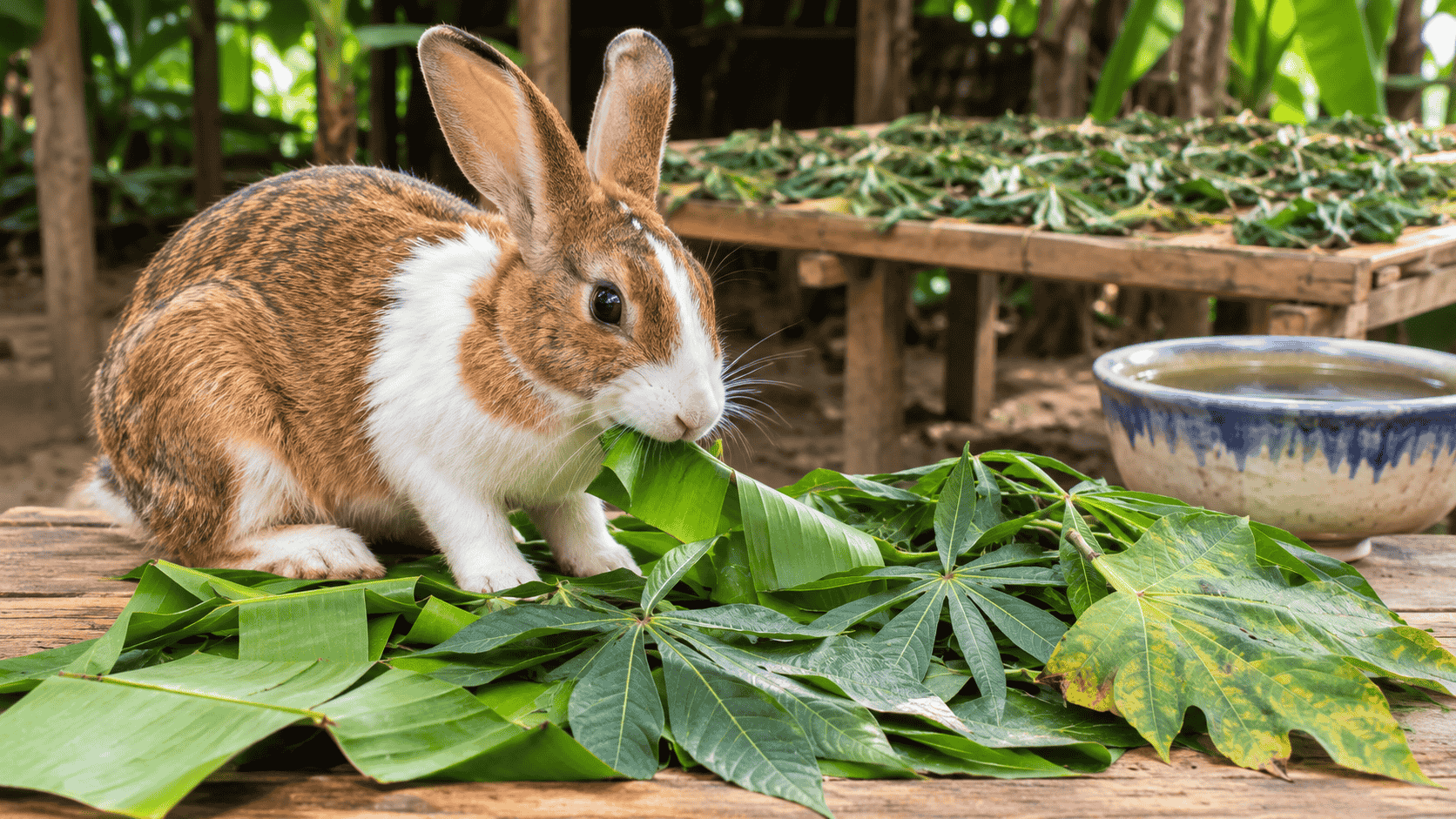
If you are asking can rabbits eat cassava leaves, pawpaw leaves and banana leaves, the short answer is yes, provided you prepare each leaf properly and feed it in the right proportion. All three plants grow abundantly across Ghana and tropical regions, making them valuable, low-cost forage options that help pet owners and commercial rabbit farmers maintain high-fibre diets year-round.
However, these three leaves do not carry the same level of risk. Banana and plantain leaves are straightforward fibrous roughage you can wash and feed almost right away. Pawpaw (papaya) leaves are safe and palatable once wilted lightly in the shade, though you should feed them in moderation because of their natural latex and papain enzymes. Cassava leaves require strict care: fresh, raw cassava foliage contains cyanogenic glycosides that release toxic hydrogen cyanide inside a rabbit’s stomach if fed straight off the stem. You must wilt or sun-dry cassava leaves thoroughly for at least 24 to 48 hours before offering them. Whether you keep backyard rabbits in Accra, Kumasi, Cape Coast, or Tamale, or raise rabbits in another warm climate, this guide gives you exact preparation steps, safe daily percentages, life-stage limits, toxicity warning signs, and practical farm feeding tips for all three leaves.
Quick Comparison: Cassava, Pawpaw, and Banana Leaves for Rabbits
Before harvesting a single stem, compare the nutritional profile, mandatory preparation time, and safe daily inclusion limit for each of the three leaves below.
| Leaf Type (Botanical Name) | Safety Status | Key Nutritional Value (Dry Matter Basis) | Mandatory Preparation | Safe Daily Share of Forage |
|---|---|---|---|---|
| Cassava Leaves (Manihot esculenta) | Safe ONLY after proper wilting or drying (toxic when fresh and raw) | High crude protein (20% to 25%), good minerals, moderate fibre | Wilt in open shade or sun-dry thoroughly for 24 to 48 hours until limp or crisp | Up to 15% to 25% of daily roughage (adults and growers over 12 weeks) |
| Pawpaw / Papaya Leaves (Carica papaya) | Safe in moderation | Moderate protein (14% to 18%), digestible fibre, vitamins A and C, papain enzyme | Rinse off dust and milky sap on cut stems; wilt in open shade for 4 to 8 hours | Up to 15% to 20% of daily roughage mixed with grass hay |
| Banana & Plantain Leaves (Musa species) | Safe (very low risk) | High crude fibre (20% to 25%), moderate protein (10% to 13%), low sugar | Wash dust cleanly, remove tough thick centre midrib if desired, wilt lightly 2 to 4 hours, tear into strips | Up to 25% to 35% of daily roughage alongside staple grasses |
Notice that none of these three leaves should serve as 100% of a rabbit’s daily food. Rabbits always need a primary base of fibrous grasses (such as guinea grass, Rhodes grass, or dry grass hay) paired with measured high-fibre pellets and unlimited clean water. For the full picture of local staples, review our country guide on what rabbits eat in Ghana and safe local foods.
1. Can Rabbits Eat Cassava Leaves? Safety, Cyanide Risk, and Preparation
Yes, rabbits can eat cassava leaves safely, and agricultural feeding trials across West Africa and Southeast Asia confirm that properly processed cassava foliage is an outstanding, high-protein feed supplement for growing meat rabbits and nursing does. Cassava leaves typically contain 20% to 25% crude protein on a dry-matter basis, rivalling expensive legume hays like alfalfa.
However, you must never treat cassava leaves like ordinary garden grass. Fresh cassava plants naturally produce defensive compounds called cyanogenic glycosides (primarily linamarin and lotaustralin). When a rabbit chews fresh, unwilted cassava leaves, plant enzymes break linamarin down into hydrogen cyanide (HCN), a fast-acting cellular poison that blocks oxygen use in the bloodstream and tissues.
Sweet vs. Bitter Cassava Varieties
Farmers often ask whether “sweet” cassava varieties grown for fufu and ampesi can be fed fresh without wilting. The answer is no. While bitter industrial cassava varieties carry much higher cyanide concentrations than sweet culinary varieties, even sweet cassava leaves contain enough cyanogenic glycosides (especially in young growing shoot tips and during dry-season drought stress) to sicken or kill a small rabbit if fed raw. Treat every cassava variety in Ghana with the exact same strict drying rule.
How Wilting and Sun-Drying Remove Cyanide
Fortunately, hydrogen cyanide is a volatile gas that evaporates rapidly into the air once plant cell walls break down during wilting or drying. Agricultural research shows that spreading chopped or whole cassava leaves in thin layers to wilt in open shade for 24 to 48 hours, or sun-drying them cleanly into crisp cassava leaf hay over 2 to 3 sunny days, reduces free cyanide levels by 75% to 95%, bringing them well within safe levels for rabbits.
Strict Rules for Feeding Cassava Leaves Safely
- Never feed fresh, raw cassava leaves straight off the plant: Always allow a full 24 to 48 hours of open-air wilting or sun-drying.
- Avoid feeding young, dark-red immature shoot tips alone: Mature green leaves carry lower cyanide levels than the very youngest tender tips.
- Never feed raw cassava roots or raw fresh cassava peels: Fresh cassava peels hold the highest cyanide concentrations in the entire plant and also pack dense raw starch that triggers lethal caecal fermentation in rabbits. (Only properly processed, thoroughly sun-dried cassava peel meal formulated in tiny balanced percentages by commercial feed mills is used in livestock pellets.)
- Keep cassava leaves to 15% to 25% of daily roughage: Mix wilted or dried cassava leaves with plenty of fibrous guinea grass, dry hay, or banana leaves so your rabbit’s liver clears trace compounds effortlessly.
- Avoid feeding cassava leaves to young kits under 12 weeks old: Newly weaned rabbits have small body weights and sensitive livers; stick to crisp dry grass hay and grower pellets until they pass 12 weeks of age.
2. Can Rabbits Eat Pawpaw (Papaya) Leaves? Benefits and Limits
Yes, rabbits can eat pawpaw leaves safely in moderate amounts. Across Ghana, pawpaw trees grow in nearly every backyard compound and farm boundary, making fallen or pruned leaves an accessible, free supplement. Rabbits generally enjoy the mild bitter taste of wilted pawpaw leaves and eagerly strip the soft green blade off the hollow stalk.
Nutritional Value of Pawpaw Leaves
Pawpaw leaves provide roughly 14% to 18% crude protein on a dry-matter basis alongside digestible plant fibre, beta-carotene (vitamin A precursor), vitamin C, calcium, and natural digestive enzymes including papain. In backyard rabbitries, pawpaw leaves add helpful dietary variety and stimulate appetite when rabbits grow bored of dry grass alone.
Why You Should Wilt Pawpaw Leaves and Feed in Moderation
Freshly snapped pawpaw leaf stalks ooze a thick, milky white latex sap rich in proteolytic enzymes (papain and chymopapain). While small amounts are harmless to healthy adult rabbits, heavy fresh latex can irritate sensitive mouth linings and cause loose, soft stools if a rabbit eats large piles of wet, freshly picked pawpaw foliage.
- Wash off milky stem sap and wilt for 4 to 8 hours: Rinse freshly cut pawpaw leaves in clean water to remove dust and sap from the cut stalk end, then lay them in open shade until the leaves turn soft and slightly limp.
- Remove thick hollow petioles (main stalks) if very sappy: Offer the leafy palm-shaped blades and thinner veins, or allow the stalks to wilt thoroughly before feeding.
- Keep portions moderate (15% to 20% of daily roughage): Offer half to one medium wilted pawpaw leaf per adult 3.5 kg to 4.5 kg rabbit, two to four times per week, always paired with staple grass hay.
- Do not rely on pawpaw leaves as a “herbal cure” for parasites or GI stasis: A common backyard myth claims pawpaw leaves cure coccidiosis or dissolve stomach hairballs. While papain is a protein-digesting enzyme, veterinary studies show it does not dissolve keratin fur masses in a rabbit’s stomach, and pawpaw leaves cannot cure an active Eimeria coccidiosis outbreak. Always seek prompt veterinary medication for diarrhoea or gut stasis.
3. Can Rabbits Eat Banana and Plantain Leaves? Fibre and Dry-Season Value
Yes, both banana leaves and plantain leaves (Musa species) are completely safe, non-toxic, and highly useful fibrous roughage for rabbits. Unlike sweet ripe bananas (which are packed with sugar and starch and must be restricted to tiny fingernail-sized occasional treats), banana and plantain leaves are low in sugar, rich in tough structural fibre, and gentle on a rabbit’s hindgut.
Why Banana and Plantain Leaves Shine in Tropical Rabbitries
- High digestible fibre for dental wear and gut movement: Tough, fibrous banana leaf blades require vigorous side-to-side chewing, helping wear down continuously growing molar teeth while keeping intestinal contractions steady.
- Natural tannins help firm up mild loose stools: Banana leaves contain gentle natural plant tannins that can support firm faecal pellet formation when lush rainy-season grasses are overly watery.
- Zero cyanide or harsh latex risk: Unlike cassava leaves, banana and plantain leaves contain no cyanogenic toxins. Even slightly fresh leaves (once washed clean of dust and drained dry) are safe, though light wilting for 2 to 4 hours keeps moisture balanced.
- Reliable dry-season availability: Banana and plantain clumps stay green around compound drains and backyard gardens during Ghana’s dry season (November to March) when roadside grasses turn brown and scarce.
How to Serve Banana and Plantain Leaves
Select clean, green, undamaged leaves rather than torn brown dead leaves hanging near the soil (which may carry fungal mould or soil parasites). Wipe or rinse dust off both sides of the wide leaf blade, tear the leaf lengthwise into 5 cm to 8 cm strips so it fits neatly into a raised wire hay rack, and discard the very thick, watery central spine (midrib) if your rabbits ignore it. Remember that banana leaves are moderate in protein (10% to 13% dry matter), so pair them with balanced commercial pellets or protein-rich browse like sweet potato vines or wilted cassava/moringa leaves for nursing does and growing fryers.
Step-by-Step Guide to Harvesting, Washing, and Wilting All Three Leaves
Clean preparation turns free compound foliage into safe, nutritious forage. Follow this practical six-step routine every time you harvest cassava, pawpaw, or banana leaves:
- Harvest only from clean, unsprayed trees and farms: Never pick leaves from cassava plots sprayed recently with herbicides or insecticides, or banana and pawpaw trees growing directly beside busy exhaust-heavy roads or open septic gutters.
- Choose healthy, mature green leaves: Skip yellowing, insect-riddled, mould-spotted, or soil-splashed lower leaves. For cassava, avoid picking only the very youngest dark-red top shoots.
- Rinse off dust and sap cleanly: Swish harvested leaves briefly in a clean basin of water (especially during the dusty Harmattan season between December and February) to wash away fine grit, bird droppings, and sticky sap on cut pawpaw stems. Shake off excess water droplets thoroughly.
- Spread thinly on a raised shaded drying rack: Lay leaves in a single loose layer across clean wire mesh, slatted bamboo, or a clean tarpaulin in open shade with good airflow. Never pile wet leaves inside a tied polythene sack or deep heap, as trapped heat causes rapid bacterial fermentation within two hours.
- Respect the exact wilting clock for each leaf:
- Banana and plantain leaves: Wilt 2 to 4 hours in shade until surface water evaporates cleanly, then tear into strips.
- Pawpaw leaves: Wilt 4 to 8 hours in shade until blades turn soft and slightly limp.
- Cassava leaves: Wilt in open shade or sun-dry cleanly for a full 24 to 48 hours (or sun-cure into crisp dry leaf hay over 2 to 3 days for long-term storage).
- Serve in raised hay racks well off the cage floor: Hanging or tying wilted leaves above shoulder height prevents rabbits from urinating or defecating on their food, blocking coccidiosis transmission cleanly. Remove any uneaten damp remnants the next morning.
Safe Feeding Quantities by Rabbit Age and Life Stage
Young rabbits have far more sensitive digestive systems and smaller livers than healthy mature adults. Always match leaf portions to your rabbit’s age and reproductive stage.
| Rabbit Age / Life Stage | Cassava Leaves (Wilted 24 to 48 hrs or Dried) | Pawpaw Leaves (Wilted 4 to 8 hrs) | Banana / Plantain Leaves (Washed Strips) |
|---|---|---|---|
| Weaned Kits (Under 12 Weeks Old) | Do not feed (too sensitive to trace cyanide; stick to dry grass hay and grower pellets) | Do not feed until 12 weeks (wait until caecal flora matures) | Tiny strip of dry/well-wilted leaf only after 10 to 12 weeks |
| Growing Juveniles (3 to 6 Months) | Introduce very slowly after 12 weeks; up to 10% to 15% of daily roughage | Introduce slowly; small portion (1/4 to 1/2 leaf) 2 to 3 times weekly | Safe daily fibrous addition (up to 20% to 25% of roughage) |
| Healthy Adult Pets & Resting Farm Stock | Up to 15% to 20% of daily roughage (roughly 1 to 2 small handfuls of wilted/dried leaves) | 1/2 to 1 medium wilted leaf, 2 to 4 times per week | 1 to 2 medium strips daily alongside grass hay |
| Pregnant & Nursing Does | Up to 20% to 25% of daily roughage (valuable protein boost once thoroughly dried/wilted) | Moderate amounts only (1/2 leaf 2 to 3 times weekly; avoid very heavy fresh latex during pregnancy) | Generous strips daily alongside guinea grass, sweet potato vines, and free-choice pellets |
Whenever you introduce any of these three leaves to a rabbit that has never eaten it before, start with a single small strip or two leaves for 2 days, check that morning droppings remain firm, round, and dry, and build up to the target portion slowly over 5 to 7 days. For complete daily gram and tablespoon targets across every life stage, check our guide on how much to feed a rabbit daily by age and weight.
How to Combine These Leaves With Grasses and Commercial Pellets
Think of cassava, pawpaw, and banana leaves as strong supporting players inside a balanced, multi-plant diet rather than standalone meals. Mixing two or three compatible forages at every meal prevents nutritional gaps and dilutes any natural plant secondary compounds (such as trace tannins, latex, or residual cyanogens).
Two Sample Balanced Forage Combos
- Combo 1 (High-Growth Farm Mix for Growers and Nursing Does): 55% shade-wilted guinea grass (Panicum maximum) + 20% thoroughly dried cassava leaves (or sweet potato vines) + 25% banana leaf strips, served alongside measured or free-choice high-fibre commercial pellets and unlimited clean water.
- Combo 2 (Maintenance Mix for Resting Adults and Backyard Pets): 65% sun-cured local grass hay or Timothy hay + 20% banana/plantain leaf strips + 15% wilted pawpaw leaf and Tridax procumbens, paired with a small measured portion of plain adult pellets (25 g per kg of ideal weight).
To explore more safe wild grasses, legumes, and browse plants you can rotate into these mixes, browse our botanical directory of the best grasses and leaves for rabbits and unsafe plants. Serve your forage and pellets consistently at dawn and dusk using our morning and evening rabbit feeding schedule guide so digestion stays predictable.
For peer-reviewed international agricultural research on cassava foliage drying, cyanide reduction, and tropical leaf meal inclusion in rabbit diets, you can consult the Food and Agriculture Organization (FAO) tropical rabbit nutrition and forage research.
Using Cassava, Pawpaw, and Banana Leaves Across Ghana’s Seasons
Across Accra, Tema, Kumasi, Takoradi, Cape Coast, Sunyani, and Tamale, strategic use of cassava, pawpaw, and banana leaves helps rabbit farmers cut feed bills by 20% to 35% while navigating both weather extremes smoothly:
- Rainy Season (April to July and September to October): High humidity slows down cassava leaf drying dramatically. During rainy weeks, do not rely on 24-hour shade wilting alone if leaves still feel cool and damp; spread cassava leaves thinly on raised racks under a breezy covered roof for a full 48 hours (or skip cassava leaves during prolonged rainstorms and rely on banana leaves, guinea grass, and dry cured hay instead). Watch out for black or white mould growing on half-dried leaves during damp nights.
- Dry Season (November to March): When roadside grasses dry out and turn woody, banana leaves, plantain leaves, pawpaw leaves, and sun-cured cassava leaf hay become lifesavers. Harvest excess cassava leaves during farm root harvesting in late October or November, sun-dry them cleanly on tarpaulins for 2 to 3 bright sunny days until stems snap crisply, crumble the dry leaves loosely into breathable woven sacks (never airtight plastic bags), and store them raised off the floor for dry-season protein supplementation.
- Compound Hygiene Note: Always rinse Harmattan dust off wide banana and pawpaw leaves before feeding during December to February, as dusty leaves trigger sneezing and eye irritation in rabbit hutches.
7 Common Mistakes When Feeding Tropical Tree and Crop Leaves
Avoid these seven everyday errors that turn safe local leaves into veterinary emergencies:
- Feeding freshly cut cassava leaves because “they are sweet cassava”: Even sweet culinary cassava leaves release dangerous cyanide if fed raw. Always wilt or sun-dry for a full 24 to 48 hours without exception.
- Feeding raw cassava peels left over from making fufu or gari: Raw peels contain very high cyanide levels and heavy starch that cause rapid poisoning and fatal gut bloat. Keep raw kitchen cassava peels strictly out of rabbit cages.
- Stuffing freshly cut leaves into tied plastic sacks overnight to “wilt”: Closed plastic bags trap heat and moisture, causing leaves to ferment and rot into toxic, gas-producing slime within hours. Always wilt in open, breezy shade on a raised rack.
- Feeding huge piles of pawpaw leaves to cure diarrhoea or worms: Excess fresh pawpaw latex upsets sensitive guts further and delays proper veterinary treatment for coccidiosis or bacterial enteritis.
- Feeding ripe banana fruit as a daily meal instead of banana leaves: Banana leaves are safe high-fibre roughage, whereas ripe banana fruit is packed with sugar and starch (limit fruit to one thin 5 mm slice once or twice a week for adults).
- Giving cassava or pawpaw leaves to 5-to-8-week-old newly weaned kits: Weaning kits have fragile caecal bacteria and tiny livers; wait until 12 weeks of age before introducing tropical tree and crop leaves.
- Tossing leaves straight onto wire or wooden cage floors: Floor-fed leaves absorb urine and mix with faecal pellets rapidly, spreading intestinal coccidiosis across your entire herd. Always feed in raised racks.
Warning Signs of Cyanide Toxicity or Digestive Upset (When to Call a Vet)
If a rabbit accidentally eats raw unwilted cassava leaves, mouldy dried foliage, or fermented leaves, act immediately. Cyanide poisoning acts very quickly, while digestive bloating escalates rapidly over several hours.
Remove all suspect leaves immediately and contact a qualified veterinarian or District Veterinary Officer urgently if you see any of these red flags:
- Sudden rapid, laboured, or open-mouth breathing paired with bright-red or pale/bluish gums (classic acute warning sign of cyanide toxicity).
- Muscle tremors, staggering, sudden weakness, collapse, or seizures.
- Refusing all food or passing zero droppings for 10 to 12 hours (review immediate emergency checks in our guide on why a rabbit stops eating and what to do immediately).
- A hard, tight, balloon-like swollen belly paired with hunched posture or loud, harsh tooth grinding.
- Watery, foul-smelling, mucus-coated, or bloody diarrhoea.
- Sudden drooling or mouth pawing after chewing sappy stems.
Never attempt to force a rabbit to vomit (rabbits cannot vomit) and never drench a sick rabbit with unprescribed oils or herbal mixtures. Bring a small sample of the exact leaf your rabbit ate to the veterinary clinic so the vet can tailor emergency fluids, oxygen, or supportive treatment immediately.
Frequently Asked Questions About Cassava, Pawpaw, and Banana Leaves
1. Can rabbits eat fresh cassava leaves straight from the farm?
No. Fresh, raw cassava leaves contain cyanogenic glycosides (linamarin) that release toxic hydrogen cyanide inside a rabbit’s digestive tract. Always wilt cassava leaves in open shade or sun-dry them thoroughly for 24 to 48 hours before feeding them in moderate portions mixed with grass hay.
2. How long should I dry cassava leaves before feeding them to rabbits?
Wilt cassava leaves spread in a thin layer in breezy shade for at least 24 to 48 hours until completely limp, or sun-dry them cleanly over 2 to 3 sunny days until crisp for long-term dry-season hay storage. Never pile wet cassava leaves inside closed plastic sacks.
3. Can rabbits eat cassava peels?
Never feed fresh, raw cassava peels to rabbits, as peels hold the highest cyanide levels in the plant alongside dense raw starch that triggers fatal bloating. Only thoroughly processed, fully sun-dried cassava peel meal included in small balanced percentages inside commercial rabbit pellets is safe.
4. Are pawpaw (papaya) leaves safe for pregnant rabbits?
Small, occasional amounts of thoroughly shade-wilted pawpaw leaves (with milky stem sap rinsed off) are generally tolerated by healthy adults, yet it is safest to keep portions modest during pregnancy and avoid heavy fresh pawpaw latex. Focus pregnant does primarily on clean dry grass hay, shade-wilted guinea grass, sweet potato vines, and balanced pellets.
5. Do pawpaw leaves cure coccidiosis or worms in rabbits?
No. Although pawpaw leaves are nutritious roughage containing natural papain enzymes, they do not reliably cure active intestinal coccidiosis or heavy parasite infections. If your rabbits develop watery diarrhoea or pot-bellied wasting, isolate affected animals and contact a veterinarian promptly for targeted anticoccidial medication.
6. Can rabbits eat banana leaves and plantain leaves every day?
Yes. Clean, washed banana and plantain leaves are safe, non-toxic, low-sugar, high-fibre roughage that adult rabbits can eat daily as up to 25% to 35% of their forage mix alongside staple grasses like guinea grass or dry hay.
7. Can baby rabbits eat cassava, pawpaw, or banana leaves?
Wait until young rabbits reach at least 12 weeks of age before introducing wilted cassava or pawpaw leaves, because newly weaned kits have fragile gut bacteria and small livers. Keep kits aged 4 to 12 weeks primarily on clean dry grass hay and plain high-fibre grower pellets, introducing a small strip of clean banana leaf slowly around 10 to 12 weeks.
8. Can rabbits eat the green pawpaw fruit or ripe banana fruit too?
Avoid unripe green pawpaw fruit, which is packed with harsh milky latex. Tiny thumbnail-sized pieces of ripe pawpaw flesh (seeds removed) or one thin 5 mm slice of ripe banana are safe only as rare sugary treats once or twice a week for healthy adult rabbits, never as daily meals.
Safe Preparation Makes Local Leaves Reliable Rabbit Forage
Cassava leaves, pawpaw leaves, and banana leaves are three of the most practical, budget-friendly local forages available to rabbit keepers across Ghana and tropical regions, as long as you respect each plant’s exact safety rules. Enjoy banana and plantain leaves freely as clean, high-fibre daily strips; rinse and shade-wilt pawpaw leaves for 4 to 8 hours in moderate portions; and always wilt or sun-dry cassava leaves thoroughly for a full 24 to 48 hours to clear toxic cyanide before feeding.
Combine these leaves with a primary base of clean fibrous grasses or dry hay, balanced high-fibre pellets matched to your rabbits’ life stage, raised hay racks off the cage floor, and unlimited cool drinking water. Smart, consistent preparation protects your rabbits’ health while turning abundant backyard foliage into dependable year-round nutrition.
