

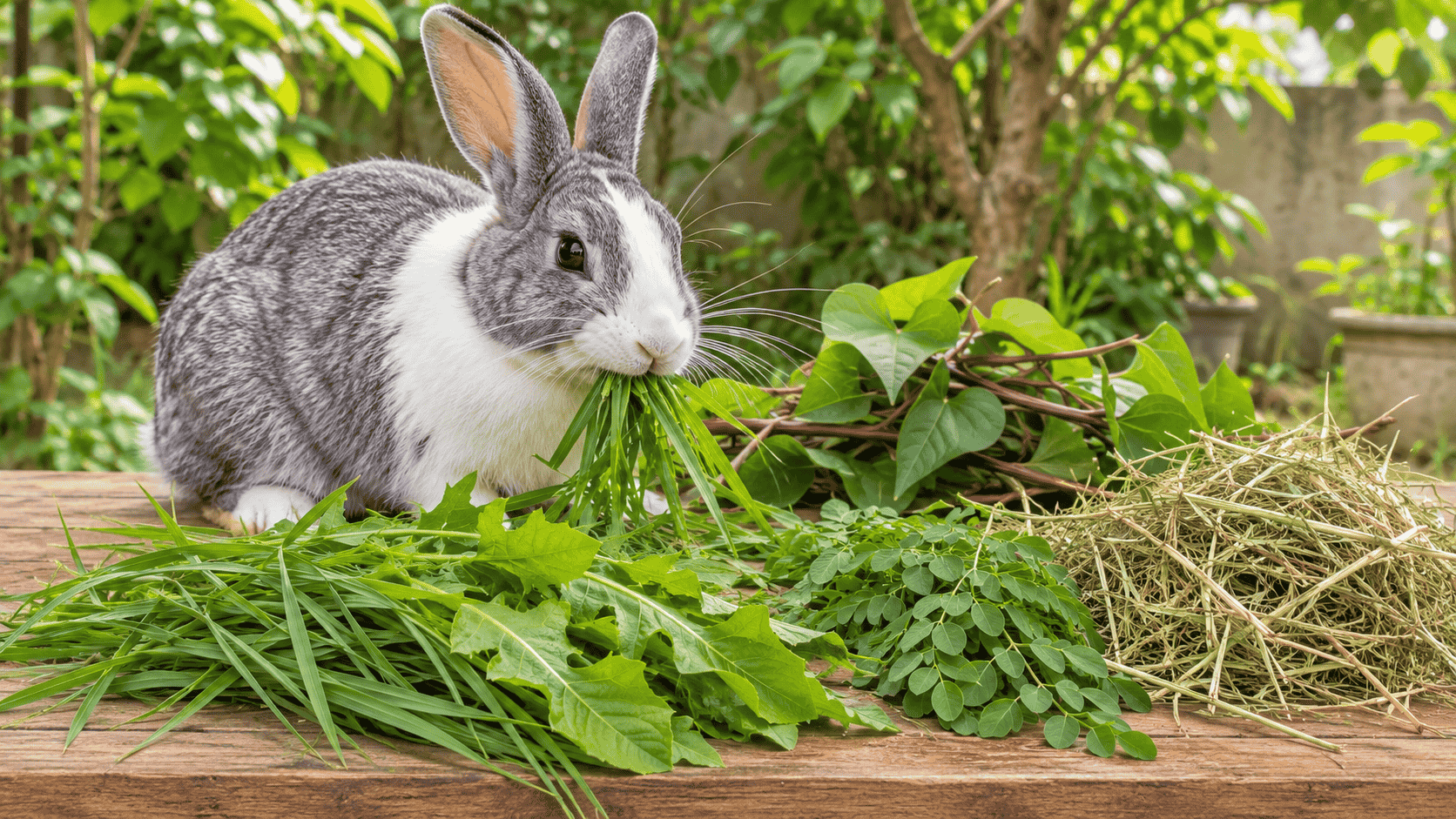
Choosing the best grasses and leaves for rabbits keeps your rabbits’ digestive tract moving, wears down continuously growing teeth, and cuts daily feed costs significantly. Wild and domestic rabbits are strict herbivores built to graze on fibrous grasses, field weeds, and safe tree leaves for most of the day. When you supply clean, high-fibre forage properly, you prevent gastrointestinal stasis, dental spurs, obesity, and weaning diarrhoea.
Feeding harvested plants does carry one serious risk: picking the wrong weed, cutting along a chemically sprayed roadside, or serving soaking-wet leaves straight from the field can poison a rabbit or trigger fatal bloating within hours. Whether you gather tropical grasses and browse in Accra, Kumasi, Sunyani, or Tamale, or forage safe garden weeds and meadow grasses in the UK, this guide gives you a clear directory of the best safe grasses, legumes, tree leaves, and wild herbs, lists the poisonous plants you must never feed, explains step-by-step harvesting and wilting rules, and shows you how to cure dry hay for lean seasons.
Why Fibrous Grasses and Leaves Are Essential for Rabbits
A rabbit’s stomach and caecum evolved to process tough plant cellulose rather than concentrated starch or soft sugary foods. Roughage should make up roughly 75% to 80% of an adult pet rabbit’s daily intake and 50% to 60% of a commercial breeding or growing rabbit’s diet alongside balanced high-fibre pellets.
Clean fibrous grasses and safe browse leaves protect your rabbits in four direct ways:
- Continuous gut motility: Long, indigestible fibre strands push swallowed food and grooming hair steadily through the intestines, preventing lethal gastrointestinal stasis and gas buildup.
- Natural dental wear: Grass blades contain microscopic silica crystals that act like gentle sandpaper. As a rabbit chews grass stems side to side, its continuously growing incisors and back molars wear down smoothly, preventing sharp cheek spurs and jaw abscesses.
- Balanced caecal fermentation: Beneficial bacteria inside the caecum ferment digestible plant fibre into essential volatile fatty acids, B vitamins, and microbial protein (which rabbits recover by eating their soft caecotrophs).
- Lower feed costs and natural enrichment: Harvesting clean local grasses, crop vines, and tree leaves reduces commercial pellet bills by 30% to 50% on backyard farms while giving rabbits hours of natural chewing activity that stops boredom bar-chewing.
Best Safe Grasses for Rabbits (Ghanaian and International)
True grasses (family Poaceae) form the safest everyday foundation of any rabbit’s diet because they provide high crude fibre with moderate, balanced calcium levels. Harvest grasses while they are green and leafy before they turn tall, brown, and woody with hard seed heads.
| Grass Name (Common & Botanical) | Where Commonly Found | Nutritional Profile | Best Way to Feed |
|---|---|---|---|
| Guinea Grass (Panicum maximum) | Abundant across Ghana, West Africa, and tropical lowlands | High crude fibre (28% to 35% DM), moderate protein (8% to 12% DM) when cut young | Cut young leafy shoots before flowering; wilt 4 to 8 hours in shade or sun-cure into dry hay |
| Elephant Grass / Napier (Pennisetum purpureum) | Ghanaian valleys, stream banks, and backyard fodder plots | High bulk fibre, moderate energy | Feed tender young leaves and thin upper stems only; discard thick woody lower canes |
| Rhodes Grass (Chloris gayana) | Savannah regions, northern Ghana, and warm subtropical pastures | Fine leafy stems, very palatable, excellent hay grass | Ideal for curing into crisp dry hay stacks for dry-season feeding |
| Gamba Grass (Andropogon gayanus) | Northern and middle-belt Ghana (Tamale, Techiman, Sunyani) | Reliable drought-tolerant roughage | Harvest early in the rainy season while leaves are green and soft; avoid old dry stalks |
| Timothy Grass (Phleum pratense) | UK, Europe, North America (sold worldwide as bagged hay) | Gold-standard balanced fibre (30%+), low calcium (0.4% to 0.5%) | Feed unlimited dry hay daily for adult pets and sensitive bladders |
| Orchard Grass / Cocksfoot (Dactylis glomerata) | UK, Europe, North America, and temperate pastures | Soft, sweet-smelling blades, high fibre, low calcium | Great soft-textured alternative for rabbits picky about coarse Timothy stems |
| Bermuda Grass / Star Grass (Cynodon dactylon) | Lawns, fallow fields, and pastures across Ghana and warm climates | Fine stems, good daily fibre | Harvest only from chemical-free, pet-free lawns; never feed lawnmower clippings |
Never feed lawnmower clippings: Grass cut by a petrol or electric mower is bruised and shredded finely. Within 30 to 60 minutes, mower clippings heat up and start fermenting, releasing toxins and gas that cause rapid fatal bloating in rabbits. Always hand-cut grass cleanly with a sharp sickle, shears, or knife.
Best Safe Tree Leaves, Crop Vines, and Legumes
While grasses supply essential bulk fibre, tree leaves, crop vines, and tropical legumes supply higher crude protein (16% to 28% dry matter), minerals, and vitamins that boost milk production in nursing does and accelerate growth in weaned kits. Because many legumes and tree leaves are also higher in calcium than grasses, feed them as 20% to 35% of the daily forage mix alongside primary grass hay.
| Plant / Leaf (Common & Botanical) | Key Nutrients | Preparation & Feeding Limit |
|---|---|---|
| Sweet Potato Vines (Ipomoea batatas) | 16% to 20% protein, high energy, very palatable | Rinse soil off vines and wilt 4 to 6 hours in shade; safe daily staple alongside grass |
| Moringa Leaves (Moringa oleifera) | 22% to 26% protein, rich in vitamins A and C, high calcium | Feed fresh wilted or dried as 10% to 20% of forage mix; avoid overfeeding to resting pets with bladder sludge |
| Centro (Centrosema pubescens) | 18% to 22% protein, good fibre | Wild trailing legume common across southern Ghana; wilt 4 to 6 hours and mix with guinea grass |
| Pawpaw (Papaya) Leaves (Carica papaya) | Good fibre, plant enzymes, minerals | Wilt cleanly in shade; offer moderate amounts mixed with primary grass roughage |
| Banana & Plantain Leaves (Musa species) | High fibrous roughage, low sugar | Wash dust off large blades and tear into strips; very useful during dry months |
| Mulberry Leaves (Morus alba) | 18% to 22% protein, highly digestible | Wash and wilt lightly; safe daily browse for both growing fryers and pet rabbits |
| Apple, Pear, Guava, & Mango Leaves | Fibre and tannins (bark and twigs also wear down teeth) | Ensure trees have zero pesticide spray; offer washed leaves and clean dried twigs in moderation |
| Groundnut & Cowpea Haulms (Vines) | 14% to 18% protein when sun-cured cleanly | Excellent dry-season legume hay; inspect strictly for dark mould or musty smell before feeding |
For a full breakdown of how to safely prepare tropical staples like cassava, pawpaw, and banana foliage without risking cyanide toxicity or loose stools, read our dedicated guide on whether rabbits can eat cassava leaves, pawpaw leaves, and banana leaves.
Safe Wild Weeds and Garden Herbs Rabbits Love
Many common garden “weeds” are actually nutritional powerhouses that rabbits seek out eagerly in nature. Identify every wild plant with 100% certainty before cutting it; if you have even slight doubt about a weed’s identity, leave it behind.
- Coatbuttons / Tridax (Tridax procumbens): Easily spotted by its small daisy-like yellow-and-white flowers on hairy trailing stems across Ghana. Tridax is safe, palatable, and widely fed daily in Ghanaian rabbitries once rinsed of roadside dust and wilted for 3 to 4 hours.
- Dandelion (Taraxacum officinale and Ghanaian wild lettuce Launaea taraxacifolia): Both the jagged leaves and yellow flowers are safe and rich in vitamins. Because dandelion acts as a mild natural diuretic and is moderately rich in calcium, feed it as part of a varied mix rather than the sole green every day.
- Broadleaf and Ribwort Plantain Weed (Plantago major / Plantago lanceolata): Common temperate lawn and footpath weeds (unrelated to the tropical plantain fruit tree) that are gentle on sensitive rabbit stomachs and widely recommended by veterinarians as daily forage.
- Clover (Trifolium species, including white and red clover): Nutritious nitrogen-fixing legume loved by rabbits. Because clover is rich in protein and moisture, introduce it slowly in small handfuls mixed with grass hay so it does not trigger gas or soft stools.
- Blackberry / Bramble Leaves (Rubus fruticosus): Safe, astringent, fibre-rich leaves popular for UK and European foraging. Use gloves to trim off sharp large thorns along thick stems if desired, though rabbits deftly eat around fine prickles.
- Kitchen Garden Herbs (Coriander, Parsley, Basil, Mint, Thyme, Dill, Oregano): Aromatic, safe daily greens for indoor pet rabbits that encourage hydration and make healthy low-sugar training rewards.
Unsafe and Poisonous Plants Rabbits Must Never Eat
Some common weeds, crop leaves, and ornamental compound shrubs contain potent alkaloids, cardiac glycosides, oxalates, or cyanide compounds that kill rabbits rapidly. Memorise this table and clear any toxic shrubs growing near outdoor hutches or grazing runs.
| Toxic Plant or Leaf | Harmful Compound | Main Symptoms & Risk |
|---|---|---|
| Avocado leaves, bark, fruit, and pit (Persea americana) | Persin | Severe heart muscle damage, fluid in lungs, laboured breathing, sudden death |
| Castor bean plant (Ricinus communis) | Ricin (extremely potent in seeds and foliage) | Fatal organ failure, severe diarrhoea, collapse even in tiny amounts |
| Oleander (Nerium oleander) | Cardiac glycosides (oleandrin) | Lethal heart arrhythmia and sudden death; even a single dried leaf can kill a rabbit |
| Lantana (Lantana camara) | Lantadenes (pentacyclic triterpenoids) | Common tropical hedge weed in Ghana; causes severe liver failure, jaundice, and weakness |
| Milkweed / Sodom Apple (Calotropis procera / Asclepias) | Cardiac glycosides in milky white sap | Heart failure, nervous tremors, digestive inflammation |
| Nightshade crop leaves (Tomato, Irish Potato, Pepper, Garden Egg / Aubergine) | Solanine and chaconine alkaloids | Digestive upset, nervous depression, slowed heart rate, poisoning |
| Raw Cocoyam / Taro Leaves (Kontomire) & Dumb Cane (Colocasia / Dieffenbachia) | Insoluble calcium oxalate needle crystals | Intense burning and swelling of mouth and throat, drooling, kidney irritation |
| Onion, Garlic, Chive, and Shallot Tops (Allium species) | Organosulphur compounds | Destroys red blood cells (haemolytic anaemia), weakness, dark urine |
| Rhubarb leaves, Foxglove, Ragwort, Ivy, Yew, and Buttercups | Oxalic acid, digitalis, pyrrolizidine alkaloids, taxines | Common UK/European garden and pasture poisons causing acute liver, kidney, or cardiac failure |
| Stone-fruit branches & leaves (Cherry, Peach, Plum, Apricot) | Cyanogenic glycosides (especially in wilted leaves) | Releases toxic cyanide in the stomach; avoid all Prunus species twigs and leaves |
Simple field rule: Be deeply suspicious of any wild plant that oozes thick milky white sap when snapped (such as milkweed, euphorbia, or frangipani) or grows from a bulb (such as onions, lilies, tulips, or daffodils). Most milky-sap and bulb plants are toxic to rabbits.
Plants Requiring Caution or Special Preparation
Several useful plants are safe once prepared correctly or fed in strict moderation, yet cause serious problems if fed carelessly:
- Cassava leaves (Manihot esculenta): Fresh raw cassava leaves contain toxic cyanogenic glycosides. Always wilt in open shade or sun-dry thoroughly for 24 to 48 hours so volatile cyanide escapes, and feed only in modest portions mixed with grass hay.
- Leucaena (Leucaena leucocephala): High-protein tropical fodder tree that contains mimosine. Keep Leucaena strictly below 10% to 15% of total daily forage to avoid hair loss and stunted growth.
- Gliricidia (Gliricidia sepium): Safe high-protein browse once wilted for 12 to 24 hours; fresh green leaves smell bitter and rabbits often reject them.
- Alfalfa / Lucerne (Medicago sativa): Excellent high-protein, high-calcium hay for growing kits under 6 months and nursing does, yet too rich in calcium and calories for healthy resting adult pet rabbits (can trigger obesity and chalky bladder sludge).
- Cabbage, kale, spinach, and broccoli leaves: Safe in small amounts for adult rabbits already accustomed to greens, yet large heaps cause painful intestinal gas (cabbage/broccoli) or excess oxalates/calcium (spinach/kale). Keep these under 10% to 15% of the leafy portion.
- Siam weed (Chromolaena odorata, locally called “Acheampong weed” in Ghana): Although widely abundant on fallow Ghanaian plots, Siam weed contains pyrrolizidine alkaloids that can damage animal livers over time and is bitter to rabbits. Avoid feeding Siam weed when safer plants like guinea grass, Tridax, and sweet potato vines are available.
How to Harvest, Wash, and Wilt Grasses and Leaves Safely
Good forage turns dangerous if contaminated by chemicals, animal droppings, or surface rain. Follow this five-step protocol every time you gather wild grasses or farm leaves:
- Inspect the harvesting site first: Choose clean plots well back from tarred roads (at least 15 to 20 metres away from vehicle exhaust dust), completely free of chemical herbicide or insecticide spraying, and away from areas where stray dogs, cattle, goats, or wild rabbits defecate (wild rabbit droppings can transmit lethal Rabbit Haemorrhagic Disease virus, RHDV2, on contaminated grass).
- Cut after morning dew dries: Harvest between 9:00 AM and 11:00 AM once heavy overnight dew evaporates, cutting clean green leaves and young stems with a sharp knife or sickle rather than pulling up muddy roots.
- Sort out stray weeds and rinse off dust: Spread your harvest on a clean table, pick out any unfamiliar weeds, thorny stems, or dry brown mouldy leaves, and swish dusty foliage briefly in a basin of clean water during dry dusty months.
- Wilt in open shade on a raised rack for 4 to 8 hours: Lay grasses and leaves in a thin, airy layer over wire mesh, bamboo slats, or a clean tarpaulin in the shade. Wilting drops excess water content cleanly and prevents gas bloating. Never leave freshly cut wet grass stuffed inside a tied plastic bag or deep heap, because trapped heat causes rapid fermentation within two hours.
- Feed off the floor in raised racks: Serve wilted grass and leaves in hanging wire hay racks or tied clean bundles so rabbits never urinate or defecate on their forage, which blocks coccidiosis transmission cleanly.
How to Sun-Cure Local Grass Into Safe Dry Hay
Making your own dry hay during lush rainy months guarantees steady, free high-fibre roughage throughout the dry season when green grass disappears or turns woody.
- Cut young grass just before flowering: Young green guinea grass, Rhodes grass, or tender elephant grass leaves hold maximum protein and digestible energy before seed heads mature.
- Spread thinly in direct sunlight on a clean raised surface: Lay cut grass 5 cm to 8 cm deep over a clean tarpaulin, concrete slab, or raised mesh drying rack. Turn the grass completely upside down twice a day so all stems dry evenly.
- Bring under cover if rain threatens: Rain-soaked half-dried grass turns brown, loses nutrients, and grows dangerous white or black mould rapidly.
- Perform the “snap test” after 2 to 4 sunny days: Take a thick stem from the middle of the pile and bend it sharply. Properly cured hay feels dry, smells sweet and fragrant, stays pale green, and snaps cleanly instead of bending softly or feeling cool and damp.
- Store in dry, breathable containers off the floor: Pack fully dry hay loosely into breathable woven polypropylene or jute sacks (never sealed airtight plastic bags, which trap condensation and breed mould) and stack sacks on wooden pallets inside a dry roofed store.
How to Balance Grasses and Leaves With Daily Pellets
Fresh wilted grasses and dry hay form the digestive engine of your rabbit’s diet, while plain high-fibre pellets fill in trace minerals, vitamins, and concentrated protein needed for growth and reproduction.
- Introduce every new grass or leaf slowly: A rabbit’s caecal microbes adapt to familiar foods. Add only one new plant species at a time in a small handful over 4 to 5 days while inspecting morning droppings for firm round consistency.
- Wait until 12 weeks for rich watery greens in young kits: Newly weaned kits (4 to 12 weeks old) have fragile digestive systems. Feed them primarily crisp dry grass hay (or sun-cured local grass hay) plus plain grower pellets until 12 weeks, then introduce shade-wilted local leaves gradually.
- Serve pellets and roughage on a steady twice-daily schedule: Offering measured pellets alongside fresh wilted forage around 6:00 AM and 6:00 PM (with dry hay available 24/7) keeps intake consistent and lets you spot appetite drops immediately. Follow exact daily quantities in our guide on how much to feed a rabbit daily and plan your morning-and-evening routine using our rabbit feeding schedule guide.
For further veterinary-backed guidance on safe wild foraging, hay selection, and balanced rabbit nutrition, you can consult the Rabbit Welfare Association & Fund (RWAF) rabbit diet and foraging advice.
Foraging and Growing Rabbit Grasses in Ghana
Across Accra, Tema, Kumasi, Takoradi, Cape Coast, Sunyani, and Tamale, relying strictly on wild roadside harvesting becomes risky as urban plots are sprayed with weedkillers or cleared for building. Forward-thinking Ghanaian rabbit keepers secure clean, reliable forage year-round using three smart practices:
- Grow a small backyard rabbit fodder plot: Even a 4 m x 4 m corner of your compound or backyard can produce steady daily forage. Plant rows of sweet potato vines (fast-growing ground cover), two or three pruned moringa trees kept short at waist height for easy harvesting, a few clumps of guinea grass or dwarf elephant grass, and a pawpaw tree. Watering your fodder bed with nutrient-rich rabbit manure compost creates a closed, low-cost farm loop.
- Coordinate with local vegetable farmers: Build relationships with nearby market gardeners to collect clean, unsprayed carrot tops, sweet potato vines after tuber harvest, or dry groundnut and cowpea haulms at little or no cost.
- Check all regional safe foods together: Combine wild grasses and tree browse with balanced local Ghanaian concentrates like wheat bran and commercial pellets using our complete country guide on what rabbits eat in Ghana and safe local foods.
7 Common Mistakes When Feeding Grasses and Leaves to Rabbits
Avoid these seven everyday forage errors that cause preventable digestive emergencies:
- Feeding freshly cut, dew-soaked or rain-wet grass immediately: High surface moisture and fast fermentation trigger severe bloating and watery diarrhoea, especially in young rabbits. Always wilt 4 to 8 hours in shade first.
- Using lawnmower clippings or grass packed in hot plastic bags: Bruised, heated grass ferments within an hour and releases toxins that cause acute enterotoxaemia.
- Harvesting along roadsides or recently sprayed farms: Chemical weedkillers (herbicides) often take 3 to 5 days to turn grass yellow, meaning freshly sprayed green grass can look completely healthy while carrying lethal chemical residue.
- Feeding mouldy, dusty, or musty-smelling dry hay: Fungal mycotoxins cause rapid liver failure and severe respiratory infections. Discard any hay with white powdery dust, dark black patches, or a damp basement smell.
- Feeding only one high-calcium leaf every day: Relying heavily on moringa, alfalfa, or dandelion alone without primary grass hay overloads calcium excretion, causing thick chalky white bladder sludge.
- Dumping forage onto bare cage floors: Rabbits step, urinate, and defecate directly on floor-fed grass, ingesting infective coccidia oocysts within 48 hours. Always use hanging hay racks.
- Skipping clean drinking water when feeding fresh greens: Rabbits still require unlimited clean drinking water 24 hours a day to digest plant fibre safely.
Warning Signs of Plant Poisoning or Bloat (When to Call a Vet)
If your rabbit accidentally eats an unsafe weed, herbicide-sprayed grass, or fermented wet foliage, symptoms can escalate from mild discomfort to life-threatening crisis within hours. Remove the suspect forage immediately (saving a sample of the plant in a bag to show the vet) and contact a qualified veterinarian right away if you notice any of these warning signs:
- Refusing all food or passing zero droppings for 10 to 12 hours (review urgent steps in our guide on why a rabbit stops eating and what to do immediately).
- A hard, tight, balloon-like swollen belly paired with hunched posture or loud, harsh tooth grinding.
- Watery, foul-smelling, mucus-coated, or bloody diarrhoea.
- Sudden drooling, mouth pawing, or swollen lips (classic sign of chewing irritating oxalate plants like raw kontomire or dieffenbachia).
- Weakness, uncoordinated staggering, tremors, seizures, pale/bluish gums, or rapid open-mouth breathing.
Never try to make a poisoned rabbit vomit (rabbits are anatomically unable to vomit) and never force-feed unprescribed oils or home remedies. Prompt veterinary supportive care (fluids, pain relief, activated charcoal where appropriate, and gut stabilisation) offers the best chance of survival.
Frequently Asked Questions About Grasses and Leaves for Rabbits
1. What is the single best grass to feed rabbits?
In Ghana and tropical climates, young shade-wilted or sun-cured guinea grass (Panicum maximum) is the most reliable, widely available staple grass, alongside Rhodes grass and young elephant grass leaves. In temperate regions like the UK and North America, clean dry Timothy hay and orchard grass hay are the gold-standard daily grasses.
2. Can rabbits eat fresh green grass straight from the garden?
Yes, provided the grass is 100% free of chemical fertilisers, weedkillers, dog/cat faeces, and wild rabbit droppings, and you introduce it gradually in small amounts if your rabbit is only used to dry hay. Never feed lawnmower clippings, and in humid tropical climates like Ghana, always wilt freshly cut bush grass in the shade for 4 to 8 hours before serving to prevent bloating.
3. Why can’t rabbits eat grass cut by a lawnmower?
Lawnmower blades crush and shred grass finely, causing the damp clippings to heat up and ferment rapidly within 30 to 60 minutes. Eating fermenting grass causes severe, painful caecal gas buildup (bloat) and fatal enterotoxaemia. Always cut rabbit grass cleanly by hand with shears, scissors, or a sharp knife.
4. What tree leaves are safe for rabbits?
Safe, nutritious tree and shrub leaves include moringa (moderate amounts), pawpaw leaves, banana and plantain leaves, mulberry leaves, guava, apple, pear, willow, and properly wilted Gliricidia. Never feed avocado leaves, oleander, lantana, milkweed, or stone-fruit tree leaves (cherry, peach, plum).
5. Can rabbits eat Tridax procumbens every day?
Yes. Tridax procumbens (coatbuttons) is safe, palatable, and fed daily on many Ghanaian rabbit farms as part of a balanced forage mix. Harvest it away from sprayed roadsides, rinse off dust cleanly, wilt for 3 to 4 hours in the shade, and pair it with fibrous grasses like guinea grass and measured pellets.
6. How long should I wilt fresh grass and leaves before feeding rabbits?
Wilt standard tropical grasses (guinea grass, elephant grass, Tridax, sweet potato vines) in open shade on a raised rack for 4 to 8 hours (up to 10 hours during very wet rainy-season days). For cassava leaves, extend wilting or sun-drying strictly to 24 to 48 hours so toxic cyanide compounds dissipate completely.
7. Are mango leaves safe for rabbits?
Clean, unsprayed mango leaves are generally safe in small, occasional amounts as fibrous browse once washed of dust and wilted lightly. Do not feed mango leaves from trees sprayed with fruit-fly insecticides, and keep mango leaves as a minor addition rather than a daily staple.
8. How do I know if a wild plant is poisonous to rabbits?
Never guess. Only feed plants you can identify with 100% certainty by both common name and botanical traits. Avoid all plants that ooze thick milky white sap when snapped, all bulb plants (onions, lilies, daffodils), all nightshade leaves (tomato, potato, pepper, garden egg), all ornamental compound shrubs (oleander, lantana, dieffenbachia), and any plant growing near sprayed farms or busy roads.
Building a Safe, Reliable Daily Forage Routine
Feeding the best grasses and leaves for rabbits is one of the smartest ways to protect digestive health, keep teeth worn down naturally, and run an affordable pet home or backyard rabbitry. Anchor every meal with clean fibrous grasses (such as guinea grass, Rhodes grass, Timothy, or orchard hay), add moderate variety with protein-rich local browse like sweet potato vines, Tridax, moringa, and safe garden herbs, and keep every poisonous shrub and kitchen nightshade completely out of reach.
Stick to clean harvesting spots, wilt tropical greens in open shade for 4 to 8 hours, serve forage in raised hay racks well off the cage floor, and cure extra dry hay before the dry season arrives. Consistent, careful forage preparation keeps your rabbits’ guts healthy, their coats glossy, and your daily feed budget firmly under control.
