

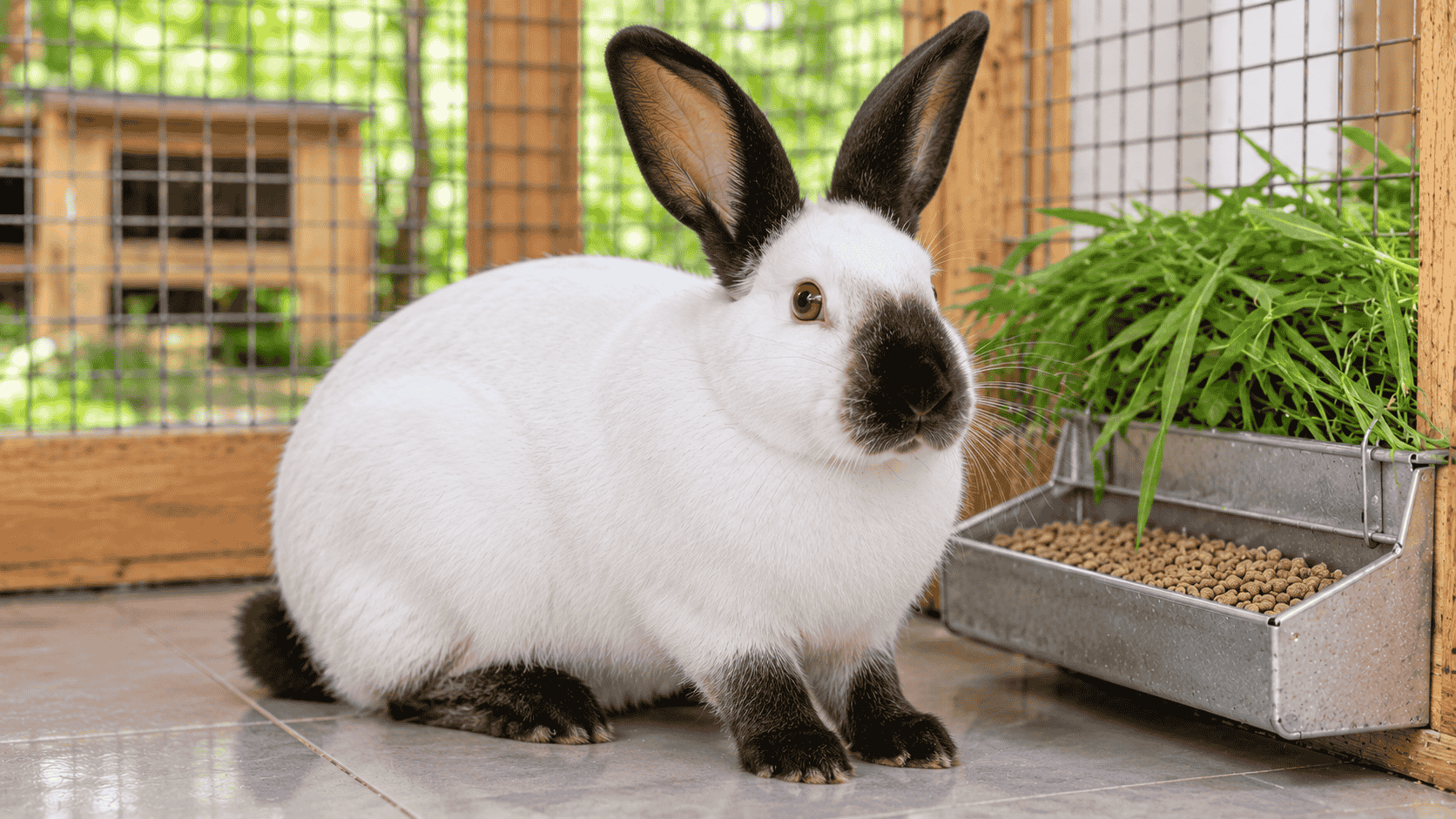
Californian rabbits are among the most productive, hardy, and visually striking dual-purpose rabbit breeds you can raise. Recognised instantly by their crisp snow-white body paired with dark charcoal or black markings on the nose, ears, feet, and tail, adult Californian rabbits weigh between 3.6 kg and 4.8 kg and carry an exceptionally high meat-to-bone ratio. Their compact, heavily muscled frame and calm nature make them a favourite on commercial farms across Ghana and internationally, while also appealing to backyard breeders and families who want a sturdy, low-maintenance companion.
Developed specifically for efficient meat production and dense commercial pelts, Californians thrive when you give them high-fibre nutrition, well-ventilated shaded housing, and disciplined breeding management. Whether you are stocking a new backyard rabbitry in Accra, Kumasi, Sunyani, or Tamale, planning a crossbreeding programme with New Zealand Whites, or keeping a Californian as an indoor pet in the UK, this guide covers the breed’s physical traits, temperature-sensitive coat markings, housing standards, daily feeding rations, growth benchmarks, breeding schedules, Ghanaian climate tips, and common health risks.
Origin and History of the Californian Rabbit Breed
George S. West of Lynwood, California, began developing the Californian rabbit in 1923 with a clear practical goal: creating a rabbit that combined a superior meat carcass with a dense, high-value white pelt. He crossed Himalayan rabbits (known for their compact frame and dark point markings) with Standard Chinchillas (prized for meaty flesh and coat density), and then crossed the offspring with New Zealand White rabbits to boost adult body size, litter size, and growth speed.
After five years of selective breeding, West first exhibited the breed in 1928, and the American Rabbit Breeders Association (ARBA) granted official recognition in 1939. Today, the Californian stands alongside the New Zealand White as one of the top two commercial meat breeds worldwide. Farmers value Californians for four consistent strengths:
- Exceptional meat-to-bone ratio: Californians carry a slightly smaller, finer skeleton than New Zealand Whites while packing deep, firm muscle across the shoulders, loin, and hindquarters, routinely achieving dressed carcass yields of 54% to 60% of live weight.
- Efficient feed conversion: Because mature adults are slightly more compact (3.6 kg to 4.8 kg) than giant breeds, breeding stock consume less maintenance feed per day while still producing fast-growing market fryers.
- Resilient, hardy constitution: Well-bred Californian lines tolerate warm shaded environments well and adapt smoothly to balanced pellet-and-forage rations.
- Distinctive appearance: Their Himalayan-style dark points make them easy to recognise and popular with buyers looking for purebred breeding stock or striking family pets.
Californian Rabbit Breed Profile at a Glance
Review the key physical and production specifications below before selecting starter Californian stock for your home or rabbitry.
| Breed Trait | Standard Specification | Practical Management Note |
|---|---|---|
| Adult Buck Weight | 3.6 kg to 4.5 kg (8 to 10 lb) | Keep breeding bucks lean (Body Condition Score 3/5) to maintain high libido and fertility |
| Adult Doe Weight | 3.9 kg to 4.8 kg (8.5 to 10.5 lb) | Compact, blocky commercial build with broad, plump hindquarters |
| Coat & Markings | Pure white dense flyback fur with dark black/charcoal nose, ears, feet, and tail; ruby-pink eyes | Low-maintenance short coat; dark points lighten slightly in hot weather and darken in cool weather |
| Body Type | Commercial (plump, rounded, firm flesh over fine bones) | Requires solid resting tiles or plastic mats on wire floors to prevent sore hocks |
| Average Litter Size | 6 to 9 kits (occasionally 10+) | Provide a clean, dry 45 cm x 28 cm nest box on day 27 of pregnancy |
| Breeding Maturity | Does: 5 to 6 months (at least 3.4 kg); Bucks: 6 months | Avoid mating underage or underweight does, as early breeding cuts adult size and milk yield |
| Average Lifespan | 5 to 10 years (pet care); 2 to 3 years peak breeding life on farms | Spaying pet females by 6 to 12 months eliminates uterine cancer risk |
| Primary Uses | Commercial meat production, terminal crossbreeding sire, backyard homesteading, calm pet | Outstanding terminal sire when crossed with New Zealand White does |
Physical Characteristics, Point Markings, and Temperament
Californian rabbits carry the Himalayan temperature-sensitive albinism gene (ch). This fascinating genetic trait controls pigment production based on skin temperature: the warmer core of the body stays pure snow white, while the cooler extremities (nose, ears, paws, and tail) produce dark charcoal or jet-black melanin pigment. Their eyes are bright ruby-pink and lack dark iris pigment, so Californians prefer shaded, softly lit enclosures out of harsh direct sunlight.
Why Californian Markings Change With Weather and Age
First-time owners are often surprised when newborn Californian kits are born completely white with zero dark markings. Because a warm fur-lined nest stays around 32°C to 35°C, pigment enzymes stay inactive at birth. As kits grow fur and leave the warm nest around weeks 2 to 4, cooler air reaches their ears, nose, feet, and tail, and dark smoky points gradually appear, sharpening into rich black by 12 to 16 weeks of age. In hot Ghanaian dry-season weather above 32°C, adult Californian points often fade slightly to smoky grey-brown, then darken again during cooler rainy or Harmattan nights. That seasonal fading is completely normal and does not indicate poor genetics or illness.
Temperament and Handling
Californian rabbits are generally gentle, calm, and quiet, though they are often slightly shyer and more cautious around sudden loud noises than New Zealand Whites. Once you build a predictable feeding routine and speak softly before opening their hutch door, Californians settle rapidly and handle smoothly during weekly health checks. Like all domestic rabbits, intact teenage bucks and pregnant or nursing does can show territorial grunting or nipping if hands enter their shelter abruptly, so always approach calmly at eye level and support the chest and hindquarters firmly when lifting.
Housing, Cage Size, and Foot Protection
Although Californians are slightly more compact than New Zealand Whites, mature does still approach 4.5 kg to 4.8 kg. Cramped hutches restrict airflow, increase nest-box trampling, and cause rapid foot sores.
Recommended Housing Dimensions
- Commercial breeding doe compartment: Minimum 90 cm long x 60 cm to 75 cm deep x 50 cm high. This gives enough space for a 45 cm x 28 cm kindling nest box, external J-feeder, ceramic resting tile, and comfortable nursing posture.
- Commercial breeding buck compartment: Minimum 80 cm long x 60 cm deep x 50 cm high, separated from neighbouring bucks by solid timber or double wire mesh so they cannot bite noses or spray urine across cages.
- Weaned grower pen (4 to 6 fryers, 6 to 12 weeks): Minimum 120 cm long x 75 cm deep x 50 cm high, giving each growing kit at least 0.15 to 0.20 square metres to prevent crowding and coccidiosis.
- Companion pet Californian: Provide at least 3 m x 2 m x 1 m high permanent single-level living space (such as a large indoor folding exercise pen or rabbit-proofed room, or a 180 cm hutch permanently attached to a predator-proof run). Compare full welfare and farm enclosure charts in our guide on the best rabbit cage size and space requirements.
Flooring and Sore Hocks Prevention
Californians carry thick foot fur, yet a 4.5 kg rabbit sitting on bare 12 mm x 25 mm welded wire all day will eventually develop red, inflamed, bleeding sore hocks on its hind heels. Place a smooth 30 cm x 30 cm ceramic floor tile, perforated plastic rabbit resting mat, or clean removable wooden board inside every wire compartment. On solid indoor floors, lay washable cotton mats or woven seagrass rugs over smooth tiles so your Californian has firm grip without splaying its hind legs.
Feeding and Nutrition Guide by Life Stage
Californian rabbits have a strong feed conversion efficiency, meaning they put on lean meat rapidly when fed balanced protein (15% to 17% crude protein for growers and lactating does) paired with high indigestible fibre (at least 16% to 20% crude fibre) to keep hindgut fermentation running smoothly.
| Life Stage / Class | Daily Plain High-Fibre Pellets | Roughage (Dry Hay / Clean Wilted Grass) | Fresh Water Requirement |
|---|---|---|---|
| Adult pet or resting buck/doe (4.0 kg) | 90 g to 120 g daily (measured; avoid free-feeding to prevent obesity) | Unlimited clean dry grass hay or shade-wilted fibrous local grasses | 250 ml to 400 ml daily |
| Pregnant doe (days 15 to 31) | 140 g to 170 g daily (increase gradually over final 2 weeks) | Unlimited dry grass hay + small portions of wilted protein-rich leaves | 350 ml to 550 ml daily |
| Lactating doe with 6 to 9 kits | Free-choice (280 g to 400+ g daily by week 3 of nursing) | Unlimited fresh hay / wilted grasses topped up morning and evening | 600 ml to 1,100 ml daily |
| Weaned growing fryers (6 to 12 weeks) | Free-choice plain grower pellets (approx. 75 g to 125 g per fryer daily) | Unlimited dry grass hay or sun-cured local grass to prevent weaning bloat | 150 ml to 280 ml per fryer daily |
Practical Feeding Rules for Californians
- Keep breeding stock lean, not fat: Because Californians gain weight efficiently, resting does and bucks put on internal abdominal fat quickly if given unlimited pellets. Excess fat around the ovaries lowers conception rates and triggers kindling complications. Check ribs and spine weekly so adults stay at an ideal Body Condition Score of 3/5.
- Never skip long-stem roughage: Even on commercial farms using complete pellets, offering daily clean dry grass hay or well-wilted fibrous stems keeps caecal bacteria healthy, prevents boredom bar-chewing, and wears down continuously growing molar teeth.
- Avoid mouldy pellets and sudden switches: Store bagged pellets in sealed plastic drums off damp floors, smell every scoop for mustiness, and transition any new feed brand or green leaf gradually over 5 to 7 days.
Expected Growth Rate and Market Weight Benchmarks
Weighing kits weekly on a digital kitchen or parcel scale lets you identify your fastest-growing replacement breeders and spot nutritional or parasite bottlenecks early. Below are realistic average benchmarks for purebred Californian kits raised on quality high-fibre grower pellets plus clean dry roughage:
| Age | Expected Live Weight Range | Management Milestone |
|---|---|---|
| Birth (Day 1) | 50 g to 65 g | Born completely white, blind, and hairless inside fur-lined nest |
| 3 Weeks (21 Days) | 280 g to 370 g | Kits exit nest box, nibble dry hay/pellets; faint smoky nose and ear tips appear |
| 6 Weeks (42 Days) | 850 g to 1,150 g | Earliest commercial weaning window (if healthy and over 850 g) |
| 8 Weeks (56 Days) | 1,350 g to 1,700 g | Recommended low-stress weaning age and minimum pet rehoming age |
| 10 Weeks (70 Days) | 1,850 g to 2,200 g | Early market fryer range; sex all young rabbits accurately and separate bucks from does |
| 12 Weeks (84 Days) | 2,200 g to 2,650 g | Prime commercial market fryer weight (high 54% to 60% dressed carcass yield) |
| 5 to 6 Months | 3.4 kg to 4.2 kg | Breeding maturity for replacement does and bucks |
Notice that while a Californian fryer may weigh 100 g to 150 g less live at 12 weeks than a large New Zealand White fryer, its finer bone structure and thick loin muscling often deliver nearly the exact same weight of edible dressed meat, at a slightly lower total feed cost.
Breeding, Kindling, and Maternal Care
Californian does are capable, attentive mothers, though they can be slightly more sensitive to loud disturbances around kindling time than laid-back New Zealand White does. Quiet, predictable management keeps kit survival high.
Step-by-Step Mating and Kindling Protocol
- Wait for proper maturity and body weight: Mate Californian does at 5 to 6 months once they weigh at least 3.4 kg, and start young bucks around 6 months.
- Take the doe to the buck’s hutch: Always place the doe into the buck’s cage, never the reverse, to prevent territorial fighting. Observe one or two clear successful matings (where the buck falls sideways with a brief squeak), write down the mating date and buck ID on the doe’s cage card, and return her quietly to her own hutch.
- Provide the nest box on day 27: Gestation lasts 31 days on average (range 28 to 34 days). Place a clean, dry wooden nest box (45 cm x 28 cm x 25 cm high) packed halfway with soft dry straw or clean grass hay into the doe’s cage on day 27. Keep dogs, loud visitors, and sudden hammering away from the rabbitry during days 28 to 33 so the doe kindles calmly inside the box rather than scattering kits on the wire.
- Run brief 1-minute daily nest checks: Wash and warm your hands, distract the doe with a fresh stalk of wilted grass or safe herbs, remove any stillborn kits immediately, and verify every surviving kit has a warm, smooth, round belly. Follow full week-by-week neonatal care and weaning steps in our guide on how to care for baby rabbits safely during their first 8 weeks.
- Allow healthy recovery between litters: Re-breeding a doe 14 to 21 days after weaning (producing 4 to 5 litters per year, or roughly 28 to 40 weaned kits annually) protects her body condition, preserves strong milk flow, and extends her productive lifespan to 2.5 to 3 years.
Crossbreeding Californians with New Zealand White Rabbits
If you run a commercial meat rabbitry rather than a purebred pedigree show programme, crossing Californians with New Zealand Whites is one of the highest-return breeding strategies in agriculture. Combining two unrelated breeds triggers hybrid vigour (heterosis), where offspring grow faster, survive weaning stress better, and convert feed more efficiently than either purebred parent line alone.
| Crossbreeding Setup | Key Advantages | Recommended Use |
|---|---|---|
| New Zealand White Doe x Californian Buck (Most Popular) | Combines the NZW doe’s larger 8-to-10-kit litters and rock-solid mothering with the Californian buck’s compact, heavy-muscled loin and high carcass yield | Primary terminal meat production on commercial and backyard farms |
| Californian Doe x New Zealand White Buck | Produces uniform, fast-growing white and pointed hybrid fryers with strong feed conversion and lower doe maintenance feed cost | Effective alternative when you already own productive Californian does |
| Purebred Replacement Lines (Cal x Cal and NZW x NZW) | Maintains pure genetic traits so you never run out of true breeding parents | Keep 15% to 20% of your herd purebred to produce future replacement breeders rather than breeding hybrids together endlessly |
To balance both halves of a commercial crossbreeding programme effectively, compare housing, weights, and breeding benchmarks in our full New Zealand White rabbits characteristics and farming guide.
Raising Californian Rabbits in Ghana and Warm Climates
Californian rabbits perform strongly across Ghana (in Accra, Tema, Kumasi, Takoradi, Cape Coast, Sunyani, and Tamale) provided you adapt feeding, cooling, and biosecurity to local tropical conditions:
- Pair shade-wilted local Ghanaian forages with balanced pellets: Californians forage efficiently on clean local plants including guinea grass (Panicum maximum), elephant grass, Tridax procumbens, sweet potato vines, and moderate amounts of young moringa leaves. Always harvest away from roadside herbicides, rinse dusty leaves, and wilt fresh cut grass in the shade for 4 to 8 hours before feeding alongside a measured daily ration of mould-free commercial grower pellets. Review safe local plants and poisonous weeds in our guide on what rabbits eat in Ghana and safe local foods.
- Protect fertility and comfort during dry-season heat (November to April): When afternoon shade temperatures pass 32°C to 36°C, Californian bucks can experience temporary heat-induced infertility for 4 to 6 weeks, and heavily pregnant does face acute heatstroke risk. Position hutches in 100% deep shade inside tall, open-sided insulated sheds, place smooth ceramic floor tiles inside every compartment, refresh cool water twice daily, and feed main pellet rations at 6:00 AM and 6:00 PM. Apply all ten tropical cooling steps in our guide on how to keep rabbits cool in hot weather.
- Do not panic when dark points fade in hot months: During peak dry-season heat in Accra or Tamale, your Californians’ black ears and noses may fade to light smoky grey because warm skin suppresses pigment formation. Once cooler rainy-season nights return (May to August), the dark charcoal markings come right back.
- Guard against rainy-season coccidiosis (April to July and September to October): Keep nest boxes and grower cages bone-dry, use external J-feeders and raised hay racks so kits never eat droppings off the floor, and keep your District Veterinary Officer’s phone number saved before an outbreak happens.
For further international technical data on commercial meat rabbit genetics, nutrition, and tropical production systems, you can consult the Food and Agriculture Organization (FAO) rabbit production and breeding handbook.
Common Health Risks and Preventive Care
Californian rabbits are genetically sturdy and rarely suffer the inherited flat-face dental deformities common in miniature dwarf breeds. Even so, keep a close weekly watch for five preventable conditions:
- Sore hocks (ulcerative pododermatitis): Heavy muscling on bare wire floors or damp bedding wears away heel fur quickly. Keep a smooth ceramic resting tile or plastic mat in every wire cage and trim nails every 4 to 6 weeks.
- Intestinal and liver coccidiosis (kits aged 4 to 12 weeks): Damp hutches and floor feeding spread Eimeria parasites rapidly after weaning. Remove manure daily, sanitise cages between litters with boiling water or steam, and contact a veterinarian urgently if weaned kits show watery diarrhoea, sunken eyes, or pot-bellied wasting.
- Respiratory infections (snuffles / pasteurellosis): Poor airflow and ammonia buildup from urine-soaked drop trays trigger sneezing and thick white nasal discharge. Ensure open cross-ventilation and quarantine all newly purchased stock for 21 to 30 days.
- Ear mites (Psoroptes cuniculi): Inspect inside both dark-furred ear flaps every week for dry, crusty brown scabs or head shaking. Never scrape crusts off bare-handed; have a veterinarian treat mites safely with rabbit-safe antiparasitic drops or injections.
- Heat stress and uterine cancer (in pet females): Provide strong summer shade and airflow, and spay companion pet females between 6 and 12 months of age to eliminate uterine cancer risk later in life.
7 Common Mistakes When Raising Californian Rabbits
Avoid these seven frequent pitfalls to keep your Californian herd healthy and profitable:
- Mistaking pale summer markings for mixed-breed genetics: Beginners sometimes cull or reject purebred Californians in hot tropical months because their black points look faded grey. Evaluate body type, muscling, growth rate, and pedigree records rather than seasonal colour shade alone.
- Overfeeding resting breeding does until they become obese: Californians convert feed very efficiently. Free-feeding pellets to non-nursing does leads straight to internal fat deposits, missed conceptions, and small litters.
- Disturbing a kindling Californian doe repeatedly: Because Californians can be slightly shyer than New Zealand Whites, noisy visitors, barking dogs, or constant peeking on day 31 can stress a first-time mother into scattering her litter outside the nest box. Keep kindling areas calm and quiet.
- Breeding sibling hybrids together generation after generation: Crossing Californian x New Zealand White produces outstanding first-generation meat fryers, yet breeding those crossbred siblings back together quickly causes inbreeding depression and uneven litter weights. Always breed purebred lines or bring in unrelated bucks every 18 to 24 months.
- Housing 4.5 kg adults on bare wire without a resting surface: Sore hocks cause severe pain, lower feed intake, and make bucks refuse to mate. Always provide a ceramic tile or plastic resting mat.
- Weaning kits at 4 weeks to rush the next litter: Early weaning destroys gut flora and causes heavy post-weaning mortality. Wait until 6 to 8 weeks once kits weigh at least 850 g to 1,000 g and eat dry hay and pellets reliably.
- Skipping 21-to-30-day quarantine for newly bought breeding stock: Introducing one untreated market rabbit carrying silent snuffles or ear mites can wipe out months of careful farm progress.
Frequently Asked Questions About Californian Rabbits
1. How big do Californian rabbits get?
Adult Californian bucks weigh 3.6 kg to 4.5 kg (8 to 10 lb), while adult does weigh 3.9 kg to 4.8 kg (8.5 to 10.5 lb). They have a compact, blocky, heavily muscled commercial build with finer bones than New Zealand Whites.
2. Are Californian rabbits good for beginners?
Yes. Californian rabbits are hardy, low-grooming, calm, and efficient converters of feed, making them one of the top starter breeds for backyard and commercial rabbit farming as well as sturdy indoor pets for owners who have room for a 4 kg to 4.5 kg rabbit.
3. Why are baby Californian rabbits born completely white?
Californians carry a temperature-sensitive albinism gene. Because newborn kits stay very warm (32°C to 35°C) inside their fur-lined nest box, dark pigment does not activate at birth. Once kits grow fur and explore cooler air around 2 to 4 weeks old, their signature dark charcoal markings develop naturally on the cooler ears, nose, feet, and tail.
4. Which is better for farming: Californian or New Zealand White rabbits?
Both breeds are top-tier commercial performers with complementary strengths. New Zealand Whites typically have slightly larger litters (7 to 10 kits) and very strong mothering instincts, while Californians have an exceptionally high meat-to-bone ratio and slightly lower adult maintenance feed costs. Many commercial farms keep both and cross New Zealand White does with Californian bucks to get the best of both breeds.
5. How many babies does a Californian rabbit have per litter?
A healthy, well-managed Californian doe typically kindles 6 to 9 kits per litter (occasionally 10 or more). Providing a quiet environment, a clean 45 cm x 28 cm nest box on day 27, and balanced nutrition without letting the doe become overweight maximises litter size and survival.
6. How long does it take a Californian rabbit to reach market weight?
On a balanced diet of high-fibre grower pellets paired with clean dry hay or wilted local grasses, Californian fryers typically reach a prime market weight of 2.0 kg to 2.5 kg in 10 to 12 weeks, yielding a high 54% to 60% dressed carcass percentage.
7. Can Californian rabbits tolerate Ghana’s hot weather?
Yes. Californians adapt well to Ghana’s warm climate when housed in 100% continuous deep shade with open welded-wire cross-ventilation, insulated roofs, cool ceramic resting tiles, and fresh cool water refreshed twice daily. Expect their dark points to lighten slightly during hot dry-season afternoons and darken again in cooler weather.
8. Do Californian rabbits make good indoor house pets?
Yes. Californian rabbits are gentle, quiet, curious, and easy to litter train. Because they are a medium-large breed (around 4 kg to 4.5 kg), give them a roomy indoor exercise pen or rabbit-proofed room with soft non-slip mats to protect their heels, spay or neuter them to calm hormones and prevent uterine cancer, and build floor-level trust patiently so shy individuals blossom.
Managing a Healthy, Productive Californian Rabbit Herd
Californian rabbits deliver an ideal balance of compact frame, heavy meat muscling, efficient feed conversion, and calm, manageable temperament. Whether you raise purebred Californians for breeding stock, use Californian bucks as terminal sires over New Zealand White does for commercial meat production in Ghana, or welcome one into your home as a distinctive companion pet, their care stays straightforward and rewarding.
Focus on roomy shaded hutches with solid ceramic resting tiles, measure pellets carefully for resting adults while feeding nursing does and growers generously alongside unlimited dry roughage, keep kindling areas quiet, and track weekly kit weights and parentage records clearly. With steady hygiene and smart hot-weather protection, your Californian rabbits will reward you with lean growth, strong litters, and reliable performance year-round.
