

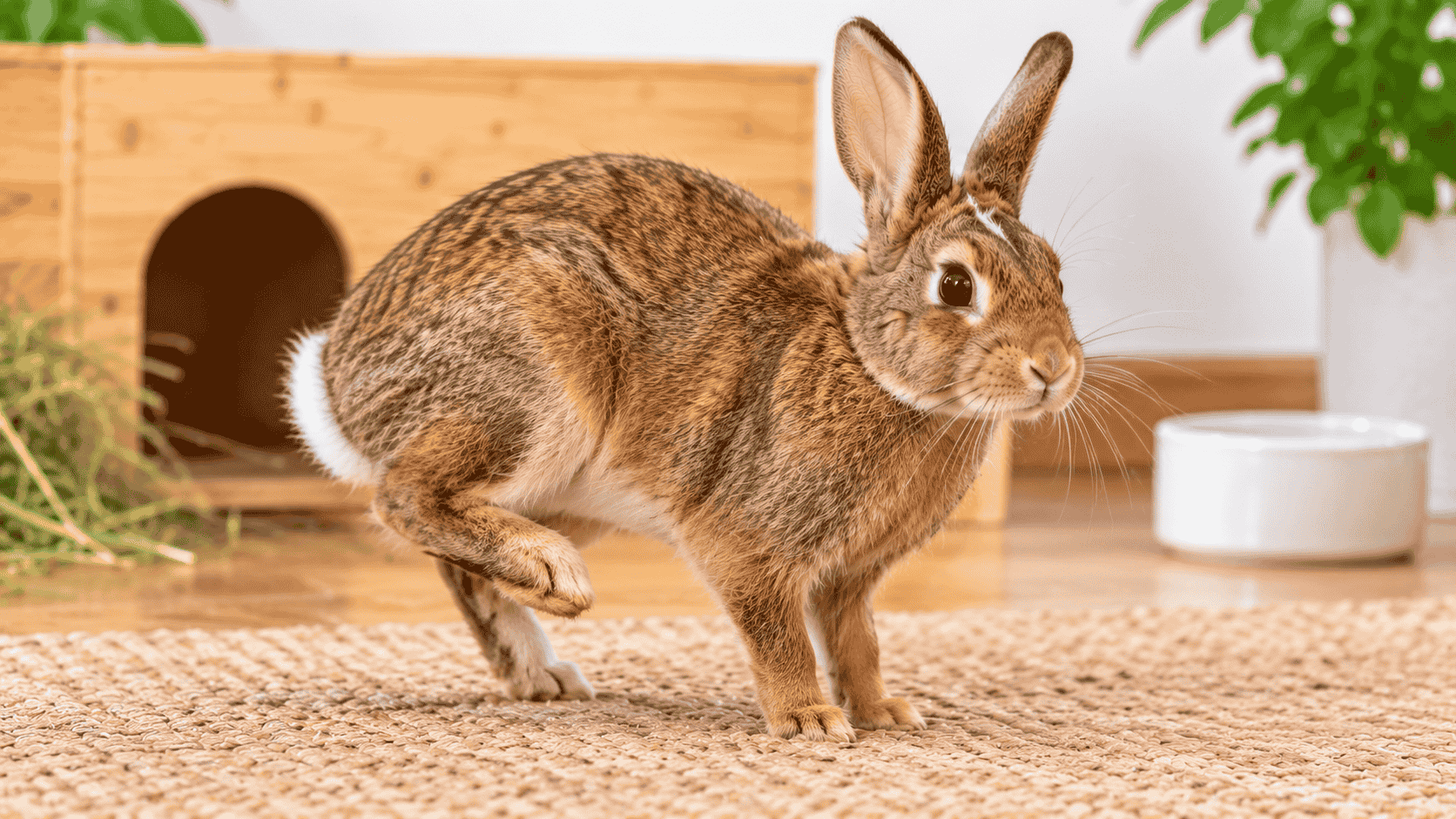
If you have ever jumped out of your seat at a loud bang coming from your rabbit’s enclosure at 2:00 AM, you have probably asked yourself why do rabbits thump their feet. That sharp, drum-like slam of the powerful hind legs against the floor is one of the most unmistakable sounds a domestic rabbit makes. In the wild, a single thump warns the entire warren that a fox, snake, or hawk is nearby. Domestic rabbits carry the exact same instinct inside your living room or backyard hutch.
Foot thumping is rarely random. Your rabbit may be warning you about an unfamiliar smell, reacting to a stray cat outside the window, expressing frustration because dinner is late, or signalling sudden physical pain. Whether you keep an indoor house rabbit in Accra, manage breeding hutches in Kumasi or Tamale, or share your home with pet rabbits in the UK, learning to decode thumping alongside ear angles, posture, and vocal sounds turns confusing moments into clear communication. This guide explains the eight main reasons rabbits thump, breaks down full rabbit body language, shows you what to do step by step during a thumping episode, addresses nighttime and Ghanaian climate triggers, and clarifies when thumping signals a veterinary emergency.
The Natural Instinct Behind Rabbit Foot Thumping
Wild European rabbits (Oryctolagus cuniculus, the direct ancestor of every domestic pet and farm rabbit) live in underground tunnel networks called warrens. Because rabbits have quiet voices compared to dogs or birds, shouting an alarm call would expose their exact location to a predator. Instead, evolution equipped them with long, muscular hind legs capable of striking the earth hard enough to send low-frequency vibrations straight through the soil.
Those ground vibrations travel quickly through underground tunnels, alerting every other rabbit in the colony to freeze or bolt for cover. Even when your pet rabbit lives safely indoors on ceramic tiles or a wooden hutch floor, its brain still runs this ancient safety software. When something looks, smells, or sounds suspicious, your rabbit alerts you (the fellow member of its “warren”) by slamming one or both hind feet down sharply.
8 Common Reasons Why Rabbits Thump Their Feet
While danger is the original evolutionary purpose, domestic rabbits use thumping in several distinct situations. Context and accompanying body language tell you which message your rabbit is sending.
1. Perceived Danger or Predator Presence
This is the number one reason rabbits thump. Rabbits possess far sharper hearing and smell than humans. Your rabbit can hear a stray dog walking down the street, smell a cat on the veranda, spot a hawk flying across a window, or detect a rat moving behind a backyard hutch long before you notice anything. A fear-driven thump is usually accompanied by wide eyes, upright ears swivelling toward the threat, rapid nose twitching, and a frozen or crouched stance ready to sprint.
2. Sudden, Unfamiliar Noises or Shadows
A dropped cooking pot, a slamming gate, a loud motorcycle exhaust outside, a blender starting up, or a sudden ceiling-fan shadow passing overhead can all trigger an instant alarm thump. Rabbits dislike unpredictability. Even moving a large piece of furniture or bringing home a rustling plastic bag that smells unfamiliar can set off several warning thumps until your rabbit inspects the object safely.
3. Strong or Strange Smells
Because rabbits rely heavily on scent to detect predators, unusual odours frequently cause thumping. Common culprits include cooking meat or frying fish in the kitchen, strong bleach or floor disinfectants, perfume, cigarette smoke, or the scent of another dog, cat, or unfamiliar rabbit carried home on your shoes and clothes.
4. Annoyance, Displeasure, or Frustration
Rabbits have strong personalities and quickly learn that thumping gets human attention. A rabbit may deliver a crisp, dramatic thump right after you put it back in its pen, trim its nails, wipe its chin, move its favourite hideout box, or serve evening pellets ten minutes late. Annoyance thumps look noticeably different from fear thumps: your rabbit will often hop a few steps away, flick its back feet dismissively in the air as it leaves, turn its back squarely toward you, and glance over its shoulder to make sure you noticed its protest.
5. Territorial Warnings and Hormonal Agitation
Rabbits guard their hutch, pen, food bowls, and bonded companions fiercely. An intact (unneutered or unspayed) rabbit aged 4 to 12 months may thump loudly when a hand enters its cage, when another rabbit walks past its bars, or during a false pregnancy when a doe guards her nest. If territorial thumping escalates into lunging, grunting, or nipping, review our guide on why rabbits bite and how to stop territorial aggression humanely.
6. Discomfort After Stressful Handling
Most rabbits dislike being lifted off the ground because losing solid footing mimics capture by a predator. If you pick a rabbit up abruptly or carry it without full hindquarter support, it will frequently thump loudly the moment you set it back down on the floor to release built-up adrenaline and tell you it hated the experience. Switching to calm, spine-supporting grips outlined in our guide on how to handle a rabbit safely without causing stress cuts post-handling thumping dramatically.
7. Physical Pain, Bloating, or Illness
Rabbits do not whimper or bark when they hurt. Occasionally, a rabbit experiencing sudden sharp internal pain (such as gas cramping in early gastrointestinal stasis, urinary tract pain, or ear discomfort) will thump repeatedly while sitting alone in a quiet room with no external threat present. Pain-related thumping is usually paired with hunched posture, narrowed eyes, refusal to eat, or loud tooth grinding.
8. Mating Behaviour and Social Excitement
In breeding rabbitries or homes with unneutered rabbits, a buck sometimes thumps once or twice right after mating or while courting a receptive doe nearby. Bonded rabbits may also exchange a brief thump during mild hierarchy squabbles over a food dish or resting spot.
Complete Guide to Rabbit Body Language: Ears, Eyes, Posture, and Sounds
Foot thumping is only one word in your rabbit’s vocabulary. Reading your rabbit’s ears, eyes, body posture, tail, and vocal sounds together gives you the full sentence every time.
Physical Body Language Signals
| Signal or Behaviour | What It Looks Like | What Your Rabbit Is Communicating |
|---|---|---|
| Ears upright and angled forward | Both ears held high, facing toward a sound or person (or gently lifted at the base in lop breeds) | Curious, alert, and interested in what is happening |
| Ears pinned tightly back | Ears pressed flat along the neck and shoulders with a tense body | Fear, anger, or an imminent defensive lunge; give space immediately |
| Relaxed resting ears | Ears resting loosely backward over the shoulders while eyes are soft and body is loose | Calm, sleepy, and completely comfortable (very different from tense pinned ears) |
| The “bunny flop” | Rolling suddenly onto the side with legs stretched out and belly exposed | Deep relaxation and complete trust in the environment |
| Binky | Running fast and leaping into the air with a joyful twist of the head and hind legs | Pure excitement, happiness, and playful energy |
| Chinning | Rubbing the underside of the chin onto furniture, toys, bowls, or your shoes | Calm territorial claiming using scent glands (“this belongs to me”) |
| Foot flicking | Hopping away while kicking both hind feet backward toward you | Mild annoyance or insult (“I am upset with you right now”) |
| Rigid hunched ball | Sitting tightly bunched with belly pressed to the floor, half-closed eyes, and tense flanks | Physical pain, abdominal gas, or illness; check appetite and droppings promptly |
| Wide eyes showing white rims | Eyes bulging slightly with white sclera visible around the dark iris; frozen posture | High fear or panic; remove the trigger and speak calmly |
Common Rabbit Sounds and What They Mean
- Soft tooth purring: A quiet, gentle clicking or light grinding of the teeth while being stroked on the forehead. Signals deep contentment.
- Loud, harsh tooth grinding (bruxism): Noticeably louder, crunchier grinding while sitting hunched and alone. Signals severe pain and requires veterinary attention.
- Honking or oinking: Soft, rhythmic honking noises while circling your feet. Signals excitement for food, affection, or hormonal courtship.
- Grunting or growling: Short, low snorting sounds paired with flattened ears. Signals territorial warning (“stay back”).
- Whimpering or soft squeaking: High-pitched nervous noises heard mostly in frightened young kits or pregnant does who dislike being touched.
- Screaming: A loud, piercing shriek heard only during extreme terror, predator attack, or severe acute injury. Always investigate and check for injury immediately.
Why Do Rabbits Thump at Night?
Nighttime thumping is one of the most common puzzles for rabbit owners. You are fast asleep in a silent house, yet suddenly your rabbit slams its foot every thirty seconds for five minutes straight. Understanding rabbit biology explains why nights trigger far more thumps than afternoons:
- Rabbits are crepuscular: Rabbits are naturally most alert and active at dusk, dawn, and during early nighttime hours. When the house goes quiet, every tiny sound outside stands out starkly.
- Nocturnal wildlife and pests come out after dark: Rats, mice, stray cats, geckos, owls, or neighbourhood dogs patrol compounds and gardens mainly at night. Your rabbit’s large ears pick up footsteps on a tin roof or scratching near a fence long before a sleeping human hears a sound.
- Moving shadows and car headlights: Passing headlights sweeping across a bedroom wall or tree branches moving in the night breeze create sudden predator-like shadows across the floor.
- Darkness without a familiar hideout: Although rabbits see well in dim twilight, pitch-black rooms make sudden sounds harder to locate. Providing a sturdy wooden or cardboard hideout box with two doorways gives your rabbit a safe burrow to retreat into instead of panicking in the open.
If your rabbit thumps repeatedly at night, turn on a soft low light, check windows, doors, and hutch wire mesh carefully for pests or stray animals, speak quietly so your rabbit hears your familiar voice, and avoid shouting or turning on harsh overhead lights suddenly.
What to Do Step by Step When Your Rabbit Thumps
How you react in the first sixty seconds after a thump teaches your rabbit whether you are a calm protector or another source of panic. Follow these five steps:
- Pause and scan the environment calmly: Do not rush over or grab your rabbit. Look quietly around the room or compound for what triggered the alarm: an open window, a stray cat on the wall, a rat near the feed drum, a strong kitchen smell, or a barking dog.
- Acknowledge the warning in a soft, steady voice: Speak gently using your rabbit’s name (“It’s okay, you’re safe”). Hearing your calm voice reassures your rabbit that you heard its warning and that no predator is attacking.
- Remove or block the trigger if possible: Close the curtain if a cat or bird is outside the glass, shut the kitchen door while frying food, chase away stray animals safely, or turn down loud television audio.
- Observe posture and offer a small distraction once alert levels drop: Sit quietly at floor level a metre away. After a minute or two, offer a fresh sprig of coriander, parsley, or a pinch of fragrant hay. A rabbit that relaxes its ears, sniffs the herb, and starts munching was simply startled or mildly annoyed.
- Check for hidden pain if thumping continues with no obvious trigger: If your rabbit refuses favourite food, sits rigidly hunched, has cold ears, or has not passed normal round droppings for several hours, move immediately to a calm health check rather than assuming it is just stubbornness.
Common Thumping Triggers in Ghana and Warm Climates
Rabbit keepers in Accra, Kumasi, Takoradi, Cape Coast, Sunyani, and Tamale face specific environmental triggers that explain many sudden thumping episodes in both indoor pens and backyard rabbitries:
- Nocturnal rats, snakes, and roaming compound dogs: In backyard wooden or wire hutches, sudden midnight thumping is often a genuine lifesaving alarm warning you that a rat, stray cat, or snake is near the rabbitry. Never ignore repeated late-night thumping from outdoor hutches. Take a torch, inspect the perimeter carefully, seal any gaps larger than 12 mm with sturdy galvanised wire mesh, and keep bagged pellets stored in tightly sealed plastic drums so rodents are not attracted to the area.
- Heavy tropical thunderstorms and rain on metal roofs: During Ghana’s major and minor rainy seasons (April to July and September to October), sudden thunderclaps and roaring rain pounding onto bare corrugated zinc sheets terrify rabbits. Adding thatch, bamboo matting, or ceiling board insulation beneath metal roofs dampens rain noise dramatically while keeping hutches cooler.
- Generator noise and sudden power outages: The abrupt roar of a backup generator starting up near a backyard hutch, or sudden silence when a cooling fan stops during a power cut, frequently triggers alarm thumping. Position hutches well away from generator exhaust fumes and vibration.
- Harmattan wind gusts and rattling gates: Dry, dusty Harmattan winds (December to February) slam loose compound gates and rustle polythene bags loudly across yards, keeping outdoor rabbits jumpy. Secure loose shutters and provide windbreak tarpaulins or wooden shields on the windward side of open hutches.
- Fireworks and festive celebrations: During December holidays and local festivals, firecrackers and loud street music cause severe panic in rabbits. Bring pet rabbits into an interior room away from street-facing windows, play gentle background radio noise to mask sharp bangs, and provide extra cardboard hideouts stuffed with hay.
How to Reduce Stress-Related Thumping Long Term
You should never try to “train out” thumping completely, because thumping is a natural, healthy communication tool. However, if your rabbit thumps constantly out of daily anxiety, improving its living setup and trust level will make it noticeably calmer:
- Provide two-door hideout shelters: Every rabbit needs at least one dark, cosy hideout box with two exits so it can retreat safely whenever a noise startles it.
- Place enclosures away from high-traffic walkways: Position indoor pens against a solid wall rather than in the centre of a busy corridor where people constantly walk past from all four sides.
- Build daily floor-level trust: Rabbits that trust their owners recover from startling noises in seconds instead of hiding for hours. Spend 15 to 20 quiet minutes sitting at floor level each day using the steps in our guide on how to bond with your rabbit and build lasting confidence.
- Keep routines predictable: Feed pellets, top up fresh hay or wilted grasses, and clean litter trays around the same times morning and evening so your rabbit feels secure in its daily rhythm.
- Use calm voice cues before approaching: Speak softly before stepping around a corner or opening a hutch door so you never ambush a sleeping rabbit.
- Consider spaying or neutering for hormonal rabbits: If teenage hormones are driving intense territorial thumping, grunting, and circling, neutering through a rabbit-experienced veterinarian usually brings calmer, steadier behaviour within 4 to 8 weeks.
Common Mistakes Owners Make When a Rabbit Thumps
Reacting poorly to a thump can accidentally increase fear or even injure your rabbit. Avoid these five common errors:
- Shouting “Stop!” or clapping at a thumping rabbit: Loud scolding confirms to your rabbit that danger is truly present, triggering even harder, faster thumping and breaking trust.
- Rushing over and picking up a frightened rabbit to comfort it: Unlike dogs, scared rabbits hate being grabbed off the ground. Lifting a panicked rabbit spikes its heart rate and risks a violent kick that can injure its fragile spine. Comfort your rabbit calmly at floor level instead.
- Ignoring repeated nighttime thumping in outdoor hutches: Outdoor rabbits rarely thump loudly at 2:00 AM for no reason. Checking the hutch promptly with a torch has saved countless litters from rats, driver ants, and stray dogs.
- Keeping rabbits on bare wire floors where hard thumping bruises heels: Repeated forceful thumping on bare metal mesh bruises the bones of the hind feet and accelerates painful sore hocks. Always place solid plastic resting mats, wooden boards, or thick dry bedding inside every enclosure.
- Assuming every thump is “attitude” without checking appetite and droppings: Dismissing persistent thumping as a bad mood can cause you to miss early GI stasis, gas pain, or urinary discomfort until an emergency develops.
When Foot Thumping Means Pain or Illness (When to Call a Vet)
While most thumps reflect external noise, smells, or mild annoyance, persistent thumping paired with physical warning signs points to pain or internal distress. Always run through a quick baseline check using our guide on checking the signs of a healthy rabbit at home whenever thumping seems unusual or lasts longer than ten minutes in a quiet room.
Contact a veterinarian promptly if foot thumping is accompanied by any of these warning signs:
- Refusing favourite herbs, hay, or pellets for 10 to 12 hours (review urgent steps in our guide on what to do when your rabbit is not eating).
- Smaller, fewer, or absent faecal pellets, or watery diarrhoea.
- A tight, bloated belly, hunched rigid posture, or loud harsh tooth grinding.
- Straining in the litter box, squeaking while urinating, or blood-tinted urine droplets.
- Limping, holding up a hind foot, or bleeding sores on the heels after repeated hard thumping.
- Sudden head tilt, rapid open-mouth breathing, or collapse.
For further veterinary-reviewed advice on rabbit behaviour, stress triggers, and welfare standards, you can consult the PDSA veterinary guidance on rabbit behaviour and welfare.
Frequently Asked Questions About Why Rabbits Thump
1. Why does my rabbit thump at nothing?
Even when a room looks completely quiet to you, your rabbit is rarely thumping at nothing. Rabbits hear much higher frequencies and detect far fainter scents than humans. A stray cat walking outside, a mouse in the wall, cooking smells from a neighbour’s kitchen, or a distant dog bark can all trigger a warning thump that humans never notice.
2. Is it bad if my rabbit thumps a lot?
An occasional thump when startled by a loud noise or annoyed after nail trimming is completely normal rabbit behaviour. However, if your rabbit thumps multiple times every single day, it signals chronic stress, an uncomfortable environment (such as a predator nearby or noisy location), territorial frustration, or hidden physical pain that you should investigate promptly.
3. Can a rabbit hurt its feet by thumping too hard?
Yes. Rabbits strike the ground with remarkable force. Occasional thumping on a soft rug, mat, or thick bedding is harmless, though repeated heavy thumping on bare wire mesh, rough concrete, or hard tiles can bruise the heels, split toenails, or trigger painful sore hocks. Always provide soft, non-slip resting surfaces.
4. Why does my rabbit thump after I put it back in its cage?
This is a classic displeasure thump. Your rabbit is expressing frustration that its free-roaming time ended or protesting the feeling of being picked up. Make returning to the enclosure positive by guiding your rabbit back in with a trail of measured pellets or fresh herbs instead of grabbing it abruptly.
5. Do happy rabbits ever thump their feet?
Occasionally, yes. While thumping mainly signals alarm, annoyance, or pain, some excitable rabbits deliver a single sharp thump right in the middle of energetic zoomies, during playful chasing, or while excited about a companion. Look at the rest of the body language: loose ears, binkies, and playful hopping mean excitement, whereas wide eyes and frozen posture mean fear.
6. Why does my rabbit thump when I leave the room?
Some bonded house rabbits thump once or twice when their owner walks away or turns off the lights at bedtime, especially if they are used to company or expect an evening snack. Giving your rabbit a fresh pile of fragrant hay and a safe chew toy right before leaving helps it settle calmly.
7. How do I calm a thumping rabbit down?
Stay calm, lower your posture, speak in a gentle steady voice, and check for obvious triggers like stray animals, loud noises, or strong smells. Give your rabbit space to retreat into its hideout box rather than grabbing it, and once its ears relax, offer a small sprig of safe herbs or fresh hay.
8. Should I punish my rabbit for thumping at night?
Never punish, shout at, or spray water on a thumping rabbit. Thumping is an involuntary survival alarm and communication tool, not bad behaviour. Punishing a frightened rabbit destroys trust and increases anxiety, leading to even more fearful thumping and defensive biting.
Listening to What Your Rabbit Is Telling You
Foot thumping is your rabbit’s clearest way of speaking up when something in its world feels threatening, frustrating, or painful. Rather than viewing a loud thump as a nuisance, treat it as helpful feedback. Pause calmly, check your surroundings for hidden noises, scents, or nocturnal pests, and read the full picture through your rabbit’s ears, eyes, and posture.
When you respond with a gentle voice, a secure two-door hideout, non-slip flooring, respectful handling, and prompt health checks whenever thumping pairs with hunched posture or lost appetite, you prove to your rabbit that its warnings are heard. That steady reassurance turns an anxious, jumpy prey animal into a relaxed, confident companion.
