

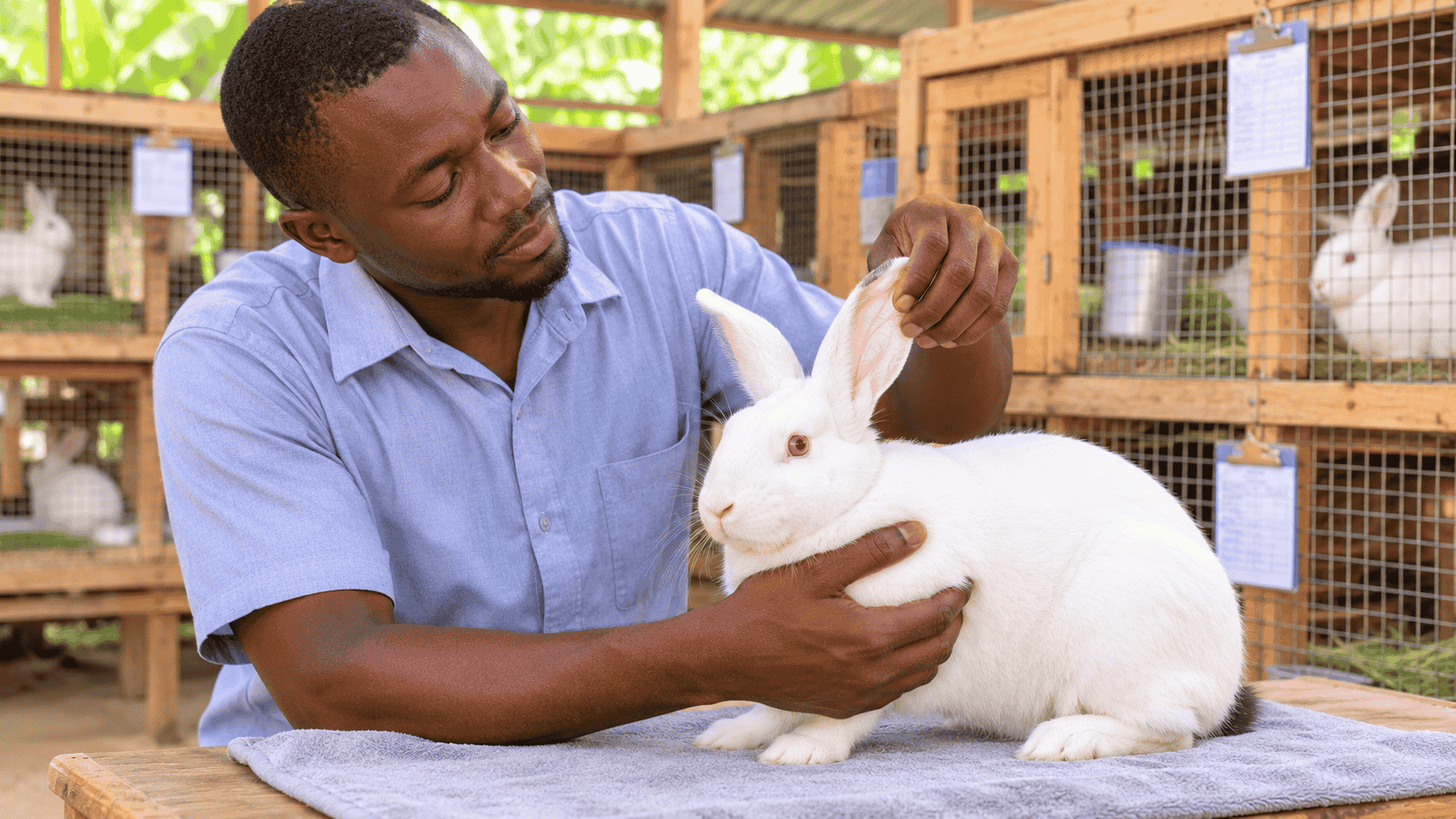
Knowing how to choose healthy rabbits for breeding is the single most important financial and welfare decision you will make when starting or expanding a rabbitry. One sick or genetically weak rabbit brought into your shed can introduce bacterial snuffles, crusty ear mites, or intestinal coccidiosis across your entire herd within weeks. Even worse, buying inbred or stunted breeding stock locks you into small litters, slow fryer growth, and high kit mortality for years.
You do not need a veterinary degree to evaluate foundation stock accurately, though you do need a disciplined physical inspection checklist and the patience to walk away from a bad deal. Whether you are buying your first starter trio in Accra, Kumasi, Sunyani, or Tamale, replacing an older herd buck on a commercial farm, or selecting purebred breeding stock in the UK, this buyer’s guide shows you how to evaluate a farm before touching a rabbit, perform a complete 10-point head-to-tail physical check, verify sex and reproductive readiness accurately, spot hidden red flags, transport new rabbits safely, and run a strict 30-day quarantine.
How Starter Stock Determines Rabbitry Success
In rabbit farming, your entire herd inherits its speed of growth, litter size, milk yield, and disease resistance directly from your original breeding buck and does. A single healthy breeding doe can produce 30 to 45 weaned kits per year, while one fertile buck can sire 200 or more kits annually across a small colony. If you buy a cheap, underweight doe with crooked incisors or a buck carrying silent respiratory bacteria, you multiply those exact flaws across dozens of offspring.
Paying slightly more up front for documented, vigorous, disease-free stock from a clean breeder almost always costs less in the long run than buying bargain rabbits from an unverified roadside market and losing half your first litters to coccidiosis or snuffles.
Choosing the Right Breed, Age, and Buck-to-Doe Ratio
Before visiting any farm, decide clearly on your target breed, ideal purchase age, and starting herd structure so a persuasive seller does not talk you into unsuitable animals.
Best Breeds for Breeding Programmes
For commercial meat production and backyard farming in warm climates, prioritise hardy, short-coated medium-large breeds with high meat-to-bone ratios and strong mothering instincts. The two proven global leaders are the New Zealand White rabbit (prized for large 7-to-10-kit litters, calm temperament, and dependable nursing) and the Californian rabbit (prized for compact, heavy-muscled loins and high carcass yield). Chinchillas and healthy first-generation crosses of these lines also perform well. If you are still deciding which starter breed fits your space and goals, compare all ten top options in our guide to the best rabbit breeds for beginners.
Ideal Age to Buy Breeding Rabbits
| Purchase Age | Pros for Buyers | Risks to Watch Out For | Best For |
|---|---|---|---|
| 8 to 10 Weeks (Newly Weaned) | Lowest purchase price; rabbits adapt easily to your own hutch and local forage | Harder to judge adult body conformation and final weight; higher risk of sexing errors; wait 3 to 4 months before first mating | Budget-conscious beginners willing to raise growers carefully to maturity |
| 12 to 16 Weeks (Junior Breeders) | Past the high-risk weaning coccidiosis window; easy to sex accurately; adult bone frame and muscling are clearly visible | Slightly higher purchase price than 8-week kits; still need 6 to 10 weeks before breeding | Best all-around balance of price, survival safety, and genetic visibility |
| 5 to 6 Months (Point-of-Breed Adults) | Ready to mate within 3 to 4 weeks (after quarantine); full adult weight, teeth, and reproductive organs can be verified on the spot | Highest purchase cost; verify the seller is not offloading an older cull doe that failed to conceive | Farmers wanting immediate production without waiting months to breed |
| Proven Mature Breeders (Over 8 Months) | Confirmed fertility and mothering history if backed by honest farm records | High risk that a seller is selling a problem doe (mastitis, poor milk, kit-eating, or declining fertility after 2+ years) | Only buy from a highly trusted breeder who is downsizing an entire healthy herd |
Recommended Starter Buck-to-Doe Ratio
Beginners succeed far more often by starting small with 1 breeding buck and 3 to 5 unrelated breeding does rather than buying 30 rabbits on day one. One healthy adult buck can comfortably service up to 8 to 10 does on a staggered schedule without losing fertility. Always source your buck from a completely different farm or verified unrelated bloodline than your does so you eliminate inbreeding right from generation one.
Step 1: Inspect the Seller’s Farm Before Touching Any Rabbit
Never judge a breeding rabbit in isolation inside a cardboard box at a roadside junction. Always insist on visiting the seller’s actual rabbitry in daylight whenever possible. The condition of the farm tells you the truth about hidden diseases that a seller can easily wipe off a single rabbit’s nose five minutes before you arrive.
Look closely at six environmental clues the moment you step into the rabbitry:
- Air quality and odour: A well-managed shed smells faintly of dry hay and clean earth. Sharp, eye-watering ammonia fumes mean manure and urine are piling up, putting every rabbit on that farm at high risk of latent bacterial snuffles (Pasteurella multocida).
- Listen for sneezing and coughing: Stand quietly for 60 seconds and listen across the entire shed. Even if the specific rabbit you want looks clean, hearing three neighbouring cages sneeze repeatedly means respiratory bacteria are circulating throughout the herd.
- Check droppings beneath every cage: Healthy drop pans hold dry, round, uniform pellets. Seeing widespread watery diarrhoea, mucus-stained trays, or thin pot-bellied kits in adjacent cages signals active intestinal or liver coccidiosis.
- Inspect waterers and feeders: Clean, working nipple drinkers or fresh ceramic water bowls and dry, mould-free J-feeders show consistent daily husbandry. Slimy green water crocks or feed dumped straight onto manure-covered floors are immediate red flags.
- Observe herd temperament and alertness: Healthy rabbits perk up curiously when you walk down the aisle. Dull, hunched, staring-coated rabbits sitting rigidly in corners point to poor nutrition, chronic heat stress, or herd-wide disease.
- Check for cage cards and parentage records: Serious breeders label every cage with rabbit ID, breed, birth date, sire, dam, and recent kindling results. If a seller cannot tell you who the parents of a young rabbit are, you have no guarantee against sibling inbreeding.
Step 2: The 10-Point Physical Health Inspection Checklist
Once the farm passes inspection, ask to examine each candidate rabbit calmly on a clean, non-slip table or towel in bright natural daylight. Always handle the rabbit gently with full chest and hindquarter support, and check these ten body areas in order:
- Eyes: Both eyes must be bright, clear, glossy, and wide open with clean, dry fur around the eyelids. Reject any rabbit with watery tears, crusty white discharge, cloudy corneas, or squinting, which can signal conjunctivitis, blocked tear ducts, or overgrown molar roots.
- Nose and breathing: The nostrils should be completely dry, clean, and twitching steadily, with silent nasal breathing. Reject any rabbit with white, cream, or yellowish nasal mucus, wet crusting around the nostrils, or audible snorting and rattling.
- Inside of the front paws (the “handkerchief check”): Always lift both front paws and inspect the fur on the inner wrists. Rabbits wipe runny noses with their front legs. Stiff, matted, yellowed, or wet fur on the inside of the front paws exposes a hidden respiratory infection even if the seller wiped the rabbit’s nose clean minutes before your arrival.
- Ears: Gently open both ear flaps and look deep into the ear canals. Healthy inner ears show smooth, pale-pink skin with minimal wax and zero foul odour. Reject any rabbit showing dry, flaky brown crusts (ear mites, Psoroptes cuniculi), redness, pus, or head shaking.
- Front teeth (incisors) and jawline: Gently lift the upper lip to verify the top and bottom incisors meet evenly, with the upper incisors resting neatly just in front of the lower incisors. Reject any rabbit with curved, slanted, chipped, or protruding “buck teeth” (malocclusion), as severe incisor misalignment is frequently inherited and makes a rabbit unsuitable for breeding. Run your fingertips gently along both sides of the lower jawbone to check for hidden hard lumps (dental abscesses) and verify the chin fur is completely dry.
- Coat and skin quality: Stroke against the fur and part the coat over the shoulders, neck, and lower back. Healthy fur feels dense, glossy, and resilient over clean, smooth skin. Reject rabbits with heavy white dandruff (fur mites), circular crusty bald patches (ringworm), open scabs, fleas, or firm lumps under the skin.
- Body condition and muscling: Run your open hand down the spine, ribs, and hindquarters. A healthy breeding candidate feels firm, fleshy, and well-rounded over the loin (Body Condition Score 3/5). Reject thin, sharp-spined rabbits with sunken flanks or pot-bellied bellies, as well as sluggish, overly obese does carrying heavy fat pads over the rump.
- Bottoms of the hind feet and nails: Tilt the rabbit gently upright against your chest (never flip it onto its back) and inspect the soles of both hind feet. Healthy heels are covered in thick, dry fur with straight, intact toenails. Reject rabbits with raw, red, bald, cracked, or bleeding sore hocks (ulcerative pododermatitis), as weak foot fur is partly hereditary and sore hocks severely limit breeding lifespan.
- Hindquarters and tail area: Inspect the fur around the tail, anus, and genital area. It must be completely clean, dry, and free of odour. Reject any rabbit with smeared watery faeces, urine-soaked yellow skin burns (urine scald), or redness and scabs around the vent (a classic sign of rabbit syphilis, Treponema paraluis-cuniculi, which spreads directly during mating).
- Posture, gait, and alertness: Place the rabbit briefly on a clean, non-slip floor or mat and watch it hop a few paces. Movement should be smooth, balanced, and energetic with straight, parallel hind legs. Reject any rabbit with splayed outward-turning legs, limping, head tilt, or sluggishness.
For a full breakdown of normal daily vital signs, healthy droppings, and home baseline checks, keep our guide on recognising the signs of a healthy rabbit at home bookmarked for your weekly herd checks.
Buyer’s Scorecard: Healthy Breeding Stock vs. Walk-Away Red Flags
Use this quick visual summary on your phone while inspecting rabbits at any farm or breeding centre.
| Check Area | Green Light (Buy With Confidence) | Red Flag (Walk Away Immediately) |
|---|---|---|
| Nose & Inner Front Paws | Dry nostrils; clean soft fur on inner front wrists; quiet breathing | White/yellow mucus; sneezing; stiff matted fur on inside of front paws |
| Ears | Clean pale-pink ear canals; upright firm ear carriage | Brown flaky crusts; foul odour; head shaking or tilting |
| Teeth & Chin | Straight aligned incisors; dry clean chin; smooth lump-free jawline | Overgrown or crooked front teeth; wet drool-stained chin; jaw lumps |
| Hind Feet | Thick dry fur pad covering heels; straight intact toes | Red hairless patches, scabs, or bleeding sores on heels; splayed legs |
| Genitals & Tail | Clean dry fur; smooth pale-pink genital tissue; two normal descended testicles in mature bucks | Crusty scabs or blisters around vent (rabbit syphilis); diarrhoea staining; missing or uneven testicles |
| Body Condition & Frame | Firm muscular loin and wide hindquarters (BCS 3/5); bright alert eyes | Sharp bony spine; bloated pot-belly; dull rough coat; hunched sitting |
Step 3: How to Check Sex, Teats, and Reproductive Soundness
Never take a seller’s word alone on whether a young rabbit is a buck or a doe, because even experienced hands make mistakes when rushing. Verifying sex and reproductive anatomy yourself takes 20 seconds and prevents buying two bucks by accident or bringing home an infertile sire.
How to Sex a Rabbit Accurately
Hold the rabbit securely upright against your chest or seated comfortably on a non-slip lap towel with a helper steadying the shoulders. Gently part the fur in front of the tail and apply very light, downward-and-forward thumb pressure on either side of the genital opening (just above the anus):
- Male (Buck): A small, smooth, rounded cylindrical tube (penis) protrudes slightly with a tiny circular pinhole opening at the centre tip. In bucks over 12 to 14 weeks old, two oval, pinkish hairless testicular sacs sit clearly on either side of the penis (note that bucks can temporarily retract their testicles into the abdomen when frightened, so check gently while the rabbit is calm).
- Female (Doe): A small, triangular or V-shaped slit opens lengthwise pointing down toward the anus, with no rounded cylindrical protrusion and no testicular sacs.
Reproductive Soundness Checks for Breeding Stock
- Check both testicles in mature bucks (over 4 months): Both testicles should be descended, roughly equal in size, firm yet springy, and free of hard lumps or swelling. Reject any buck with only one descended testicle (cryptorchidism is heritable and lowers fertility) or swollen, scarred scrotal skin.
- Count functional teats in breeding does: Gently part the fur along the doe’s belly to verify she has at least 8 well-spaced, evenly developed teats (4 pairs; top commercial New Zealand White and Californian lines often carry 8 to 10 teats). Fewer than 8 teats limits how many kits a doe can nurse comfortably without losing runts. On mature proven does, also check that every mammary gland feels soft and smooth; hard knots, purple discolouration, or scar tissue signal chronic mastitis.
- Inspect closely for vent disease (rabbit syphilis): Any red blisters, crusty scabs, or raw swelling on the vulva, penis, lips, or eyelids means you must reject the animal immediately. Vent disease is sexually transmitted and spreads rapidly across a breeding colony.
Step 4: Evaluating Body Conformation, Litter Records, and Genetics
A rabbit can pass every disease check yet still be a poor breeder if it comes from weak, slow-growing, or inbred genetics. Look beyond basic health to evaluate true breeding potential:
- Wide, meaty commercial frame: Run your hands over the shoulders, back, and hips. Good meat breeders have a smooth, compact body that widens evenly toward deep, well-rounded hindquarters (often described as feeling firm and dense rather than flabby or narrow-hipped).
- Strong weaning and 12-week weight history: Ask to see the parents and littermates. For New Zealand White and Californian stock, target replacement breeders coming from litters of 7 to 10 healthy kits where kits reached at least 1.4 kg to 1.7 kg by 8 weeks or 2.2 kg to 2.6 kg by 12 weeks on normal rations.
- Mother’s track record: The strongest predictor of a young doe’s future mothering ability is her own mother. Ask whether the dam pulled ample fur, kindled inside the nest box reliably, and weaned at least 85% to 90% of her kits without needing a nurse doe.
- Zero close inbreeding: Confirm the breeding buck you buy shares no parents or grandparents with your breeding does. Inbreeding reduces litter size, weakens immune resistance to coccidiosis, and surfaces recessive defects like malocclusion and splayed legs.
For further international technical standards on selecting genetic foundation stock and herd record-keeping in tropical agriculture, you can consult the Food and Agriculture Organization (FAO) rabbit breeding stock selection guidelines.
10 Essential Questions to Ask Any Rabbit Breeder Before Paying
An honest, knowledgeable breeder welcomes clear questions and answers them without hesitation. Ask these ten questions before finalising your purchase:
- What is the exact date of birth and current live weight of this rabbit? (Confirms true age and verifies whether weight matches healthy breed benchmarks.)
- Can I see both the mother (dam) and father (sire)? (Shows you the adult size, coat quality, temperament, and health you can expect from future offspring.)
- How many kits were born in this rabbit’s litter, and how many survived to weaning? (Reveals fertility and maternal strength.)
- Are the buck and does I am selecting completely unrelated? (Protects your starter herd from inbreeding.)
- What exact pellet brand and local grasses are these rabbits eating right now? (Allows you to transition feed gradually over 7 days and prevent weaning diarrhoea.)
- Have there been any recent cases of diarrhoea, sneezing, ear mites, or sudden unexplained deaths on the farm? (Checks for active outbreaks like coccidiosis, snuffles, or RHD.)
- What health treatments, dewormers, or anticoccidials (if any) have these rabbits received recently? (Prevents accidental overdosing or masking active illness.)
- Why are you selling this specific rabbit (especially if buying a mature adult)? (Helps you spot whether a mature doe is being culled for infertility or mastitis.)
- Can you provide a small bag of their current pellets for the first 5 to 7 days? (Good breeders almost always include a transition scoop.)
- Do you offer a written receipt or health-check record noting parentage and birth dates? (Establishes clean herd records from day one.)
Buying Healthy Breeding Rabbits in Ghana: Markets vs. Verified Farms
Across Ghana (in Greater Accra, Ashanti, Eastern, Central, Western, Bono, and Northern regions), beginner farmers typically encounter two very different places to buy rabbits: busy open livestock markets (and roadside vendors) versus established, registered breeding farms.
| Buying Source | Typical Price | Disease & Inbreeding Risk | Recommendation |
|---|---|---|---|
| Open Livestock Markets & Roadside Vendors | Lower up-front price | Very high: rabbits from multiple farms are mixed in crowded cages, exposed to snuffles, ear mites, coccidiosis, and RHD; zero parentage records; often rough ear-handling | Avoid for breeding stock whenever possible |
| Established Reputable Rabbit Farms & Agricultural Stations | Moderate to slightly higher price | Low when inspected in person: clear breed lines, clean raised hutches, accurate birth dates, known diet, and ongoing mentorship | Strongly recommended for all foundation breeding stock |
Practical Buying Tips for Ghanaian Farmers
- Buy from at least two separate verified farms: Purchase your starter does from one reputable breeder (for example, an established rabbitry in Kumasi or Accra) and your breeding buck from a completely different trusted breeder, or consult local rabbit farmers’ associations and agricultural extension offices under Ghana’s Ministry of Food and Agriculture (MoFA) for verified breeder referrals.
- Never pay full price online without live inspection: Social media marketplaces show polished photos that may not match the actual animals delivered. Inspect in person, or ask for a live video call showing the rabbit’s eyes, nose, inner front paws, inner ears, teeth, hind feet, and genitals in real time before sending mobile money.
- Time your purchase for cooler hours: In Ghana’s warm climate, inspect and collect rabbits between 6:00 AM and 9:00 AM or after 4:30 PM so you never transport newly stressed stock inside a hot vehicle at midday.
Safe Transport Home and the Mandatory 30-Day Quarantine Protocol
Even the healthiest breeding rabbit can fall sick if transport is stressful or if you place it straight into your main rabbitry without quarantine.
Safe Transport Home
- Use a rigid, well-ventilated carrier: Transport each adult rabbit in its own clean plastic pet carrier or sturdy slatted wooden crate (never stuff rabbits into sealed cardboard boxes, polythene sacks, or closed car boots where heatstroke kills within 20 minutes).
- Line the base for grip and comfort: Place a clean cotton towel, dry straw, or corrugated cardboard on the carrier floor so feet do not slip during braking, and tuck a handful of dry grass hay inside for nibbling.
- Keep airflow moving: Keep the carrier shaded inside the passenger cabin away from direct window glare, and bring a small bowl to offer clean water if the drive lasts longer than 2 hours.
The 30-Day Quarantine Protocol (Non-Negotiable Biosecurity)
Many serious rabbit illnesses (including bacterial pasteurellosis, ear mites, coccidiosis, and viral Rabbit Haemorrhagic Disease) can incubate silently for days or weeks before symptoms appear. Follow these four quarantine rules every single time you buy new stock:
- House new rabbits in a completely separate space for 21 to 30 days: Keep quarantine cages in a separate room, veranda, or opposite side of the compound well away from your existing rabbitry so airborne droplets and flies do not cross between them.
- Tend healthy existing rabbits FIRST, quarantined rabbits LAST: Always feed, water, and clean your established herd first, and care for newly bought rabbits last, changing footwear or washing your hands and arms thoroughly with soap afterwards. Never share water bowls, feed scoops, or brushes between quarantine and main cages.
- Transition feed gradually over 7 days: Mix 75% of the breeder’s pellets with 25% of your own brand on days 1 to 2, 50/50 on days 3 to 4, 25/75 on days 5 to 6, and 100% your feed on day 7 alongside unlimited clean dry hay and fresh water.
- Monitor daily for warning signs: Check appetite, faecal pellets, nose, inner paws, and ears every morning for the full 30 days. If any sneezing, diarrhoea, ear crusting, or weight loss appears during quarantine, consult a veterinarian promptly rather than mixing the rabbit into your herd. Review early symptoms of all major herd infections in our guide to common rabbit diseases, symptoms, and when to call a vet.
7 Costly Mistakes Beginners Make When Buying Breeding Rabbits
Steer clear of these seven frequent purchasing traps that derail new rabbit farms:
- Buying “cheap” sneezing or thin rabbits intending to nurse them back to health: Chronic snuffles (Pasteurella) often stays latent for life and flares up during pregnancy and kindling, infecting every newborn litter. Never buy visibly sick rabbits as foundation breeders.
- Buying a brother and sister from the same litter as a starter pair: Some market sellers happily sell two siblings as a “breeding pair”. Sibling inbreeding causes small weak litters, slow fryer growth, and inherited defects.
- Buying underage 4-to-5-week-old kits because they are cheaper: Kits separated before 6 to 8 weeks have fragile gut flora and suffer high mortality from weaning enteritis within days of travel.
- Skipping the inner front paw and tooth checks: A quick glance at a fluffy coat misses matted nasal mucus on the front wrists and curved lower incisors hidden behind the lips.
- Buying “already pregnant” does from strangers: First-time buyers often get offered “pregnant does” at a premium price. Travel stress late in pregnancy frequently causes miscarriage, stillborn litters, or kit abandonment, and many sellers simply claim an overweight non-pregnant doe is expecting. Buy healthy open does and breed them calmly on your own schedule after quarantine.
- Ignoring sore hocks on wire-raised stock: Buying a 4.5 kg buck with raw, hairless heels leads to painful infections that stop him from mounting does reliably.
- Skipping quarantine when adding one new buck to an existing herd: One unquarantined rabbit can infect 20 healthy breeding does with ear mites, coccidiosis, or RHD in a single month.
Frequently Asked Questions About Choosing Healthy Breeding Rabbits
1. What is the best age to buy rabbits for breeding?
The smartest age for most buyers is 12 to 16 weeks (3 to 4 months). At this age, rabbits are safely past the fragile weaning diarrhoea window, easy to sex accurately, priced reasonably, and mature enough to judge bone frame and growth rate cleanly. Point-of-breed rabbits aged 5 to 6 months are also a strong option if you want to start mating immediately after a 30-day quarantine.
2. How many female rabbits should I buy for one male rabbit?
A practical starter ratio for beginners is 1 breeding buck to 3 to 5 unrelated breeding does. One healthy adult buck can comfortably service up to 8 to 10 does on a staggered farm schedule without overworking him.
3. How can I tell if a rabbit is healthy before buying it?
Run a complete 10-point physical check in bright daylight: verify bright clear eyes, a dry clean nose, clean unmatted fur on the inside of the front paws, clean pink inner ears free of brown crusts, straight aligned front teeth, dry chin fur, dense glossy coat, firm fleshy loin (BCS 3/5), thick dry fur on the hind heels, and a clean dry tail and genital area.
4. Why should I check the inside of a rabbit’s front paws when buying?
Rabbits use the inner sides of their front wrists like a handkerchief to wipe away nasal mucus. Even if a seller wipes a sick rabbit’s nose right before showing it to you, stiff, yellowed, or matted fur on the inner front paws exposes a bacterial respiratory infection (snuffles) immediately.
5. Should I buy breeding rabbits from a local livestock market in Ghana?
It is strongly advisable to avoid open livestock markets for foundation breeding stock. Market cages mix rabbits from multiple farms, spreading snuffles, ear mites, coccidiosis, and RHD rapidly, and market sellers rarely have accurate age or parentage records. Buy directly from clean, reputable breeding farms where you can inspect the shed and parent stock in person.
6. How do I avoid buying inbred breeding rabbits?
Buy your breeding buck from a completely different reputable farm than your breeding does, ask to see parentage cage cards confirming separate sires and dams, keep clear written ID records of every litter born on your own farm, and bring in a fresh unrelated buck every 18 to 24 months.
7. How many teats should a good breeding doe have?
A strong commercial breeding doe (such as a New Zealand White or Californian) should have at least 8 well-spaced, evenly developed teats (and ideally 8 to 10). Does with fewer than 8 functional teats struggle to nurse large litters evenly.
8. How long should I quarantine newly bought breeding rabbits?
Always quarantine newly purchased rabbits in a completely separate area for 21 to 30 days before placing them into your main rabbitry or mating them with existing stock. Feed and clean healthy existing rabbits first and quarantined rabbits last, washing your hands thoroughly afterwards.
Building a Healthy, Profitable Breeding Foundation
Choosing healthy rabbits for breeding is never about luck or finding the lowest price at a crowded market. It is a clear, repeatable inspection process: visit a clean, well-ventilated breeding farm in daylight, verify parentage records and unrelated bloodlines, run the full 10-point physical check checking clear eyes, clean inner front paws, straight incisors, and fur-covered hind heels, confirm sex and reproductive soundness yourself, and never hesitate to walk away if anything looks off.
Bring your new rabbits home in calm, shaded, ventilated carriers, transition their feed slowly over 7 days, and respect a strict 30-day quarantine before mating. Starting with vigorous, disease-free foundation stock saves veterinary bills, boosts kit survival, and sets your rabbitry up for strong, reliable production for years to come.
