

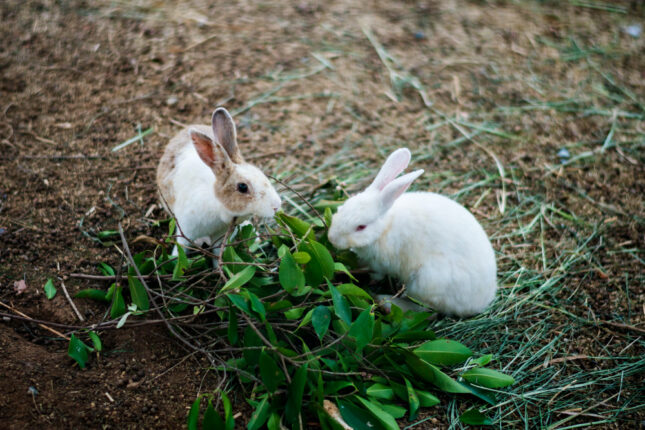
Feeding rabbits in Ghana does not have to depend entirely on expensive imported hay or commercial feeds.
Many locally available grasses, leaves and forage plants can form useful parts of a rabbit feeding programme when they are correctly identified, clean, introduced gradually and combined with a nutritionally balanced diet.
However, there is an important warning.
Just because a rabbit is willing to eat a plant does not mean the plant is automatically safe.
Some common farm and garden plants can be harmful, while others are suitable only as part of a balanced feeding system rather than as the rabbit’s only food.
For most rabbits, appropriate fibrous forage should form a major part of the diet. Depending on whether the rabbits are pets, growing meat rabbits, breeding stock or nursing does, additional balanced pellets or formulated feed may also be necessary.
This guide looks at some useful rabbit foods available in Ghana and other tropical African countries, including grasses, leaves and commercial feed options.
1. Good-Quality Hay and Safe Grasses
The most important food group for rabbits is fibrous grass and forage.
For pet rabbits, suitable hay and/or fresh grass should form the foundation of the diet.
Long-stemmed grass encourages:
- Normal chewing
- Natural dental wear
- Digestive movement
- Foraging behaviour
Imported timothy hay is commonly discussed online, but it is not the only possible source of fibre.
Rabbit keepers in Ghana can also use appropriate locally available grasses when they are correctly identified, harvested safely and handled properly.
Whatever grass or hay you use should be:
- Free from mould
- Free from pesticides
- Free from herbicides
- Free from dangerous weeds
- Free from excessive road pollution
- Stored somewhere dry and well ventilated
Never feed grass simply because it grows nearby.
Correct identification is essential.
2. Guinea Grass
Guinea grass, scientifically known as Megathyrsus maximus, is widely available in tropical regions and can be useful as rabbit forage.
It provides substantial fibre and has been used successfully in rabbit feeding studies.
Young, leafy growth is generally preferable to very old, coarse material.
Guinea grass should still be used as part of a balanced feeding programme rather than assuming grass alone supplies every nutrient a growing or breeding rabbit needs.
For rabbit farmers, it can provide an affordable local source of forage, particularly where imported hay is expensive.
Introduce it gradually if the rabbits are not already accustomed to fresh grass.
3. Elephant Grass
Elephant grass, also known as Napier grass or Cenchrus purpureus/Pennisetum purpureum, is another forage commonly available in Africa.
It can be fed fresh to rabbits and can also be dried and incorporated into formulated diets.
Elephant grass provides useful fibre.
Young leafy material is generally more suitable than very mature stems because older plants become tougher and their nutritional composition changes.
One important limitation is that elephant grass should not automatically be treated as a complete rabbit diet.
Growing rabbits, breeding rabbits and nursing does need adequate energy, protein, minerals and vitamins in addition to fibre.
For small farms, elephant grass may therefore work well alongside a properly balanced concentrate or pellet ration.
4. Tridax Leaves
Tridax, scientifically known as Tridax procumbens, is a common tropical plant that can be used as rabbit forage.
It is sometimes known as coat buttons or Tridax daisy.
Rabbit-feeding research has found the leaves to be useful fodder, and studies have compared them favourably with some other tropical forages.
This makes Tridax one of the more interesting locally available plants for rabbit farmers.
Before feeding:
- Make sure the plant has been identified correctly
- Avoid roadside plants exposed to heavy pollution
- Avoid areas sprayed with herbicides or pesticides
- Remove visibly contaminated material
- Introduce it gradually
Do not promote Tridax as a medicine simply because it contains plant compounds with biological activity.
Its most defensible use here is as forage, not as a home treatment for disease.
5. Moringa Leaves
Moringa (Moringa oleifera) is another useful plant for rabbit production in tropical regions.
The leaves contain relatively high levels of protein compared with many grasses and have been used in smallholder rabbit feeding in African countries, including Ghana.
Rabbit studies have also examined moringa leaf meal as part of formulated diets.
Fresh leaves and tender stems may be eaten by rabbits.
However, moringa should still be considered part of a balanced diet rather than a magical complete feed.
It is especially useful because it can provide additional nutrients alongside more fibrous grasses.
Do not assume the seeds are equally suitable.
Rabbit-feeding evidence is much stronger for the leaves than for the seeds.
6. Banana and Plantain Leaves
Banana and plantain leaves can be used as rabbit forage when correctly prepared and incorporated into a balanced feeding system.
Research has evaluated banana leaves in rabbit diets without negative effects at moderate inclusion levels.
For Ghanaian rabbit keepers, this can be useful because banana and plantain plants are widely available in many areas.
Use:
- Clean leaves
- Leaves free from pesticide residues
- Material that has not begun rotting or moulding
Banana or plantain leaves should not be the rabbit’s only food.
They work better as one component of a varied feeding programme.
Plantain Leaf vs Plantain Herb
There is an important naming issue.
In this article, plantain leaf means leaves from the banana/plantain plant in the Musa group.
Some foreign rabbit-care websites use the name “plantain” for an entirely different herb in the Plantago genus.
They are not the same plant.
Correct identification matters.
7. Sweet Potato Vines and Leaves
Sweet potato vines and leaves can be used as rabbit forage.
This is very different from ordinary potato plants.
Research has found sweet potato vines to be palatable to rabbits and useful when combined with other feeds.
They can contribute:
- Fibre
- Protein
- Moisture
- Variety
Make sure you are dealing with sweet potato, Ipomoea batatas.
Never Confuse Sweet Potato Leaves With Potato Leaves
The leaves and green portions of the ordinary Irish potato plant, Solanum tuberosum, should not be fed to rabbits.
Potato green parts can contain toxic glycoalkaloids.
Washing them—even with salt water—does not make them an appropriate rabbit food.
This distinction is extremely important.
Sweet potato vines may be used appropriately.
Ordinary potato leaves should not be fed.
8. Sunflower Leaves
Fresh sunflower leaves can also be eaten by rabbits.
They can provide fibre and encourage chewing.
However, this is another food where moderation matters.
Research has found fresh sunflower leaves palatable, but very high inclusion of dried sunflower leaves in experimental diets has produced poor growth and other negative effects.
For that reason, use sunflower leaves as part of a varied forage programme rather than allowing them to dominate the diet.
Make sure the leaves are:
- Free from pesticides
- Free from mould
- Properly identified
- Introduced gradually
What About Bitter Leaf?
Bitter leaf, Vernonia amygdalina, has been studied as an ingredient in rabbit diets.
Research suggests that the leaf can be incorporated at controlled levels in formulated rabbit feeding programmes.
There is also research examining its biological effects, including gastrointestinal parasite measures.
However, this does not mean rabbit owners should use bitter leaf as a home medicine whenever a rabbit has diarrhoea.
Diarrhoea in rabbits can be associated with serious disease and may require urgent veterinary treatment.
Studies have also shown that higher levels of bitter-leaf meal may not be desirable in every rabbit, particularly breeding and lactating does.
So the safer conclusion is:
Bitter leaf can be a potential feed ingredient when used appropriately, but it should not be advertised as a cure for diarrhoea or other diseases.
What About Emilia Sonchifolia?
Emilia sonchifolia, sometimes referred to locally by names such as Emilia or rabbit-ear plant, appears in some tropical forage systems.
However, compared with plants such as Tridax, elephant grass, Guinea grass, moringa and banana leaves, strong rabbit-specific feeding guidance is more limited.
For a public rabbit-care website, it is better not to describe it as one of the “best rabbit foods” until there is stronger evidence concerning appropriate amounts and long-term use.
When good alternatives are available, there is no need to make uncertain plants central to the feeding programme.
Are Commercial Rabbit Pellets Good?
A quality commercial pellet or nugget can be useful, particularly for:
- Growing rabbits
- Breeding rabbits
- Nursing does
- Farms requiring consistent nutrition
However, pellets should not automatically replace fibrous forage.
For healthy adult pet rabbits, hay and/or suitable grass should still form the majority of the diet.
Choose a plain, uniform pellet or nugget formulated specifically for rabbits.
What About Russel Rabbit Tasty Mix?
Russel Rabbit Tasty Mix is marketed as a nutritionally balanced adult rabbit food when fed according to instructions alongside hay and greens.
However, it is a mixed or muesli-style product containing visibly different ingredients such as peas, maize, wheat and oats.
Mixed diets can encourage selective feeding, where a rabbit chooses favourite pieces and leaves the rest.
Even the manufacturer advises monitoring for this problem and recommends changing to a uniform nugget food if selective feeding occurs.
For that reason, SimpleTipsGH would generally favour a plain, uniform high-fibre rabbit pellet or nugget rather than placing a muesli-style product at the top of a “best foods” list.
The Best Rabbit Diet Is Not Just One Plant
A common mistake in rabbit farming is finding one inexpensive leaf and feeding it as though it supplies everything rabbits need.
Rabbit diets require an appropriate balance of:
- Fibre
- Energy
- Protein
- Vitamins
- Minerals
- Water
The nutritional requirements of a mature pet rabbit are also different from those of:
- A growing rabbit
- A pregnant doe
- A nursing doe
- A breeding buck
- An underweight rabbit
For commercial rabbit farming, a nutritionally formulated concentrate or pellet may therefore be combined with suitable forage.
Always Introduce New Forage Gradually
Do not suddenly change a rabbit from one diet to large quantities of unfamiliar fresh leaves.
Introduce new forage in small amounts.
Then monitor:
- Appetite
- Droppings
- Activity
- General behaviour
Increase gradually if the rabbits remain healthy.
Sudden dietary changes can disturb normal digestion.
How to Harvest Rabbit Forage Safely
When collecting grasses and leaves, avoid plants from:
- Busy roadsides
- Industrial areas
- Places sprayed with pesticides
- Places sprayed with herbicides
- Areas contaminated by sewage
- Areas heavily contaminated with animal waste
Correct identification is essential.
If you do not know what a plant is, do not feed it.
Should You Wash Rabbit Forage?
Dirty forage can be rinsed with clean water where appropriate.
You do not need to wash leaves in salt water to make toxic plants safe.
Salt water does not remove the natural toxins from plants such as potato foliage.
If a plant itself is unsafe, washing will not turn it into safe rabbit food.
Allow excessively wet forage to drain before feeding.
Don’t Use Forage as Medicine Without Diagnosis
One of the biggest improvements rabbit farmers can make is separating feeding from treatment.
A plant may contain compounds studied for medicinal effects without being an appropriate home treatment for a sick rabbit.
Do not try to treat serious symptoms such as:
- Watery diarrhoea
- Complete appetite loss
- No droppings
- Severe bloating
- Difficulty breathing
- Collapse
- Severe weakness
with leaves alone.
Contact a veterinarian.
Rabbit Feeding in Ghana
One advantage Ghanaian rabbit farmers have is access to a wide variety of tropical forage plants.
This can reduce feed costs when forage is safely identified and incorporated into a properly balanced diet.
Useful options can include:
- Guinea grass
- Elephant grass
- Tridax
- Moringa leaves
- Banana or plantain leaves
- Sweet potato vines
- Small amounts of sunflower leaves
- Appropriately formulated commercial feed
The goal should not be to find the cheapest single leaf.
It should be to create a feeding programme that supplies adequate fibre and nutrients throughout the year.
Dry-Season Feeding
Forage availability can change significantly during the dry season.
Plan ahead by:
- Producing hay during periods of good grass growth
- Storing feed properly
- Growing useful forage plants
- Maintaining reliable pellet or concentrate supplies
- Protecting stored feed from rodents and moisture
Moringa can also be particularly useful as a dry-season protein-rich forage source.
Rainy-Season Feeding
During the rainy season, fresh forage may be abundant, but moisture creates other problems.
Watch for:
- Mould
- Rotting vegetation
- Contaminated feed
- Damp storage
- Increased parasites
- Plants harvested from flooded areas
Do not feed rotten or mouldy leaves simply because forage is plentiful.
Keep Drinking Water Available
Fresh clean water should always be available regardless of how much fresh forage the rabbits eat.
High-moisture leaves can affect how much a rabbit drinks directly, but they do not replace access to water.
Check water more frequently during hot weather.
Frequently Asked Questions
What Is the Best Food for Rabbits?
For most healthy adult pet rabbits, suitable hay and/or grass should form the majority of the diet, supported by appropriate greens, a measured amount of rabbit pellets and fresh water.
Farm rabbits may require a formulated ration appropriate to their stage of production.
Can Rabbits Eat Elephant Grass?
Yes.
Elephant grass can be used as rabbit forage, particularly young leafy material, but it should be part of a balanced feeding programme rather than the only food.
Can Rabbits Eat Tridax?
Tridax procumbens has been used successfully as rabbit forage and is supported by rabbit-feeding research.
Correct plant identification and clean harvesting remain important.
Can Rabbits Eat Moringa Leaves?
Yes.
Moringa leaves have been used successfully in rabbit feeding and can provide useful nutrients, particularly protein.
They should still be used as part of a balanced diet.
Can Rabbits Eat Banana or Plantain Leaves?
Yes.
Banana and plantain leaves can be included in rabbit feeding programmes.
They should not be relied upon as the sole diet.
Can Rabbits Eat Sweet Potato Leaves?
Sweet potato vines and leaves can be used as rabbit forage.
Make sure the plant is correctly identified as sweet potato.
Can Rabbits Eat Potato Leaves?
No.
The green parts of ordinary potato plants should not be fed to rabbits because they can contain toxic glycoalkaloids.
Washing them does not make them safe.
Can Rabbits Eat Sunflower Leaves?
Fresh sunflower leaves can be used in limited amounts as part of varied forage.
They should not dominate the entire diet.
Can Bitter Leaf Cure Rabbit Diarrhoea?
Do not rely on bitter leaf as a treatment for diarrhoea.
Although Vernonia amygdalina has been studied in rabbit nutrition and disease research, diarrhoea can indicate serious illness and needs proper diagnosis.
Final Thoughts
There is no single list of best rabbit foods that works for every rabbit.
The best feeding programme depends on:
- Age
- Body condition
- Health
- Production stage
- Local forage availability
- Overall nutritional balance
For rabbit owners and farmers in Ghana, locally available plants such as Guinea grass, elephant grass, Tridax, moringa, banana or plantain leaves and sweet potato vines can be valuable feeding resources when they are correctly identified and used appropriately.
Sunflower leaves and bitter leaf may also have a place in a varied feeding programme, but they should not dominate the diet or be promoted as medicines.
One food from the old version of this article should be avoided completely:
Ordinary potato leaves and other green parts of the potato plant should not be fed to rabbits.
Most importantly, do not build a rabbit diet around one leaf simply because it is free and easy to find.
Provide suitable fibrous forage, balanced nutrition, continuous access to clean water and different feeding plans where necessary for growing, breeding and nursing rabbits.
Sources and Further Reading
For further information about tropical rabbit feeds and rabbit nutrition, readers can consult:
- Feedipedia — Guinea Grass
- Feedipedia — Elephant Grass
- Feedipedia — Tridax Daisy
- Feedipedia — Moringa
- Feedipedia — Banana Leaves and Pseudostems
- Feedipedia — Sweet Potato Forage
- Feedipedia — Sunflower Forage
- Merck Veterinary Manual — Plants and Foods Harmful to Rabbits
- MSD Veterinary Manual — Nutrition of Rabbits
This article provides general educational information and does not replace individual veterinary or animal-nutrition advice.
