

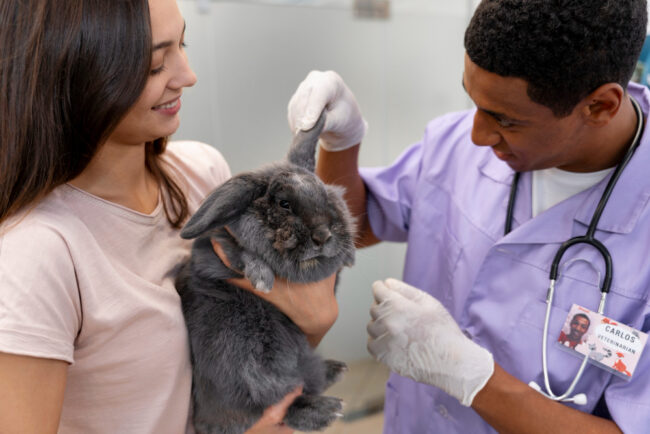
Rabbits can become seriously ill without showing obvious symptoms at first.
As prey animals, rabbits often hide weakness and pain. This means a change that seems small—such as eating less, producing fewer droppings, sitting differently or becoming unusually quiet—can sometimes be the first indication of a health problem.
Learning about common rabbit health problems does not mean trying to diagnose your rabbit at home. Instead, it helps you recognise when something has changed and when veterinary attention may be necessary.
This guide covers 12 important rabbit health problems, their common warning signs and some of the steps owners can take to reduce risk.
Know What Is Normal for Your Rabbit
Before discussing individual diseases, one of the most useful things you can do is learn your rabbit’s normal routine.
Pay attention to:
- Appetite
- Water intake
- Droppings
- Activity
- Body weight
- Grooming
- Breathing
- Movement
- Behaviour
A sudden change from normal can sometimes be more useful than any single symptom.
MSD Veterinary Manual lists loss of appetite or weight, abnormal nasal or eye discharge, diarrhoea, lack of droppings, abnormal movement and difficulty breathing among important warning signs that require veterinary attention.
Rabbit Emergency Warning Signs
Some symptoms should not wait for a routine appointment.
Contact a rabbit-experienced veterinarian urgently if your rabbit:
- Suddenly stops eating
- Produces very few or no droppings
- Has difficulty breathing
- Breathes with its mouth open
- Collapses
- Develops severe weakness
- Has true watery diarrhoea
- Has a severely swollen or painful abdomen
- Has visible maggots
- Develops severe bleeding
- Cannot stand or move normally
- Deteriorates rapidly
These signs can occur with several different illnesses.
Do not delay treatment while attempting to identify the exact disease yourself.
1. Gastrointestinal Stasis
Gastrointestinal stasis, commonly shortened to GI stasis, occurs when normal movement through the rabbit’s digestive tract slows significantly.
It is one of the most important conditions rabbit owners should recognise.
However, GI stasis is often a result of another problem rather than a disease occurring completely on its own.
Possible contributing factors include:
- Dental pain
- Another painful condition
- Reduced food intake
- Dehydration
- Stress
- Illness
- Inappropriate diet
- Gastrointestinal obstruction
Early Signs of GI Stasis
Watch for:
- Eating less than normal
- Refusing favourite food
- Reduced hay intake
- Smaller droppings
- Fewer droppings
- No droppings
- Reduced activity
- Hunched posture
- Signs of abdominal discomfort
A rabbit may also grind its teeth when experiencing pain.
Why It Requires Veterinary Attention
The important challenge is that a rabbit with reduced gut movement can look similar to a rabbit with an intestinal obstruction.
Those situations may require different treatment.
Do not automatically force-feed a rabbit with a swollen abdomen or suspected obstruction without veterinary advice.
Veterinary assessment may involve examination, X-rays and blood tests to distinguish possible causes.
Good-quality hay, clean water, an appropriate diet, exercise and early treatment of painful conditions can help reduce some risk factors.
2. Dental Disease
Rabbit teeth grow continuously.
Normal chewing, particularly of fibrous food such as hay and grass, helps maintain appropriate tooth wear.
Dental problems can affect the front teeth, back teeth or tooth roots.
Possible Signs of Dental Disease
Look for:
- Reduced appetite
- Avoiding hay
- Difficulty chewing
- Dropping food
- Drooling
- Wet fur under the chin
- Weight loss
- Facial swelling
- Eye discharge
- Changes in food preference
A rabbit may appear hungry and approach food but then struggle to eat it.
This behaviour can be particularly important.
Can You Check Rabbit Teeth at Home?
You can gently look at the front incisors, but owners cannot properly inspect all of the back teeth.
A full oral examination may require veterinary equipment and sometimes sedation.
Do not attempt to clip overgrown teeth yourself.
If your rabbit suddenly stops eating or develops significant dental symptoms, seek veterinary care.
3. Respiratory Disease and “Snuffles”
Sneezing and nasal discharge are commonly associated with rabbit respiratory disease.
The term snuffles is often used for upper respiratory infection.
Pasteurella multocida is an important bacterial cause, but not every rabbit with respiratory symptoms has Pasteurella.
Other infectious organisms and non-infectious problems can produce similar signs.
Respiratory Warning Signs
Watch for:
- Repeated sneezing
- Nasal discharge
- Eye discharge
- Wet or matted front paws
- Noisy breathing
- Reduced appetite
- Reduced activity
- Rapid or laboured breathing
Rabbits frequently wipe their noses with their front paws, so matted fur on the inner forelegs can provide a clue that discharge is present.
Difficulty breathing requires urgent veterinary attention.
For a detailed explanation of respiratory Pasteurella, diagnosis, transmission and veterinary treatment, see our Pasteurella in Rabbits guide.
4. Ear Mites and Ear Disease
Rabbit ears should be checked regularly.
Ear mites can cause considerable irritation and crusting, while bacterial infections of the middle or inner ear can affect balance and movement.
Signs of Ear Problems
Possible symptoms include:
- Scratching the ears
- Head shaking
- Thick crusting
- Ear sensitivity
- Discharge
- Head tilt
- Loss of balance
Do Not Pull Off Ear-Mite Crusts
One important mistake to avoid is manually pulling thick crusts from an ear affected by mites.
MSD Veterinary Manual warns that removing these crusts from an awake rabbit can be extremely painful.
Seek veterinary treatment instead.
Head tilt should also not automatically be blamed on ear mites because middle-ear infection, E. cuniculi and other neurological conditions can produce similar signs.
5. Uterine Disease and Uterine Cancer
Uterine disease is an important concern in intact female rabbits.
Uterine adenocarcinoma is one of the most common tumours affecting female rabbits that have not been spayed.
The risk increases with age.
Current MSD veterinary guidance states that incidence can reach approximately 60% in intact female rabbits older than three years, although risk varies with age and breed.
Possible Signs
Depending on the disease and stage, signs may include:
- Bloody discharge from the vulva
- Reduced appetite
- Weight loss
- Reduced activity
- Enlarged abdomen
- Reproductive problems
Blood around the rear should be professionally investigated rather than automatically assumed to be blood in the urine.
Prevention
Spaying a healthy female rabbit before uterine disease develops prevents uterine cancer because the uterus is removed.
The appropriate age and individual surgical risk should be discussed with a rabbit-experienced veterinarian.
6. External Parasites
Rabbits can be affected by parasites such as:
- Fur mites
- Ear mites
- Fleas
They can cause discomfort and changes to the skin and coat.
Possible Signs
Watch for:
- Excessive scratching
- Dandruff-like flakes
- Bald patches
- Crusts
- Skin irritation
- Visible fleas or flea dirt
- Ear crusting
Do not diagnose a parasite from appearance alone because fungal infections and other skin diseases may look similar.
Never Use Random Dog or Cat Flea Treatments
Some flea products intended for dogs or cats can be dangerous to rabbits.
In particular, fipronil is contraindicated in rabbits because severe toxic reactions have been reported.
Use only treatment recommended as appropriate for rabbits by a veterinarian.
Our Skin Diseases in Rabbits guide covers fur mites, ear mites, fleas, ringworm and other skin conditions in greater detail.
7. Flystrike
Flystrike, also called myiasis, occurs when flies lay eggs on or around a rabbit and those eggs hatch into maggots.
It can progress extremely quickly and is a genuine veterinary emergency.
Rabbits at Higher Risk
Risk increases when a rabbit has:
- A dirty rear
- Urine-soaked fur
- Soft faeces stuck to the coat
- Open wounds
- Obesity
- Arthritis
- Reduced mobility
- Difficulty grooming
Warm weather increases the importance of checking rabbits regularly.
Warning Signs
Possible signs include:
- Maggots
- Fly eggs
- Wounds
- Unusual smell
- Wet or dirty fur
- Severe restlessness
- Weakness or collapse
If you discover maggots, contact a veterinarian immediately.
Do not delay treatment to bathe the rabbit.
RWAF describes flystrike as a true emergency that can cause extensive tissue damage very quickly.
For rabbits kept in Ghana and other warm environments, rear-end checks and good sanitation are particularly important.
8. Head Tilt and Vestibular Disease
A rabbit whose head suddenly tilts to one side is showing a symptom rather than one specific disease.
Head tilt may be accompanied by:
- Loss of balance
- Falling
- Rolling
- Circling
- Abnormal eye movements
- Difficulty walking
Possible causes include middle or inner ear disease and neurological conditions such as Encephalitozoon cuniculi.
E. cuniculi can infect rabbits without always producing clinical disease, making diagnosis more complicated than simply seeing head tilt.
A rabbit with sudden balance problems needs veterinary examination.
Don’t Assume a Rabbit With Head Tilt Cannot Recover
A severe tilt can look frightening, but the appearance alone does not determine the rabbit’s future quality of life.
Veterinary investigation and supportive care are important.
Keep an affected rabbit somewhere secure where rolling or falling cannot cause additional injury while veterinary attention is arranged.
9. Obesity
Being overweight is more than a cosmetic problem for rabbits.
Excess body weight can interfere with:
- Movement
- Grooming
- Reaching the rear
- Eating caecotrophs normally
This can contribute to dirty fur and increase the risk of secondary problems such as skin irritation, sore hocks and flystrike.
Common Contributing Factors
These may include:
- Excessive pellets
- Too many calorie-rich treats
- Insufficient exercise
- Small living spaces
- Reduced mobility
- Pain or other illness
Do not simply starve an overweight rabbit.
Weight loss should be gradual, and significant obesity is best managed with veterinary guidance.
Our Overweight and Underweight Rabbits guide explains body-condition scoring and safer weight management in detail.
10. Sore Hocks
Sore hocks are medically known as pododermatitis.
Despite the common name, the damaged area generally develops on the weight-bearing surface of the rabbit’s feet.
Early disease may begin with thinning fur and redness.
More advanced cases can become painful and infected.
Warning Signs
Check for:
- Redness underneath the feet
- Hair loss
- Thickened skin
- Open sores
- Bleeding
- Swelling
- Limping
- Reduced movement
Risk factors can include:
- Hard flooring
- Unsuitable wire flooring
- Damp or dirty surfaces
- Excess body weight
- Reduced movement
Severe cases can extend into deeper tissues and bone.
Provide clean, dry, comfortable flooring and inspect your rabbit’s feet regularly.
11. Abscesses and Skin Infections
Rabbits can develop infections underneath or within the skin.
Abscesses are particularly important because rabbit pus is often extremely thick.
Unlike some abscesses in dogs or people, simply opening a rabbit abscess and allowing it to drain may not solve the problem.
Signs to Watch For
Possible symptoms include:
- Unexplained lumps
- Swelling
- Redness
- Pain
- Wounds
- Discharge
- Bad smell
Facial and jaw abscesses can sometimes be connected to dental disease.
Other lumps may be cysts, tumours or different types of swelling, so owners should not automatically assume that every lump is an abscess.
Veterinary treatment may involve diagnostic testing, surgery and appropriate antimicrobial treatment depending on the cause.
MSD notes that rabbit abscess contents can be too thick for ordinary drainage and may require surgical removal.
See our Skin Diseases in Rabbits guide for more information about abscesses, mites, fungal disease, urine scald and other skin problems.
12. Diarrhoea and Other Digestive Problems
This final condition needs an important distinction.
Rabbits produce two different types of normal droppings.
The familiar hard faecal pellets should generally be firm and relatively dry.
Rabbits also produce nutrient-rich caecotrophs, which are soft and normally eaten directly from the anus.
Seeing soft caecotrophs does not automatically mean the rabbit has diarrhoea.
True Diarrhoea
True watery diarrhoea is abnormal and can be serious, particularly in young rabbits.
Potential digestive problems can be associated with:
- Infection
- Parasites
- Inappropriate diet
- Sudden dietary change
- Antibiotic-associated intestinal disturbance
- Other gastrointestinal disease
Young rabbits can develop severe diarrhoeal diseases such as enterotoxaemia.
When to Seek Help
Contact a veterinarian if your rabbit develops:
- Watery diarrhoea
- Severe lethargy
- Loss of appetite
- Dehydration
- Significant abdominal discomfort
- Persistent abnormal stools
Do not attempt to treat serious diarrhoea simply by withholding food.
What About Uneaten Caecotrophs?
If you frequently see sticky clusters of caecotrophs around the rabbit’s living area or attached to the rear, there may be a different problem.
Possible contributing factors include:
- Inappropriate diet
- Obesity
- Dental disease
- Arthritis
- Difficulty reaching the rear
RWAF distinguishes persistent uneaten caecotrophs from severe diarrhoea and recommends investigating persistent problems.
How to Reduce the Risk of Rabbit Health Problems
Not every illness is preventable.
However, good husbandry can reduce several important health risks and make problems easier to notice.
Provide an Appropriate High-Fibre Diet
For healthy adult pet rabbits, good-quality hay and/or grass should form the foundation of the diet.
Appropriate fibre supports normal digestive movement and chewing behaviour.
Fresh water should always be available.
Avoid sudden dietary changes.
Provide Enough Space and Exercise
Rabbits need space for normal movement.
Physical activity can help maintain:
- Appropriate body condition
- Mobility
- Muscle strength
- Natural behaviour
An empty small cage should not be considered adequate permanent housing.
Maintain Clean, Dry Housing
Remove:
- Wet bedding
- Spoiled food
- Accumulated waste
- Heavily soiled litter
Keep drinking containers clean.
Good sanitation is particularly important for controlling flies, parasites and some infectious diseases.
Check Your Rabbit Every Day
Daily observation does not need to be complicated.
Ask yourself:
- Is the rabbit eating?
- Is it producing normal droppings?
- Is it moving normally?
- Is its breathing normal?
- Are its eyes and nose clean?
- Is its rear clean?
- Is its behaviour normal?
These simple checks can reveal problems surprisingly early.
Monitor Weight
Weigh your rabbit periodically and pay attention to its body condition.
Unexpected weight gain or weight loss may indicate a feeding problem or underlying illness.
Look at the Feet and Skin
Regular grooming gives you an opportunity to check:
- Feet
- Coat
- Skin
- Ears
- Rear end
Long fur can hide wounds and skin disease.
Find a Rabbit-Experienced Veterinarian
Do this before an emergency occurs.
Ask whether the clinic regularly treats rabbits.
Keep the contact details easily available.
Rabbit medicine differs from dog and cat medicine in important ways, particularly when it comes to medications.
For example, MSD warns that several orally administered antibiotics commonly used in other animals can disrupt the rabbit’s intestinal microorganisms and cause severe disease.
Never self-medicate a rabbit with leftover human, dog or cat medicines.
Health Problems in Rabbits Kept in Ghana
Rabbit owners and farmers in Ghana need to consider the same basic diseases discussed above, but local conditions can affect risk.
Particular attention should be paid to:
- Heat stress
- Ventilation
- Reliable water supply
- Flies
- Wet housing during the rainy season
- Parasites
- Feed hygiene
- Overcrowding
- Predator protection
Warm weather can make fly control especially important.
Rabbit housing should remain shaded, dry and properly ventilated.
For larger rabbitries, keeping basic records can also help identify patterns.
Record:
- Illness
- Deaths
- Treatments
- Breeding performance
- Weight changes
- Appetite problems
- Unusual outbreaks
If several rabbits develop the same symptoms, such as diarrhoea, sneezing or skin disease, obtain veterinary help rather than repeatedly treating the group without a diagnosis.
When Should You Take a Rabbit to the Vet?
Not every small change is an emergency, but rabbits should not be left deteriorating for days.
Arrange veterinary assessment when there is a persistent or unexplained change in:
- Appetite
- Weight
- Droppings
- Behaviour
- Movement
- Breathing
- Eyes
- Nose
- Skin
- Urination
Get urgent help for severe symptoms such as:
- Complete loss of appetite
- No droppings
- Difficulty breathing
- Collapse
- Severe diarrhoea
- Maggots
- Major injury
- Severe abdominal swelling
- Inability to stand
Because rabbits often hide illness, early treatment can be especially important.
Frequently Asked Questions
What Is the Most Common Sign That a Rabbit Is Sick?
There is no single symptom that identifies every illness.
However, changes in appetite, droppings, activity and behaviour are particularly important.
Knowing what is normal for your individual rabbit makes unusual changes easier to notice.
Is a Rabbit Not Eating an Emergency?
A rabbit that suddenly refuses food requires prompt attention.
Loss of appetite may be associated with dental pain, gastrointestinal disease, respiratory illness or many other problems.
Significantly reduced food intake combined with few or no droppings is especially concerning.
Can Rabbits Hide Pain?
Yes.
Rabbits may show relatively subtle behavioural changes when experiencing pain or illness.
Possible signs include hiding, reduced appetite, a hunched posture, reduced movement and tooth grinding.
Is Every Rabbit With a Runny Nose Infected With Pasteurella?
No.
Pasteurella multocida is an important cause of respiratory disease, but other organisms and conditions can produce similar symptoms.
Veterinary diagnosis may be required.
Is Head Tilt Always E. Cuniculi?
No.
E. cuniculi is one possible cause, but middle or inner ear disease and other neurological conditions can also result in head tilt.
Is Soft Rabbit Poop Always Diarrhoea?
No.
Rabbits naturally produce soft caecotrophs that they normally eat directly.
True watery diarrhoea is different and requires veterinary attention.
Can I Give My Rabbit Dog or Cat Medicine?
Not unless a veterinarian specifically prescribes that medication for your rabbit.
Some drugs that are safe in dogs or cats can be dangerous to rabbits.
Can All Rabbit Health Problems Be Prevented?
No.
Good diet, housing, sanitation, exercise and veterinary care can reduce risks, but even well-cared-for rabbits can become ill.
The goal is prevention where possible and early recognition when illness occurs.
Final Thoughts
Understanding common rabbit health problems can help you notice trouble before a rabbit becomes severely ill.
Important conditions include gastrointestinal stasis, dental disease, respiratory infections, ear disease, uterine disease, parasites, flystrike, head tilt, obesity, sore hocks, abscesses and digestive disorders.
However, symptoms often overlap.
Sneezing does not automatically mean Pasteurella. Head tilt does not automatically mean E. cuniculi. Hair loss does not automatically mean mites. A rabbit refusing food may have digestive disease, dental pain or another serious underlying problem.
That is why this guide should be used for early recognition rather than home diagnosis.
Learn your rabbit’s normal appetite, droppings, activity, weight and behaviour.
If something changes significantly, investigate early.
And when a rabbit stops eating, has difficulty breathing, develops severe diarrhoea, has no droppings, collapses or develops flystrike, contact a rabbit-experienced veterinarian promptly.
Early attention can make a major difference to a rabbit’s comfort, treatment options and chances of recovery.
Sources and Further Reading
For further information about rabbit diseases and warning signs, readers can consult:
- MSD Veterinary Manual — Illness of Rabbits
- MSD Veterinary Manual — Diseases of Rabbits
- VCA Animal Hospitals — Diseases in Rabbits
- Rabbit Welfare Association & Fund — Recognising Rabbit Emergencies
- Rabbit Welfare Association & Fund — Flystrike in Rabbits
This article provides general educational information and does not replace veterinary examination, diagnosis or treatment.
